
How do you sell a water management program to clients who don’t think it’s necessary?
“If the grass is green, the system is ‘working,’” says Rob Bardunias, COO of David J. Frank Landscape Contracting, based in Germantown, Wisconsin. “Overwatering doesn’t announce itself — it shows up as disease pressure, shallow roots, and a water bill nobody reads line by line. Our hardest sale is to a client whose landscape currently looks fine.”
Other common reasons clients decline water management include believing they can monitor the system themselves or being skeptical of the savings you can provide.
“Almost every objection comes back to not yet understanding the value,” says Justin White, CEO of K&D Landscaping, Inc., based in Watsonville, California.
Sell The Value Clients Care About
Your customer base and your market will determine what resonates when pitching water management.
“Our value proposition in Wisconsin is not the value proposition in Phoenix,” Bardunias says. “If you’re in a place where water is cheap, and rain is reliable, savings won’t carry the sale — plant health, risk management, and convenience will. Figure out what your clients actually lose when irrigation is mismanaged and sell against that.”
For instance, HOAs, property managers and commercial property owners are far more interested in water management as they have budgets and boards to answer to, while others also have sustainability commitments to report on.
“When you can show them hard savings and keep them compliant with local water regulations, it becomes an easy yes,” White says.
Meanwhile, for residential clients, depending on their location, water savings isn’t as compelling. Bardunias says they focus on selling plant health and peace of mind.
“Your $80,000 landscape doesn’t die, your system doesn’t run during a thunderstorm in front of the neighbors, and nobody has to remember to shut it off,” Bardunias says. “When we’ve tried to sell residential on ROI, we’ve lost. When we sell on protecting the investment, we win.”
Even though technology is critical to your water management program’s success, it should not be the hardware you sell to clients. Bardunias says you should be selling the outcome instead.
“Clients don’t want a controller platform,” Bardunias says. “They want a landscape that thrives and a system they never have to think about.”
Use Water Reports to Demonstrate Results
One way to convert the skeptics is to show, not tell, via water usage reports.
Dillon Wilde, vice president of the irrigation division with Wilde Companies, based in Holden, Massachusetts, says currently every Hydrawise controller they install includes one year of complimentary monitoring. This allows customers to experience the benefits of proactive monitoring and reporting firsthand before deciding whether they want to continue long-term.
“The complimentary year also gives clients access to the water usage reports generated through the Hydrawise platform,” Wilde says. “Once clients become accustomed to receiving those reports, they often recognize the value when the complimentary monitoring period ends. We have had clients opt back into the program specifically because they wanted continued access to that reporting.”
Bardunias says their water usage reports can be accessed by customers through an app. The reports cover usage against the prior year and against site need, rainfall received, any alerts they caught and resolved, and what the company adjusted and why.
“The ‘what we caught’ section does the most work,” Bardunias says. “A client who reads that we shut down a broken lateral on a Sunday morning before it ran for eight hours understands exactly what the management is for. Renewal conversations are much shorter when the report has been doing the arguing all season.”
White agrees that transparency is everything and they lead with the numbers.
“We share water usage and savings reporting so the client can see exactly what they are getting for their money,” White says. “When they can watch the trend line go down, it builds trust, and it makes renewal a no-brainer.”
Build Stronger Client Relationships Through Water Management
Introducing a client to a water management program isn’t just a way to boost your revenue. It also helps strengthen your relationships with clients.
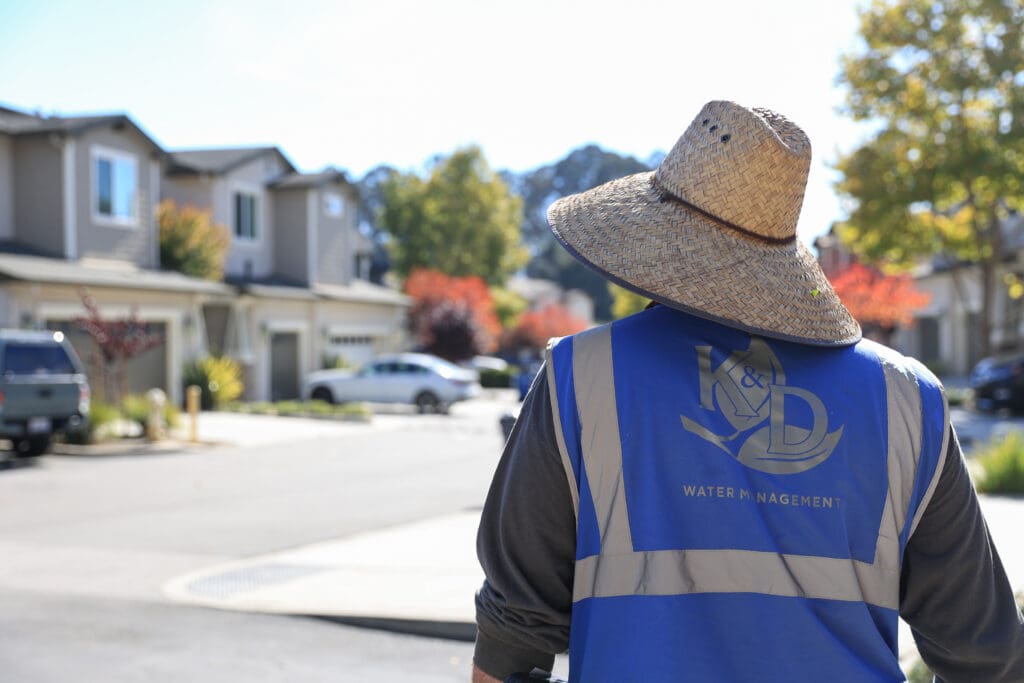
“It has made us a partner instead of a vendor,” White says. “When you are managing something as critical and as visible as water, you are in constant communication, and you are solving real problems for them every month. That builds a level of trust that a mow-and-blow relationship never will. It also makes us stickier. A client who trusts us with their water and their budget is not shopping our contract every year. The relationship gets deeper, and it lasts longer.”
Bardunias says they’ve gone from two scheduled irrigation visits and a handful of emergency calls to seeing clients monthly and explaining the problems they prevented.
“The practical effect is that we’re consulted earlier,” Bardunias says. “When a client is planning a landscape renovation or a building addition, we are running the design phase instead of after the fact, because we’ve become the people who understand their site and their goals. That’s worth more than the service or management fee.”
Wilde agrees that water management has changed how their clients view them, shifting to more of an active manager of the irrigation system rather than simply a contractor they call when something goes wrong. He says clients understand the value of the program even more when his team identifies an issue proactively.
For instance, Wilde Companies recently received an alert that a client’s controller had gone offline. When they contacted him, he discovered that another contractor had unplugged the controller in the garage to use the outlet and never plugged it back in.
“Those types of situations help clients see that the value is not only in water savings, but also in protecting the landscape, extending the life of the irrigation system, and having someone proactively watching for problems,” Wilde says.