

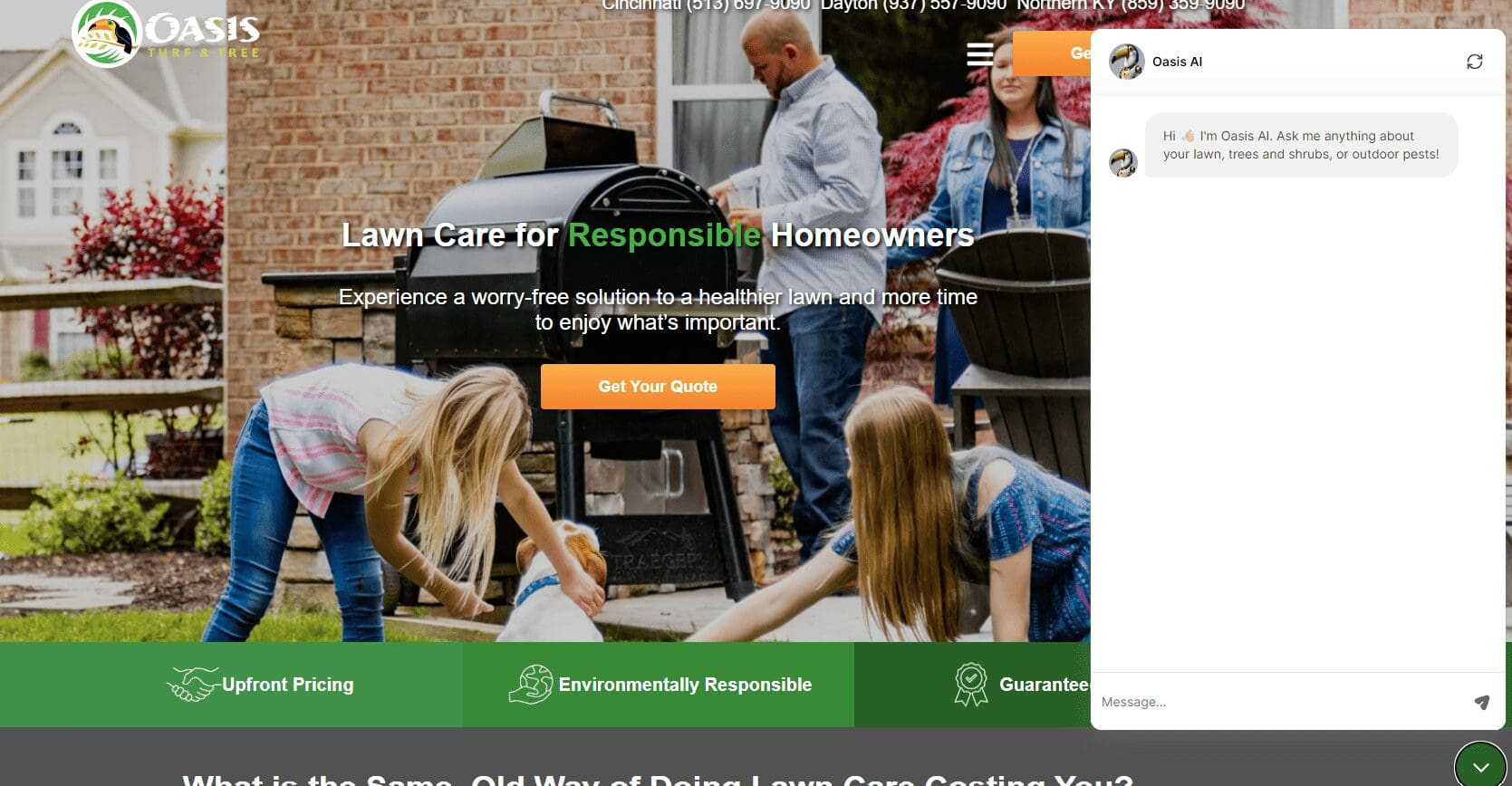
How much time does your team have to spend answering basic customer questions like where can they pay their bill on your website or how high they should mow their grass?
With the help of an AI website agent, Oasis Turf & Tree, based in Loveland, Ohio, has been able to save hours of being on the phone with customers.
Adam Zellner, vice president of sales for Oasis Turf & Tree, says adding the AI website agent was suggested to them by a company they work with that helps them with their marketing efforts. They explained it was very different from the traditional chatbot experience.
“I think the way they used to operate was very frustrating and didn’t give you a whole lot of information,” Zellner says. “The time that you had to put in was just excruciating to hope that they asked the exact right question to get them the answer that you wanted to get them. With the new wave of advancements in AI we thought we would give it a try and just see kind of what that what that looked like for us.”
Benefits of Adding An AI Website Agent
In the past, Oasis was against using traditional chatbots because they typically don’t point customers in the right direction. Zellner says they’ve been using the AI website agent for five months and it’s been incredible so far.
He says the AI website agent can provide customers with information that might not be easy to find if they have a specific question, such as what to do about mites on their trees and shrubs.
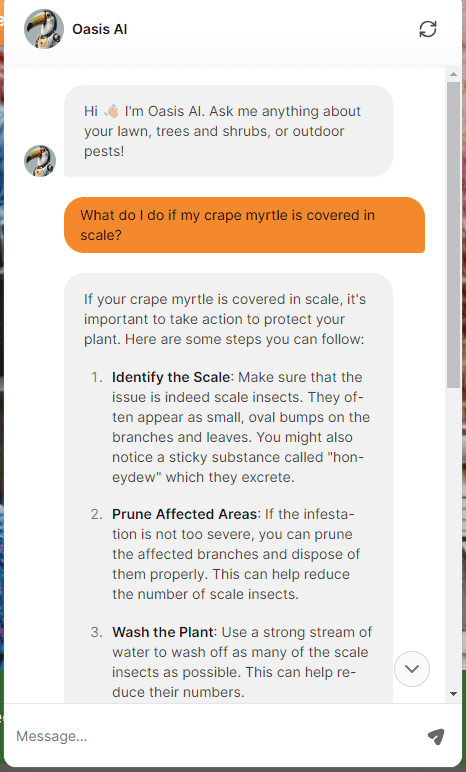
“We’re hoping to educate our customers, not just push them towards a service,” Zellner says. “That’s what the traditional chatbots would do. It’s like if they ask about this, and this service that you offer is a solution, then it will say, ‘Oh, that’s great. Contact us about our tree and shrub care program.’ The way that it’s designed now is it will teach them about mites, give them a few things that they can do or that they should look out for and then the last option is always feel free to reach out to us if this is something you’d like help for.”
Zellner says the AI website agent is able to direct people to resources in a much quicker way. They have their chatbot at the bottom of their website and it will ask if there’s anything it can help a visitor with. He says it’s like having a high-level customer service rep that’s available 24/7 to answer any questions people have.
Zellner says it’s a convenient tool for their customers, who are frequently asking how to pay their bills. They’ve had some people ask at 2 a.m. about paying their bills and the AI website agent is able to respond.
“This is just quick and easy,” Zellner says. “You can jump on. You don’t have to say thank you because it doesn’t have feelings, and then you’re just on to whatever else you need to do.”
The AI website agent has also been helpful with directing those looking for jobs to Oasis’s career page. Zellner says in one instance someone asked the AI website agent what was the meaning of life.
“It said the meaning of life is purpose, and if you’re looking for a purpose, a career at Oasis would be great and then basically pitched Oasis as a career,” Zellner says. “It then even gave the link to apply, which was pretty crazy.”
He notes that the AI website agent doesn’t have an off day or a poor conversation where it gets flustered or fails to mention something.
“I think the benefit of having something like this is you know what you’re getting every single time and it’s always just giving them the exact answer and pointing them in the right direction.”
How It Works
With an AI website agent, it can utilize ChatGPT, various documents to refer to for context and it can crawl Oasis’s website for relevant information and give a nuanced answer to the visitor.
“We also have message guidelines because we want the voice of this to sound like the voice we’re using on the website and the other marketing,” says Chad Diller, president of Landscape Leadership, a sales and marketing agency for lawn and landscape companies.
Oasis can also review the conversations and revise responses for future instances when a similar question is asked. The more conversations that happen, the smarter it will become.
Zellner says in the beginning the AI website agent struggled with knowing exactly what services they offered. Visitors would ask about leveling their yard or treating weeds in their flower beds, which Oasis doesn’t handle because it’s not part of the turf.
“It basically required creating templates of everything we do treat, and everything we don’t treat that was in a three-page document for each, and we loaded it in, so it is a good reference that anytime something like that comes up,” Zellner says.
Zellner says has he revises answers, the AI website agent does not make the same mistake. He started out editing five to 10 responses a week and now it’s just one response a week.
“98% of the answers are spot on and it’s just a couple words that need to change,” Zellner says.
Oasis receives 20-30 conversations a week. Typically questions are about paying bills and cultural practices like mowing and watering.
“People don’t talk to it the way that they would talk to a person,” Zellner says. “Someone will go in and just say ‘water.’ It responds really great. It’s like, ‘Yeah, your lawn definitely needs water. Here are watering recommendations…’ and it’s really positive. I’m just amazed because if we have that type of interaction I think as just human beings, we’d be like, ‘Yeah, what about water?’ It just takes the ball and runs with it, and it keeps it at a very high level and very professional.”
