

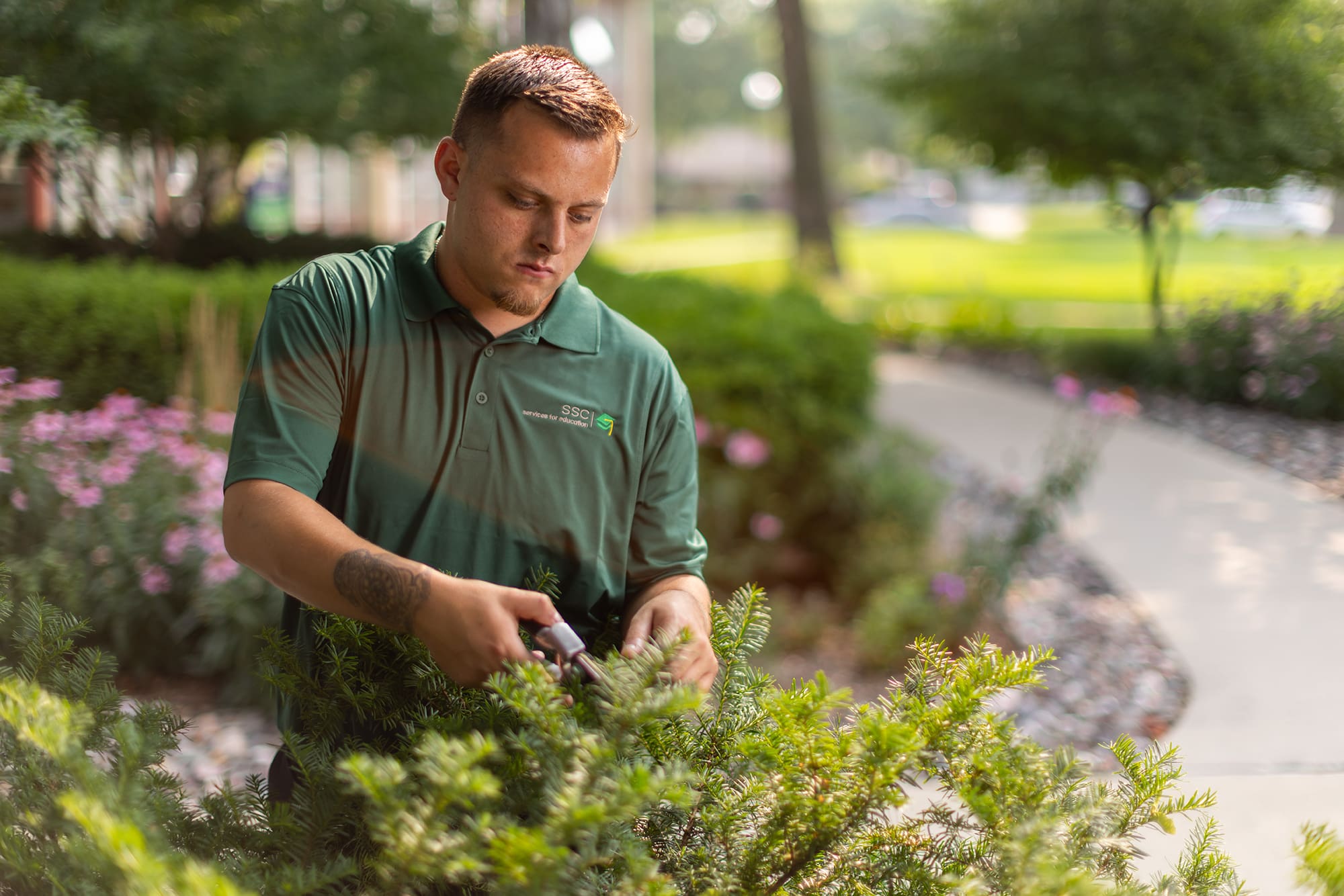
SSC Services for Education, headquartered in Knoxville, Tennessee, provides custodial, facilities maintenance and grounds management services to educational facilities. They have around 170 accounts across the U.S., and one of the hardest roles for them to fill is grounds management positions.
Part of their solution to this challenge is their manager-in-training (MIT) program, which provides participants with optimal hands-on exposure to different aspects of grounds management, such as horticulture, irrigation or sports turf management.
“Our MIT program is designed to accelerate both technical expertise and leadership readiness,” says Nickie Dwyer, director of learning and development at SSC Services for Education. “Participants receive on-the-job training paired with formal leadership development and the financial support to pursue certifications and licenses. This ensures they are prepared to step confidently into management roles as opportunities arise.”
Selecting Candidates
SSC has a thorough screening process for their MITs and typically finds them at career fairs or through job postings. They will go through a multi-interview hiring process where candidates share prior work experience and past examples of leading teams.
“Many of our MITs are entering their first professional role,” Dwyer says. “We prepare them not only for management responsibility but also for the realities of the work – like being out in the elements every day.”
On average annually, SSC puts about 20 to 25 people through the student hire MIT program. Dwyer says their goal is to have five grounds MIT hires a year. She says they’ve been more strategic with the grounds MITs they’ve hired this year. Most are graduates with some grounds certification or a degree focus.
Inside the Program
After they pass the screening, the MITs start the first week working remotely, going through virtual onboarding. The second week, they start traveling to SSC’s different customer sites.
“They’re getting up early on a Monday morning, getting on a plane, traveling across the country, showing up, working a half day on site, working all week long, and then leaving Friday evening to be back home on the weekends,” Dwyer says.
By traveling, the MITs can familiarize themselves with different climates, weather and types of plants.
“Every site has a management team that they’re partnered with, as well as a subject matter expert mentor through their program who is doing constant check-ins,” Dwyer says. “We have an incredible pool of industry experts for them to learn from as they become integrated with SSC. We also do weekly evaluations for all of our MITs.”
She says these meetings serve as a skills inventory so they can identify if any corrective action is needed and to celebrate the MITs’ successes along the way. Dwyer says they also use this time to gauge if the MIT is above target, on target or below target with their skills.
Dwyer says they take a tailored approach with each MIT who comes into the program as they are all coming in with a different background. While all grounds MITs are put through key certification programs, such as the Landscape Technician Certification through NALP and others through PGMS, most other parts of the program are unique to the associate.
“Our approach is individualized,” Dwyer says. “Every MIT comes in with different strengths – some may have a horticulture degree but no sports turf experience, for example. We build on what they know while ensuring they gain a bottom-up understanding of every role they will eventually lead. You can’t be a manager of a team if you don’t understand their roles and responsibilities in their daily tasks because you’re responsible to make sure it’s done properly.”
Dwyer says by teaching from the ground up, they gain a better appreciation for the hourly roles as well as the supervisor and management levels. Often, the most important skill they develop in their MITs is leadership. She says they are always looking for their MIT candidates to have the vision, drive and ability to lead a team.
“Managing people is a difficult business,” Dwyer says. “We’re human, we are spontaneous, we are unpredictable. Managing people requires vision and adaptability. We start small with crews of three to five, and expand responsibilities until they’re prepared to lead large, complex teams.”
Finding the Right Fit
After about nine months, SSC begins looking at placement opportunities for the MIT.
“Their next job title could be an assistant director of grounds, or it could be a director of grounds based on the size of the account, managed volume, and scope of responsibility. MITs do go directly into a management position after completion of the program.”
One of the most important pieces to placing an MIT is the individual’s flexibility for relocation.
“We love it when they say, ‘I’m wide open. Put me anywhere. I’m about growth development. I’ll go where the company needs me,’ Dwyer says. The more open a candidate is to relocation, the more opportunities they’ll have.”
Dwyer says the majority of the MITs are open to relocation and SSC will pay to help move them.
“It’s a very large investment,” Dwyer says. “They do come in as a salaried manager with full management benefits, everything, and we fund all of their travel and training through their program as well.”
While there are some instances where MITs do not step into a position with SSC following their program, whether due to missed expectations or an inability to relocate, the program is very successful at creating a pipeline of talent for SSC’s growing partnerships.
Dwyer says their first grounds MIT to go through the program is now on his third promotion since graduating from the program.
“The feedback from him is he’s always felt supported,” Dwyer says. “He’s always known who to call when he has a question or needs something. He’s never once felt like he’s been on that deserted island. We’ve provided him a career path.”
Dwyer recommends that when building out a manager training program, training managers need to get their teams involved.
“You can design the most sophisticated program, but if your leaders don’t understand it or see the value, it won’t succeed,” she says. “We involve our current teams in program development to make sure it reflects their realities and provides practical support for success.”
