
Snow removal is probably the farthest thing from your mind in the middle of the summer, but it is also the prime time for you to be reviewing your snow fleet.
Starting your snow equipment evaluations in the summer gives you the luxury of time. Rather than scrambling 24 hours before a winter storm is forecast, you can methodically inspect and maintain your fleet.
“If you need time to order and replace equipment, you have time,” says Alex Bonnard, director of purchasing and estimating for C. Caramanico & Sons, Inc., based in Upland, Pennsylvania. “If you are having issues in other areas of the business, you have time. We have all experienced a winter storm that comes way too early. Reviewing needs in the summer helps us be prepared for those anomalies.”
Failing to review your fleet in advance can create an unnecessary last-minute fire drill, as early, unexpected winter storms do happen.
“The last few years we’ve had major, measurable storms happen over Halloween!” says Chris Kujawa, president/CEO of Kujawa Enterprises, Inc., a Sperber company, based in Oak Creek, Wisconsin. “That’s early for Milwaukee. We want to be in a position where all we need to do is quickly swap out trailers/buckets/etc. for plows/pushers/spreaders and expect it to work on a day or two’s notice.”
Kujawa notes that failing to be prepared can also negatively impact client trust when they have to shut down a production shift because your company didn’t get around to making sure everything was ready months prior.
“When it comes to being prepared, remember, ‘Noah didn’t wait for the rain before building the ark!’” Kujawa says.
Balancing Snow Prep with Summer Work
While your snow equipment may be sitting idle, this doesn’t mean your team is, which is why it can be challenging to think about inspecting them in the middle of the growing season.
Kujawa says it comes down to discipline and taking a ‘little-by-little’ approach.
“Have your checklist of pieces and as the moment presents itself, tackle one or two pieces,” Kujawa says. “Keep checking off pieces until you’ve gone through the whole list. Review the list for progress and keep plugging along.”
Take advantage of slowdowns strategically, as this can be a prime opportunity to conduct inspections.
Bonnard says because the summer brings them hot, dry weather, it decreases the chance of repairs needed for their maintenance fleet. This allows their mechanics to focus on conducting preventative maintenance with their plows and sidewalk machines.
Kujawa recommends being flexible, as it can be hard to get trucks and loaders into the shop for a day or more since they’re being deployed during the summer.
“If necessary, consider a temporary split-shift in your shop to help make pieces available,” Kujawa says.
It’s a good rule of thumb to prioritize your larger, more complex snow equipment first in the summer months. Kujawa says they start with their larger salters as they tend to have bigger issues and are likely to be the first pieces deployed for a pre-season storm that surprises everyone.
What Summer Snow Fleet Maintenance Should Entail
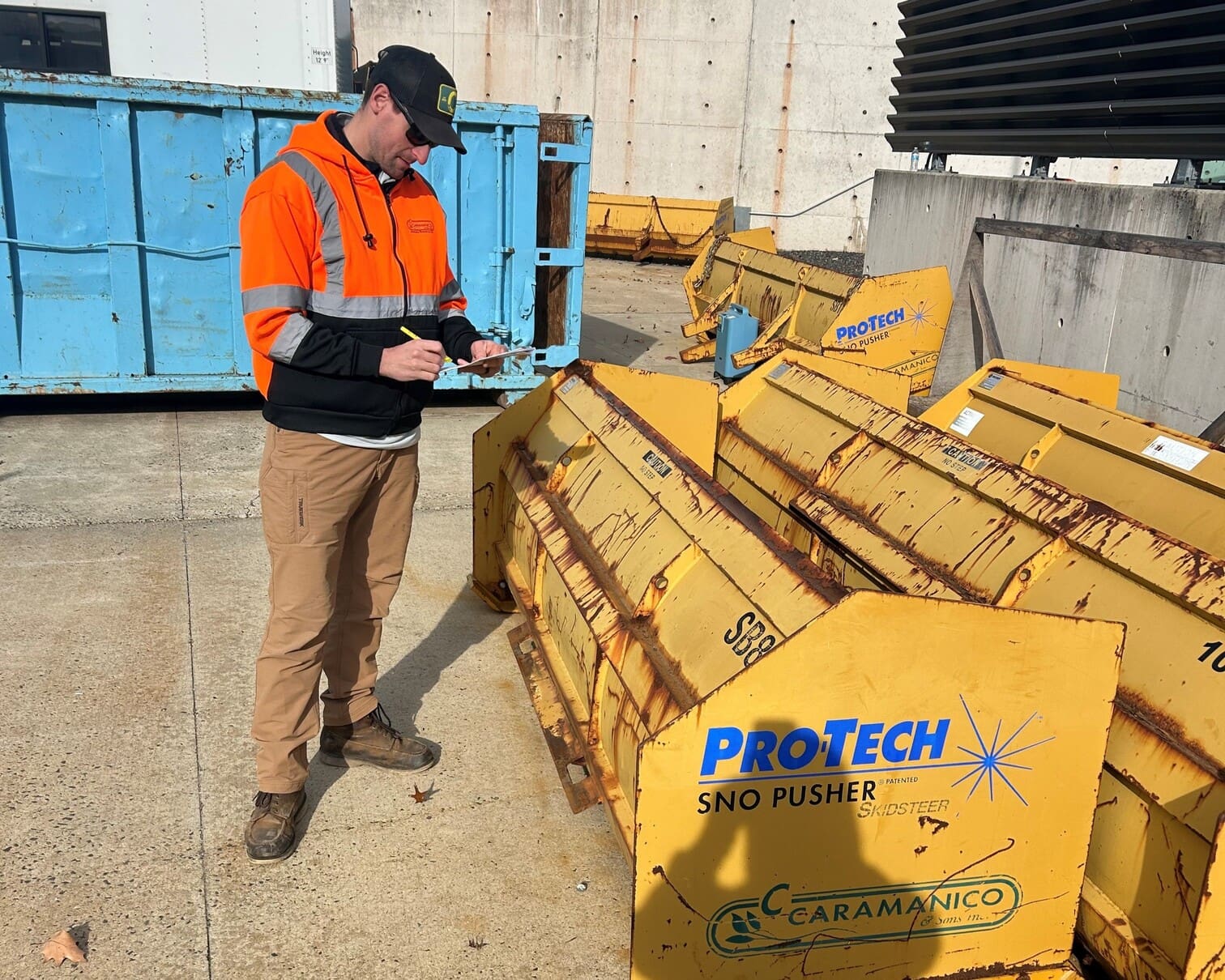
Building out a checklist can help systemize your review process for your snow equipment. Kujawa recommends first inspecting everything for structural integrity. This includes checking for cracks, weld failures, rust, hose fittings, seats, handles and other safety-related components.
Then, you can move on to preventative maintenance. Bonnard says this includes making sure oils and filters are changed, belts and tires are in good condition, and throttle and choke cables are moving freely. He says they also check wear items, cutting edges, shoes, brush wafers, and replace as needed.
Bonnard notes that when companies wait until the last minute to review their fleet, these spare parts can become unavailable, which is why they keep a large stock of anything that could break.
“Also, we review any major repairs completed during the season to understand the ‘why,’” Bonnard says. “Could training have prevented the downtime, or was a preventive maintenance step missed?”
After these steps, test run the equipment to make sure everything is operating properly.
When to Retire Snow Equipment
As you review your snow fleet over the summer, determine which pieces may need to be retired.
Kujawa says because snow and ice control takes a heavy toll on equipment, with the corrosion caused by salt, they make sure to cycle out equipment that has lost its structural integrity.
“We can and do repair major components with patches, outright replacements, retrofits, etc.,” Kujawa says. “But at some point, the totality of the corrosion/deterioration is enough that a piece can’t safely handle the enhanced stresses that heavy plows, salt spreader loads, and the aggressive acceleration/deceleration of typical plowing demands.”
Bonnard says they log hours by machine by job, which allows them to take a closer look at the higher-hour machines and see if they are due for replacement.
“We look at anything with high miles or hours,” Bonnard says. “Then we look at the repair tickets for that piece of equipment. We try to cycle equipment while it still has decent value in the used market to offset costs.”
What is considered high hours will vary depending on the piece of equipment. For example, 1,000 hours on a 5-year-old sidewalk machine means the piece is probably fairly worn out and needs to be replaced, but 1,000 hours on a 5-year-old loader is acceptable.
“We all know – or have mechanics who know – how to resurrect any equipment from the dead,” Bonnard says. “But just because you can keep a machine running doesn’t always mean you should. Smart equipment replacement is about striking a balance among reliability, operating costs, and resale value to offset the capital expense.”
Bonnard advises starting planning early, as it helps get teams in the mindset that snow is coming. They begin reviewing equipment in July and August.
“Starting in September, we will meet every few weeks to check in on assigned tasks, new accounts, and renewals, and revise the plan,” Bonnard says. “Snow will be in the forecast before you know it!”