

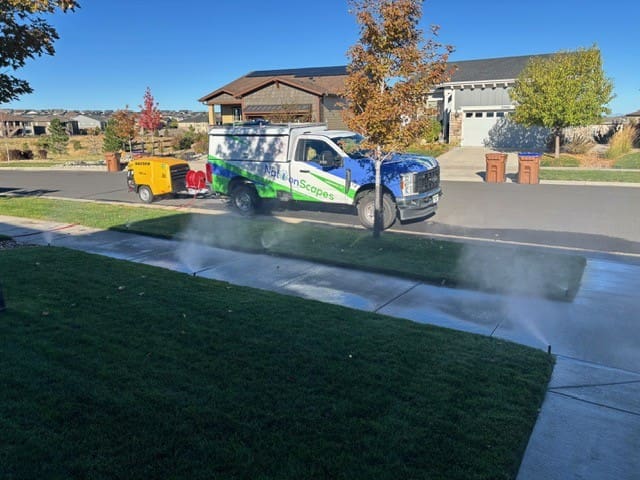
Irrigation winterizations may not be top of mind when you think of revenue generators for your business, but this service shouldn’t be overlooked either.
NationScapes, based in Lakewood, Colorado, will conduct over 6,000 winterizations this year with a team of 15-18 technicians. Tom Handy, manager of the irrigation department at NationScapes, says they achieve this through thorough planning and organization.
Creating Capacity
Getting the timing right for starting winterizations can be tricky, but you have to start somewhere.
Handy says for their area, they will start the last week of September and go heavy until the first week of November. Their busiest weeks are the third and fourth weeks of October. He says they have to start early so they can take care of all their recurring clients and still have the capacity to take on new customers as well.
Many of NationScape’s customers are on prepaid packages where they have already purchased an activation, a mid-season check and winterization, so they’ll start prescheduling in August and September.
“They’re not worried that we’re going to forget about them,” Handy says. “And that way we can plan for quite a few people all at once and just get them on the schedule.”
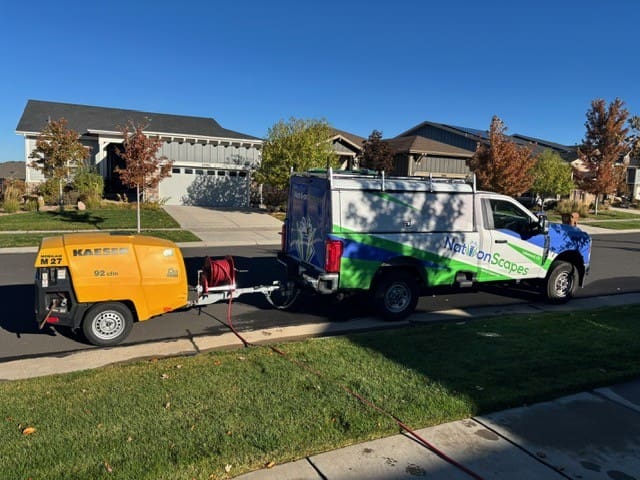
He says they preschedule different areas based on how many of their core clientele are there.
Handy says they have the capacity to take on more calls during the day because they route their technicians tightly. He says typically their technicians do 13 to 15 blowouts a day.
“Let’s say we get a real bad cold snap coming through,” Handy says. “My guys could probably all stay out doing four or five more. Plus, I’ve got a couple of other guys open, so we can capture quite a few each day if we absolutely have to.”
Having capacity plans allows NationScapes to capture all the leads calling in and get them taken care of promptly if the weather changes.
Handy says because winterizations don’t need to happen as soon as October 1, you need to be proactive in your message if you want to avoid an influx of panicked client calls.
“Send them out some information, saying, ‘Hey, colder temperatures are going to be happening at night. It’s a good time to insulate your backflow so you don’t necessarily have to have it off right away, but maybe have that backflow insulated before we get there,’” Handy says. “I think just giving them as much information as possible, because the repairs would be costly. You just need to put them at ease.”
If a client expresses a desire to handle their winterization themselves, Handy doesn’t discourage them; rather, he tries to educate them as much as possible so they can make an informed decision.
“There are a lot of people who can do it themselves, and that’s fine,” Handy says. “I just think the more they know, the better.”
Investing for Efficiency
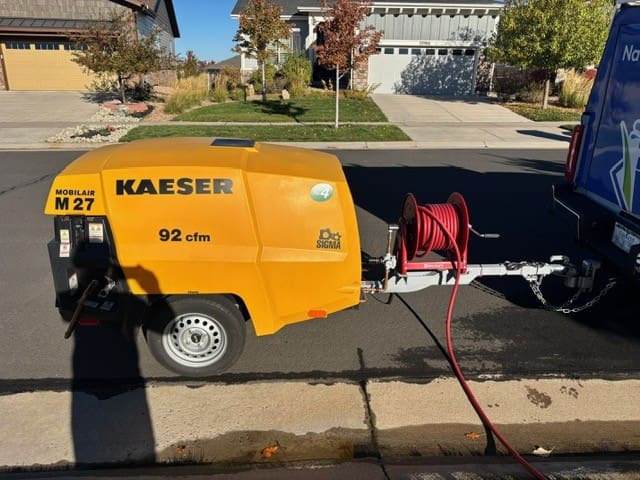
Because of the number of properties they winterize, NationScapes has invested in purchasing 23 compressors. They also have their compressors customized with 200 feet of hose and a hand crank.
“Rental prices over the past 10 years have just gone through the roof,” Handy says. “I used to be able to rent a machine for a month for $1,100. Now they’ll get you for $6,000. The compressors themselves they’re expensive upfront, but they typically pay for themselves after one season.”
Handy says if companies want their winterization service to be profitable, they need to consider it a serious part of the business and charge appropriately.
“They’re just really not doing it to make any money,” Handy says. “It’s a real important part of our business. We take it real serious. That’s why we do a lot of planning. We get organized. We have enough people to do the routes. We have newer, well-maintained equipment so that it doesn’t break down.”
Winterizations are also a great opportunity to upsell clients.
“When you’re winterizing a system, you’re going to see things like broken manifolds,” Handy says. “You’re going to see broken main lines. Maybe you’ll run into a controller that’s not working real well, or the backflow is not one that you can hook an air compressor up to. You see a lot of these things that are definitely opportunities to get some more work.”
NationScapes’ technicians are trained to identify many of these problems in the fall that might slow down their activation process in spring. Their CRM allows them to create a quick estimate and email it to the customer in the field.
“If we can identify and sell some of these other items that we run into, we try to get them all done in the fall as many as we can, so that we’re ready to go in spring,” Handy says. “Some people want to wait, but I always offer discounts in the fall.”
Training Proper Technique
Handy says the biggest mistake companies can make is not training their employees on how to properly winterize an irrigation system.
This starts with ensuring they can determine whether the system is suitable for gravity drainage or if it requires an air compressor.
“There are a number of different ways, primarily it’s going to be the type of materials that were used for the installation, such as PVC lines versus high-grade poly lines,” Handy says. “Did they put drains by all the manifolds? That’s probably the biggest determining factor there. I’d say the size of the system. Obviously, a big commercial system is just going to need to be blown out. But if you got a really big residential system, you might want to just blow that out too.”
Handy says in cases where they didn’t install the irrigation system, they will always blow out the system.
“Unless we’re 100% sure, we could just drain it,” Handy says. “If we don’t know, it’s better safe than sorry.”
Handy also recommends checking to see what the customer’s preference is, as some may only want their system gravity drained.
For properties they want to be able to get ahead on in the spring, Handy says blowing out the system in the fall allows them to get ready a month ahead before they need to be activated.
When blowing out a system, Handy cautions against using too much pressure or blowing out zones for too long. Rather than blowing for three to four minutes at a time, he says 30 to 60 seconds on a residential zone is plenty, as blowing out excessively can overheat the connection to the system.
Handy recommends starting low with 50-60 pounds of pressure on a residential property and adjusting up as needed. Additionally, he says you need to make sure you have the right size compressor for the job.
“You can determine that primarily by how big the backflow is and how big the property is,” Handy says.
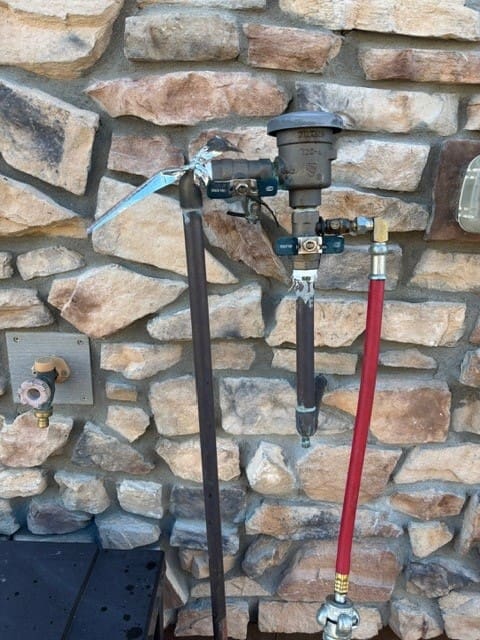
Handy says the backflow handles also need to be left at a 45-degree angle over the winter.
“That’s a common mistake,” Handy says. “I see they’re either left all the way open, or people close them all the way, and that can cause some freeze damage.”
Key Takeaways
- Plan early to build capacity. Preschedule clients in advance and route technicians tightly so they can handle late-season demand spikes.
- Proactive communication prevents panic calls and builds trust with your customer base.
- Owning compressors pays off quickly compared to rental costs, while maintaining well-trained crews and organized routes keeps winterization profitable.
