

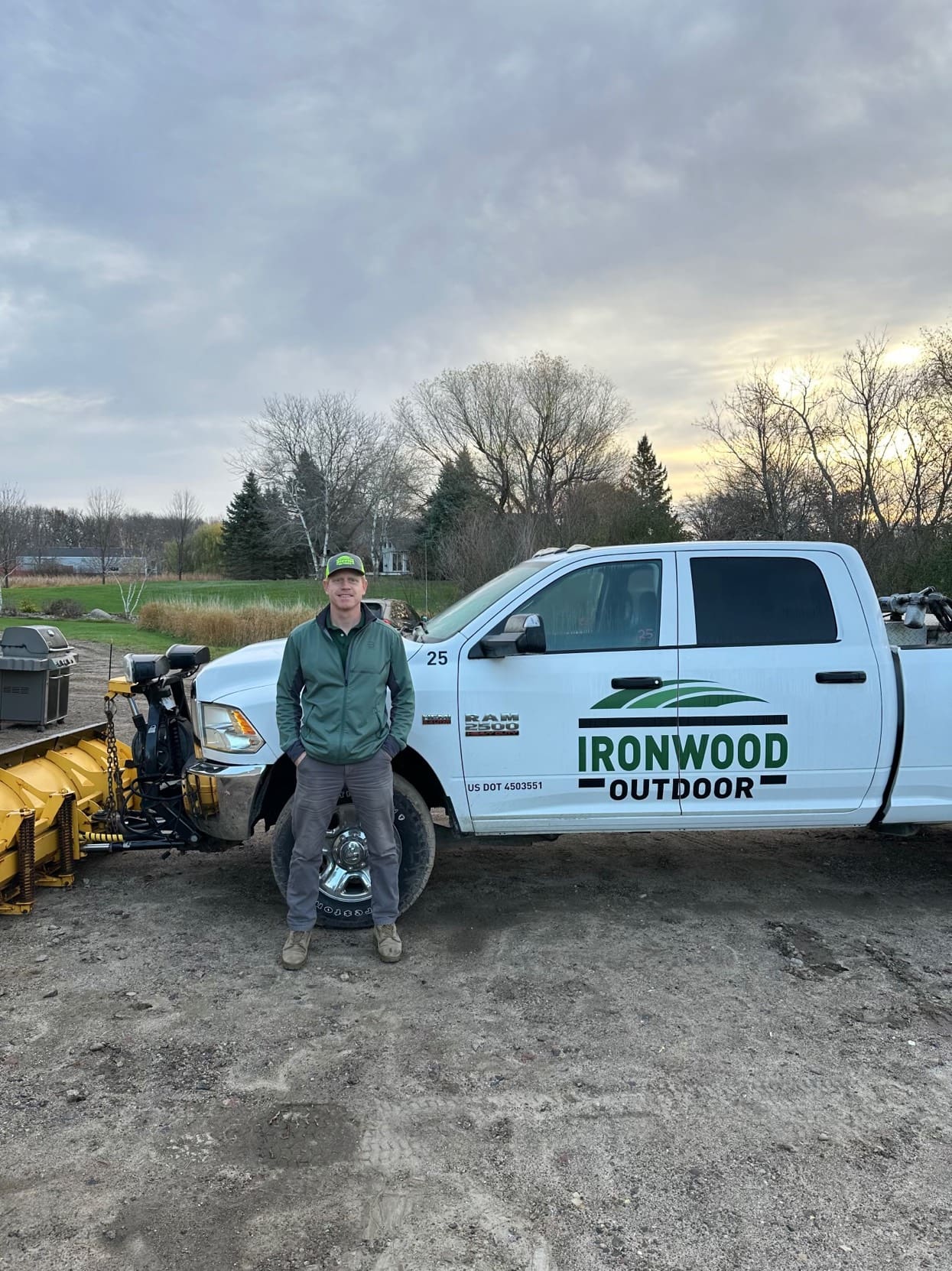
Ian Cameron’s first day in the landscape industry was also his first day owning Ironwood Outdoor Services, based in Minneapolis, Minnesota.
Previously, Cameron had served as a commissioned infantry officer in the Marine Corps for eight years and worked for two tech startups in San Francisco for three to four years before he decided it was time to move back home to Minnesota, but he still had the entrepreneurial itch.
He ended up meeting a landscape company owner who had the classic story of mowing from a young age and then growing a business.
“He was ready to do other things, and so I linked up with him to buy his business, and that was just over a year ago,” Cameron says.
The former owner wanted a clean deal and wasn’t interested in staying on in the business.
“We had negotiated 30 hours of transition,” Cameron says. “That didn’t happen. Day two, my questions weren’t getting answered.”
Over his first year in business, Cameron says he has learned a lot, and NALP was a big part of helping him as an outsider learn more about the industry. He says he has benefited the most from NALP’s training and publications.
Coming in with a fresh perspective caused Cameron to lean on his team members’ experience while figuring out where his own military background and leadership could make the biggest impact.
Building Training Around Employees’ Expertise
While Cameron doesn’t have a background in the landscape industry, he does have a lot of operational experience, including how to invest in and train people.
“In the Marine Corps, you don’t get to pick your team,” Cameron says. “You’re given your team. I think a lot of people in our industry really focus on hiring and firing to try to get the team right. We do that too. We want to get the right people in here. The competitive advantage is being able to take guys, train them to do the job appropriately. Maybe they don’t come to you with the skillset that you need, but if you’re able to train them into that skillset, you can create a really strong team.”
He says that with clear guidance, his team members can come back at the end of the day with a feeling of accomplishment.
“Giving them the tools to be successful in this industry creates a level of loyalty that nothing else can match,” Cameron says.
Cameron says his experienced employees are helping provide the content for their training. He provides the framework for effective training while his foreman leads the training sessions.
“I think marrying my experience with these subject matter experts has been really helpful,” Cameron says.
He says one of his next steps is to integrate NALP’s free training with their own training programs.
Cameron says he was concerned that the team would respond poorly to him buying the business, but it ended up being a non-issue.
“Just me being involved in the business every single day, 12 hours a day, was giving the guys the support that I think had been missing for a little bit,” Cameron says.
Cameron says he was transparent with the team about what he didn’t know and sought their input. He says this has helped long-term employees feel appreciated.
“Me not knowing a lot about this industry could be viewed as a weakness,” Cameron says. “But the way in which I’ve been able to engage with my guys and learn from them is actually a strength. It helps the guys understand, ‘Hey, you know a lot and not only do you know a lot, but I want to hear that, and I need you to teach me that stuff.’”
Learning the Realities of Landscape Operations
One aspect of the business Cameron didn’t fully appreciate before buying the company is how much operations evolved based on the weather and seasons.
“When I bought the business, I got to see the end of the summer, and then I was like, ‘Oh, okay. Well, I just need to see a few snowfalls, and I got it,’” Cameron says. “That happened, and then I was like, ‘Oh, actually, we do this whole different thing in the spring. I need to get to spring, and then I’ll have seen it.’ Then we got through spring, and we got into summer, and I started realizing no, every single week is different.”
In one instance in the spring, Cameron didn’t call off work on a day that it rained, and one of his foremen disagreed and explained why it was a bad call. Cameron agreed with his foreman and asked what they should do at this point. What started as an angry conversation turned into a proactive one where his foreman identified properties they could still work on.
Cameron didn’t just stop at asking his team questions. He also went out in the field and worked alongside his crews to see what goes on at a customer’s site.
Adding Structure to an Established Landscape Business
Cameron has been strategic about what changes to make in the business and when to do so. One simple change has been the introduction of a weekly Thursday morning meeting.
“We don’t try to accomplish a ton at it, but just having once a week where all the guys are together, go over a couple of topics that we need to reiterate, and then recognize somebody each week for just a job well done,” Cameron says.
He says this helps build up their team and celebrate the wins as they occur.
When Cameron bought the business, it lacked documented processes and wasn’t using any software. Now, they are currently working to implement LMN, but it’s been harder to get up and running than anticipated.
“To go from flying blind to actually understanding how revenue and how profit are driven in your company is what separates most companies from the good ones, and that’s our next step,” Cameron says.
He says while he knows at the end of the year how profitable they are, he can’t tell which customers are making or losing money.
Since taking over the business, Cameron has also implemented GPS tracking for the crews and Company Cam to help with proposals and documenting what is happening on site.
Despite his background in tech startups, Cameron says he’s more of a tech skeptic and understands it is a tool, not a solution.
“Software isn’t going to fix broken processes,” Cameron says. “There are lots of great tools out there that can help make your business more efficient. But fundamentally, it’s about people, and it’s about process, and you’ve got to have that first.”
Cameron also chose to rebrand the company in the spring, as it was previously named after the owner, but no one knew how to pronounce it correctly.
“We definitely had to communicate that, and delaying the rebrand a little bit helped,” Cameron says. “We broke it up in two parts. The ownership change happened first, and then the rebrand happened.”
Knowing What to Keep
Cameron says one of the strengths of the business is that it is highly focused on maintenance contracts for homeowner associations in the northwest metro of the Twin Cities, and he plans to continue pursuing that client base.
He says they have a number of long-term customers who have been with the company for 15+ years. It was the longevity of the customer relationships that attracted Cameron to buy the business.
“We’re really looking to just leverage that credibility and grow and be a trusted partner to property managers who are working with homeowners associations, and we’re starting to see that we’re getting more bids requests than we can handle, and we’re just doing our best to be thoughtful about what we take on moving forward,” Cameron says.
Another element Cameron opted to keep was a physical punch clock in the office. When he first visited, he couldn’t believe it when he saw it and wondered how dated the company was.
“What I came to realize is the punch clock was close to where I sat in the office, so it’s just a great way to check in with guys as they were coming in in the morning,” Cameron says. “It just created a natural way to check in with the guys when they came in.”
Now, he says he has no intention of getting rid of it.
Cameron recommends others who acquire companies come into it with an open mind and understand the why behind certain practices before making changes.