

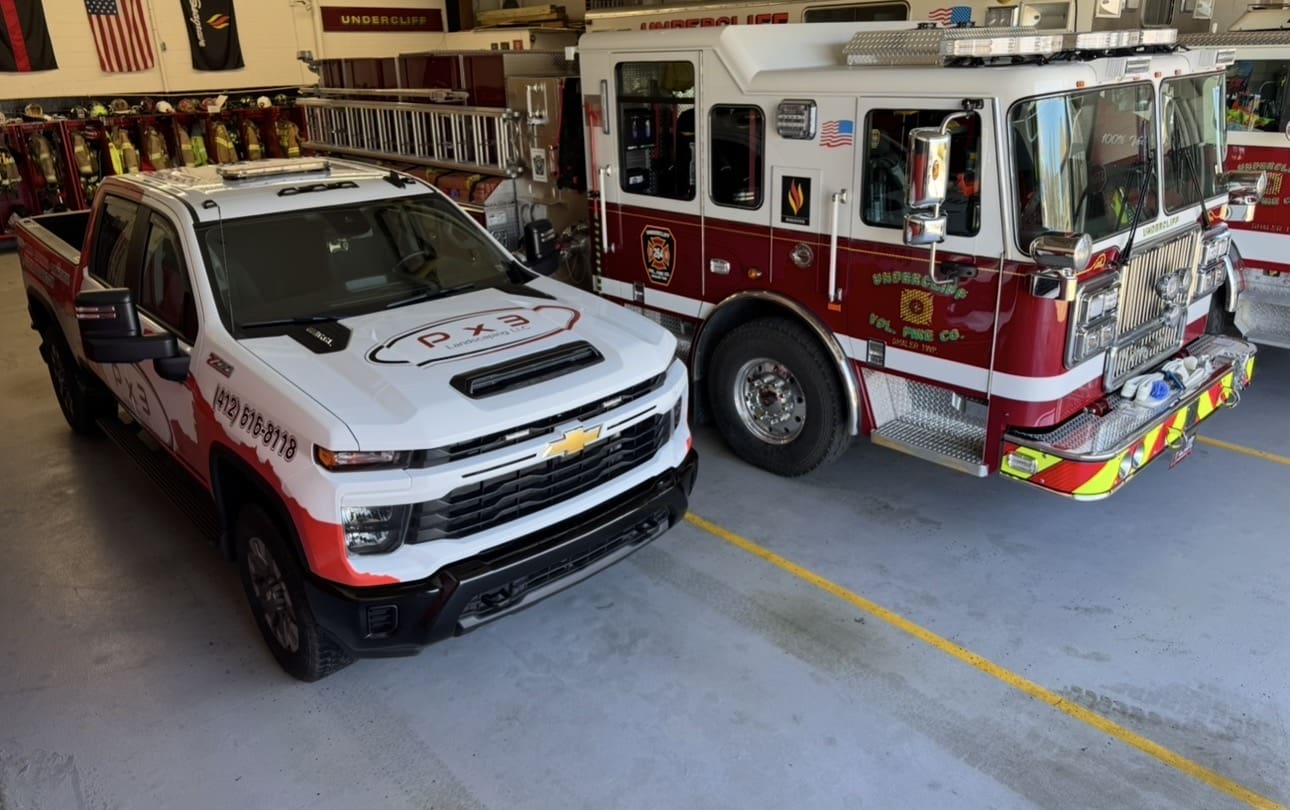
Safety is paramount for any landscape company, but Ryan Pontzloff, owner of Px3 Landscaping LLC, based in Pittsburgh, Pennsylvania, approaches it from the lens of a volunteer firefighter.
“Being a volunteer firefighter in the communities in which your company operates really shifts your focus,” Pontzloff says. “You get to learn street names and addresses through working and meeting clients, which is great for both landscaping and firefighting. There is something so important to serving those in their greatest time of need through volunteer firefighting.”
Pontzloff and his operations manager, who is also a volunteer firefighter, both have to balance running the business and responding to fire calls.
“Sometimes you make them, and sometimes you don’t,” Pontzloff says. “What matters is that we make an effort to show up when we can. Sometimes, our operations manager will leave the work he is doing in the office to run a fire call. Other times, I will leave the worksite to run a fire call. We are simply trying to help when and where we can.”
Safety Through a Firefighter’s Eyes
With their background as volunteer firefighters, this has shaped how Pontzloff and his operations manager approach safety. Some practices Pontzloff has carried over from his training, and other times he translates instances from firefighting into how his team can work more safely.
“For example, any time we are raising ground ladders in the fire service, we are taught to check to make sure our overhead is clear first and announce that it is clear,” Pontzloff says. “We practice the same technique when using ladders or heavy equipment while landscaping – this could be for something as simple as cleaning gutters to raising the dump bed on the truck.”
Another safety practice he has carried over to his team is how firefighters know where each tool or resource is on their apparatus at all times.
“We want to keep things organized and in a manner that each employee knows exactly where their tools and resources are in the vehicle or trailer,” Pontzloff says. “This is especially important for safety items such as PPE and ensuring that all employees are fully aware of the correct location of PPE within each vehicle or trailer.”

Each truck includes items like traffic cones, flares, roadside kits, first-aid kits, safety vests, and other PPE.
“It is imperative that these items remain in consistent and easily identifiable/accessible locations for the safety of our team and those around us,” he says.
Pontzloff says they’ll also think about landscape design and properties through the lens of a first responder.
“If the landscape design or property is not ‘first-responder-friendly,’ then we are likely going to make recommendations to ensure that it is,” Pontzloff says.
An example of a landscape design that is not first-responder-friendly is when elements hinder access to doors, windows, or utilities. Hiding utilities behind plantings or burying the gas meter shut-off valve in mulch are other risks.
“I believe most people would agree that utilities are unsightly on properties,” Pontzloff says.
“Although that may be a shared belief among many of us, the fact is that when seconds matter most, we need clear and obvious access to these things. Shutting off utilities or gaining entry to the building at a certain point could be the difference between life and death for a victim that is entrapped in a house fire.”
Another example is when plantings are too close to a structure. Pontzloff explains that these have the potential to catch fire if they are touching the house and can spread the fire into the yard.
“It is understandable that if you are not a first responder, you might not immediately see or think through this lens, but it is extremely important that we make these considerations when working for our clients,” Pontzloff says.
Training Team Members to a High Standard
Px3 Landscaping is driven by high safety standards and has implemented many systems to enhance their overall accountability and safety measures for their team.
This includes having their team members complete routine and random drug testing, vehicle and equipment training, NALP training and CPR/first aid/AED training.
Pontzloff says they chose to have all of their employees CPR/first aid/AED certified to highlight their commitment to safety and provide their team members with the necessary skills to work safely in the elements.
“Whether we are working in extreme heat and concerned about heat-related illnesses, or someone has a simple cut/scrape/bruise, we want our employees to be safe wherever possible,” Pontzloff says.
In addition to ensuring that all of their employees are NALP certified landscape technicians, Px3 Landscaping also conducts drills and scenario-based training so that employees are comfortable and confident in practicing safety in the field.
“Furthermore, although Pennsylvania is not an OSHA state, we require all employees to be trained in OSHA-30,” Pontzloff says. “This further emphasizes our company’s commitment to safety and training.”
He says all of these trainings, along with their other systems and processes, allow them to ensure that their operations are running safely.
The company also utilizes separate apps for training logs, injury reports, and vehicle accident reports to document everything, as well as apps for vehicle and trailer checks to ensure everything is safe to operate prior to leaving for the day. They also employ forward and rear-facing dash cameras in every vehicle that communicate to drivers if they engage in distracted driving behaviors.
“We want to foster a work environment in which every team member feels safe and supported,” Pontzloff says.
During peak work times, Pontzloff stresses to staff that what matters most is working slowly and safely while maintaining efficiency. He says even when they have strict deadlines, he doesn’t want his employee putting their safety at risk just to complete a job sooner.
“We always remind employees that we ‘Drive to arrive,’” Pontzloff says. “Meaning, if you are going to be driving recklessly, you may not arrive there in one piece or at all. It is imperative that we all practice safety for the sake of ourselves and our clients.”
Safety’s Impact on Success
Px3 Landscaping identifies as a “Firefighter Owned and Operated” business, and Pontzloff says this holds them to the standards and expectations of a firefighter.
“To have anything less would be antithetical to the identity of our company,” Pontzloff says. “At the end of the day, most clients are going to want to choose a company that prioritizes safety over one that doesn’t. I believe this helps us to further grow and strengthen our client base. Regardless though, our overall success can only happen when safety is also happening.”
He says clients have frequently commented on their safety practices and they appreciate the fact the business takes safety seriously.
Px3 Landscaping’s culture of safety has also had a positive impact on employee recruitment and retention.
“Not many people are looking to work for companies where danger or high-risk activities are present,” Pontzloff says. “Our employees (current and future) appreciate the fact that they know we are a company driven by excellence in safety and focused on ensuring everyone stays safe and can return home at the end of the day.”
Advice for Others
One firefighter safety practice that Pontzloff says every landscape company could implement tomorrow is preplanning.
“Firefighters often have ‘preplans’ for buildings within their fire district,” Pontzloff says. “These preplans often identify hydrant locations, FDC connections, site maps, special hazards, and more. Albeit simple, these preplans can save time and save lives during emergencies.”
For landscape companies, this could include outlining potential hazards such as irrigation lines, hardwired landscape lighting, utilities (both underground and overhead) and property lines. He says this is particularly helpful for snow removal sites. Mapping out important elements on a property is a simple step that can make a positive impact on safety and can be implemented at any time.
“Safety is not just something that shows up when something goes wrong,” Pontzloff says. “Safety needs to be an integral part of everything your company is doing. Even before a truck leaves the yard or shop, safety standards need to be in place. This includes vehicle checks, trailer checks, PPE checks, and even ensuring all passengers are wearing seat belts.”