
For years, Americans have debated whether it is time to end the twice-yearly ritual of “springing forward” and “falling back.” This month, Congress took another significant step toward that goal as the U.S. House of Representatives passed the Sunshine Protection Act, legislation that would make Daylight Saving Time (DST) permanent nationwide. The bill now awaits consideration in the Senate.
The House approved the Sunshine Protection Act with broad bipartisan support by a vote of 308-117, sending the measure to the Senate. If approved by the Senate and signed by the President, the legislation would end the biannual clock changes by making Daylight Saving Time the permanent, year-round standard for most of the United States. Hawaii and most of Arizona, which already observe permanent standard time, would remain unaffected.
Although there is widespread public frustration with changing clocks twice each year, the legislation faces a more uncertain path in the Senate. Similar proposals have repeatedly stalled despite bipartisan support, largely because senators remain divided over whether the country should adopt permanent Daylight Saving Time, permanent Standard Time, or retain the current system. Sleep medicine experts have also expressed concerns that permanent Daylight Saving Time would result in darker winter mornings and could negatively affect circadian rhythms, school safety, and public health.
The bill has more momentum today than previous efforts. It has:
- Passed the House with a strong bipartisan vote.
- Received support from President Trump, who has advocated ending the twice-yearly clock changes.
- Continued to receive bipartisan interest in both chambers of Congress.
Even so, Senate approval is far from guaranteed. Unlike the House, where the measure advanced comfortably, senators remain divided on whether permanent Daylight Saving Time is the best solution. Some lawmakers favor permanent Standard Time instead, while others question whether Congress should act at all. Until the Senate schedules and approves the bill, its ultimate prospects remain uncertain.
We’ve Been Here Before
While the current debate feels new, the United States has already experimented with permanent Daylight Saving Time.
In response to the 1973 oil embargo and the nation’s energy crisis, Congress enacted the Emergency Daylight Saving Time Energy Conservation Act, placing the country on year-round Daylight Saving Time beginning in January 1974. The expectation was that additional evening daylight would reduce energy consumption.
Initially, public support was strong. However, enthusiasm faded quickly as Americans experienced extremely late winter sunrises. In many parts of the country, children waited for school buses in darkness, commuters traveled during darker morning hours, and concerns over safety grew.
As public opinion shifted, Congress reversed course. After less than a year, lawmakers restored seasonal clock changes, ending the experiment with permanent Daylight Saving Time in October 1974.
That history serves as an important reminder that while many Americans agree they dislike changing clocks twice a year, there is less agreement on which permanent time standard the nation should adopt.
What Happens Next?
For now, Americans should expect the current schedule of changing clocks twice a year to remain in place unless the Senate approves the legislation and it is signed into law.
Whether Congress ultimately adopts permanent Daylight Saving Time, permanent Standard Time, or maintains the status quo, one thing is clear: the debate over America’s clocks is far from over, and lawmakers continue to wrestle with balancing convenience, public health, safety, and economic considerations.
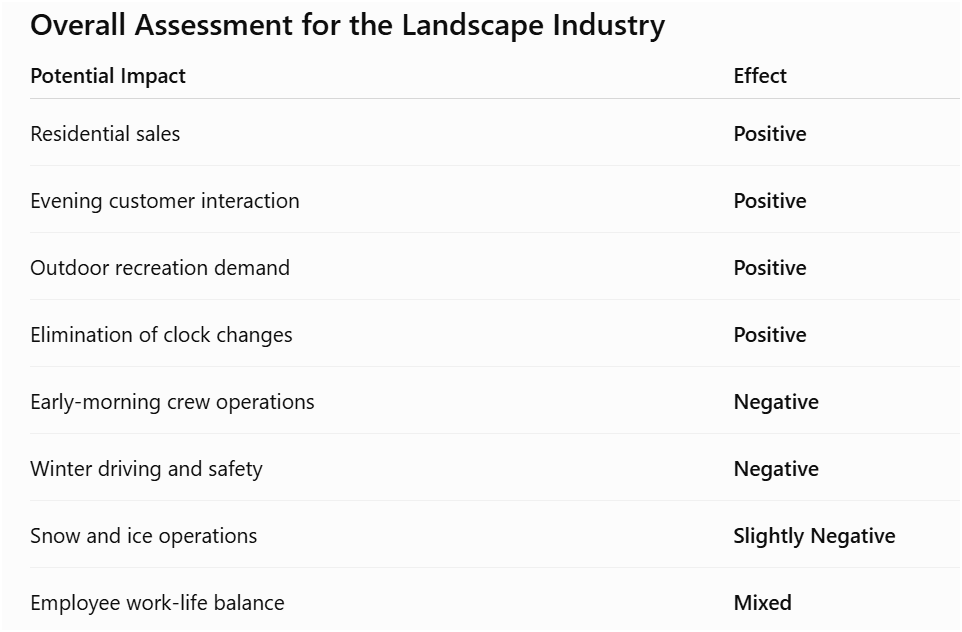
Impacts for the Landscape Industry