

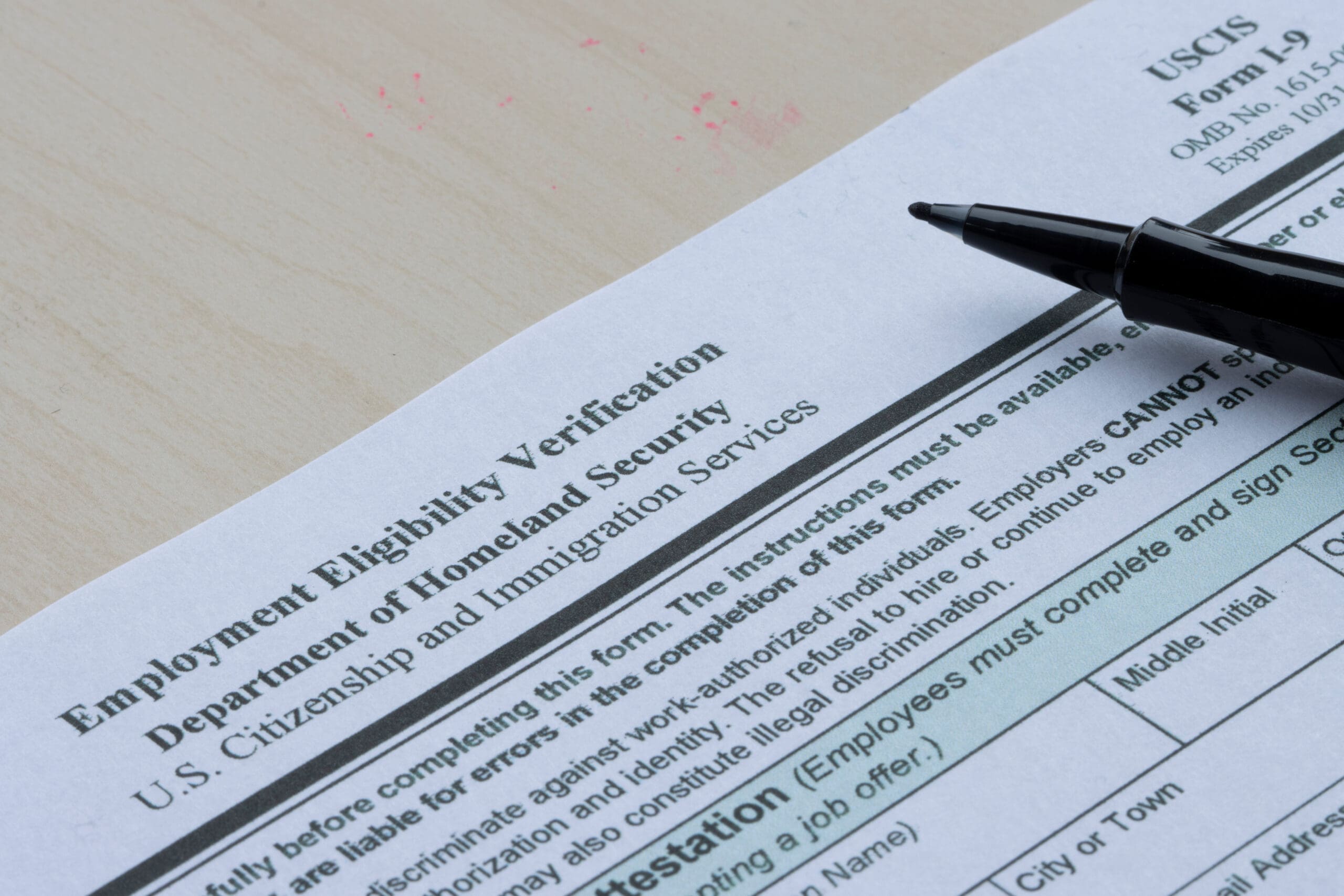
Recently, U.S. Immigration and Customs Enforcement has quietly changed how it classifies I-9 form violations, significantly increasing the risk of fines for employers.
All U.S. employers are required to verify the identity and work authorization of every employee hired after Nov. 6, 1986, by completing Form I-9. Under the Immigration Reform and Control Act of 1986, employers that made technical or procedural errors could avoid civil penalties if these were corrected within 10 business days, while substantive violations did not receive this grace period. However, ICE has rewritten and reclassified certain errors, eliminating the window for corrections.
What’s Changed
Under the new guidance, errors that were previously considered minor and correctable are now treated as substantive violations. This means employers may no longer have the opportunity to fix mistakes before being fined.
These updates supersede the provisions of the 1997 Virtue Memorandum. Because there was no Federal Register notice, no proposed rulemaking, and no public announcement, ICE may begin assessing fines under the new framework immediately.
Errors now considered substantive include:
- Failure to ensure an employee provides date of birth (DOB) in Section 1;
- Failure to ensure an employee provides their USCIS number in Section 1;
- Failure to record a date in Section 1 next to employee’s signature;
- No expiration date listed in Section 1, Box 4, regardless of whether such expiration date is listed in Section 2, List A, and/or the Employment Authorization Document (EAD);
- Use of Spanish-language I-9 outside of Puerto Rico;
- Missing name and title of the employer representative;
- List A, B, or C data not fully recorded/incorrectly recorded in Section 2, such as name of document, number of document, issuing authority, or expiration date, regardless of whether a copy of an underlying document, such as a green card or driver’s license, was retained;
- Failure to provide the first day of employment in the Certification;
- Failure to ensure that the preparer and/or translator’s complete name, address, signature, and date are provided on Form I-9 at the time of completion in Supplement A;
- When utilizing remote verification procedure, the employer representative fails to check the alternative procedure box in Section 2 or Supplement B, indicating that remote inspection was used and/or is not an active E-Verify participant when using the alternative procedure; and
- Failures of electronic I-9 system’s audit trails, electronic signature protocols, or security documentation that falls short of specific DHS standards.
Because we anticipate increased ICE enforcement activity in the coming weeks and months, with the landscape industry specifically being targeted, landscape companies should be prepared.
What This Means for Employers
I-9 fines now range from $288 to $2,861 per violation.
Because fines are assessed per form, a high error rate across your workforce can quickly lead to tens or hundreds of thousands of dollars in penalties. Even small companies face significant financial exposure.
This change has substantially reduced employers’ ability to correct routine administrative mistakes and raises the stakes of inspections in an aggressive enforcement environment.
To reduce risk, landscape employers should take immediate steps:
- Conduct an internal I-9 audit of current and recent employees
- Stop relying on document copies to cure missing data on the I-9
- Train all staff involved in hiring and onboarding
- Standardize your onboarding process across all locations
- Consider implementing a compliant electronic I-9 system
- Consult with legal counsel on complex work authorization situations
I-9 compliance is no longer just an administrative task; it’s a business-critical risk area. With stricter rules and faster enforcement, landscape employers must ensure their hiring and documentation processes are accurate, consistent, and audit-ready.
This topic was originally covered in The Advocate, NALP’s government affairs newsletter. Subscribe to The Advocate for more legislative news.