
As attention on water usage increases due to cost and restrictions, the need for water-efficient landscapes has never been more prevalent. Thankfully, there are a wealth of tools and tactics to help your clients maintain a vibrant landscape while irrigating sustainably.
“There are many more options for water-saving technologies compared to 20 years ago,” says Larry Giroux, segment manager for Ewing Outdoor Supply. “There are EPA WaterSense-labeled smart controllers. Pressure regulators for valves, pressure-regulated spray bodies, soil sensors, micro or drip irrigation, to mention a few.”
Smart Controllers Paired with Professional Calibration
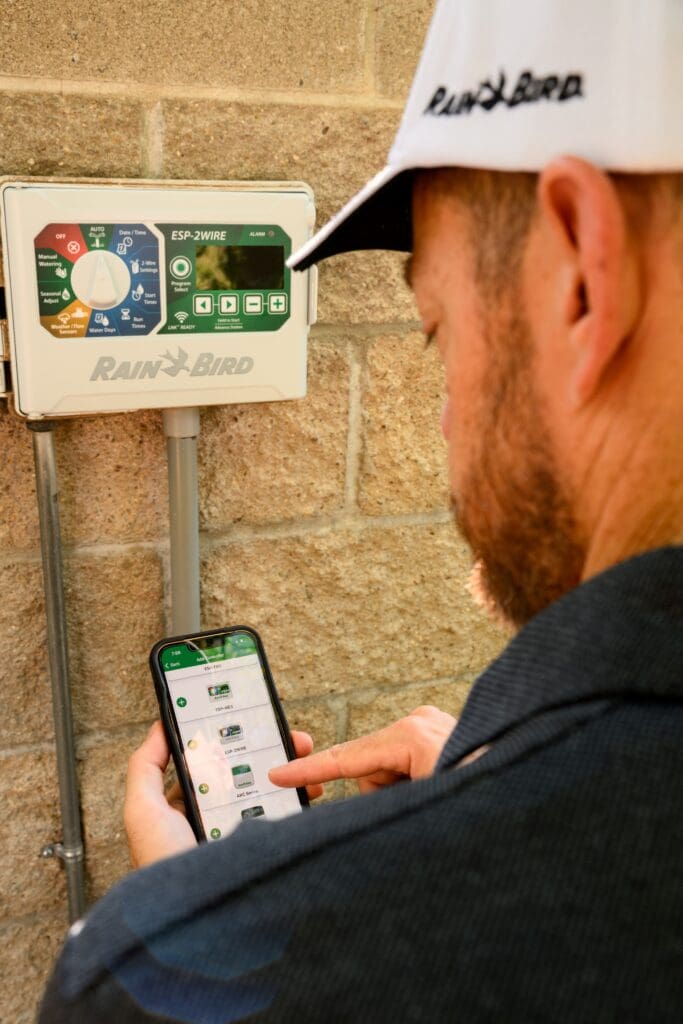
One of the most commonly championed water efficiency tools is the smart controller. These systems can automatically adjust watering schedules based on local weather data.
“Using smart control from a contractor’s perspective is like having a virtual service technician at the job site 24/7 keeping their finger on the pulse of what’s going on with the weather, but also the electrical and hydraulic integrity of the system,” says Kevin Battistoni, national customer experience manager with Hunter Industries.
Steve Barendt, senior product manager with Rain Bird, adds that when installed properly and used with flow sensing, smart controllers can alert contractors if something unexpected is happening, such as a high/low flow situation or a system short. Having this visibility without having to be on site can help professionals scale their business without adding headcount while strengthening client trust.
“You’re not getting a screaming phone call from a client two weeks after they notice a damaged landscape or a very high water bill,” Battistoni says. “It’s now allowing the green industry professional in real time to tell the customer, ‘Last night at your house when zone five was supposed to run at 1:30, it used 30% more water than the previous cycle, which is likely something is broken on that zone. Would you like us to send somebody out to take a look at it?’”
While smart controllers are powerful, they are not magic, which is why professional calibration is equally crucial.
“An irrigation system’s overall efficiency is directly tied to how well its controller is programmed and calibrated,” Barendt says. “Even the smartest controller cannot automatically account for site-specific variables without professional input. Landscape professionals must perform ‘professional calibration’ to dial in precise programming, establish accurate base run times, set up proper ‘Cycle & Soak’ schedules to prevent runoff, and configure flow-sensing thresholds.”
Battistoni stresses that for a smart controller to truly make a difference, you first need to make sure the irrigation system itself is up to par. Without doing a proper site survey and addressing any issues found, a smart controller cannot overcome these issues.
“You could give me Michael Jordan’s brain, and I’m still 5’6 with a 10-inch vertical,” Battistoni says. “I’m not going to be able to slam dunk a basketball ever. From a detached perspective, when green industry professionals get into smart control, and they pitch it to their client without doing a true site study, if you put a smart control on a dumb system, it’s still a dumb system.”
Retrofits That Improve Efficiency Without a Full Overhaul
Some of the additional ways to create a more sustainable irrigation system include taking advantage of high-efficiency nozzles, pressure regulators and check valves.
High-efficiency nozzles can help with water conservation as they lay down water at a rate that doesn’t exceed the infiltration rate of the soil. These nozzles are designed to deliver thick streams and larger water droplets to maximize distribution uniformity.
Meanwhile, pressure regulation is a commonly overlooked win.
“Having the proper pressure at the head itself is going to distribute the water, whether it’s below grade and drip or above ground and atmospheric in the most efficient fashion,” Battistoni says. “Except for the states that have mandated it, it’s a rarity when you see that implemented when it’s up to a design/build situation.”
Battistoni acknowledges that pressure regulators are more expensive, but landscape contractors need to consider the long game.
“Pressure regulation is a highly effective way to improve irrigation performance,” Barendt says. “Excessive system pressure can cause misting, fogging, and wind drift, reducing efficiency and uniformity. Pressure-Regulating Stem (PRS) technology helps maintain optimal operating pressure (typically ~30 PSI for sprays and ~45 PSI for rotary nozzles), improving distribution uniformity and reducing water waste.”
Check valves are another useful addition to irrigation systems.
“With check valves in the head, it traps all the water in that lateral piping, and it’s used on the next cycle, so there is a water savings component there, but it’s twofold,” Battistoni says. “Without check valves, the water is naturally going to go to the lowest heads on that zone and all that lateral water that’s left after it depressurizes is going to leak out of there.”
Battistoni says these are changes that can be retrofitted to existing systems without even requiring a shovel.
“You can literally unthread a sprinkler head, install pressure regulation and a check valve, putting new internals into that same body, and now we’re getting that extra savings because we’re trapping the water in between cycles and not wasting it due to low head drainage, then when it runs, instead of running at 50 PSI at the base of the head, it’s operating at 30, which is optimal for how that nozzle was designed to emit water most evenly,” Battistoni says.
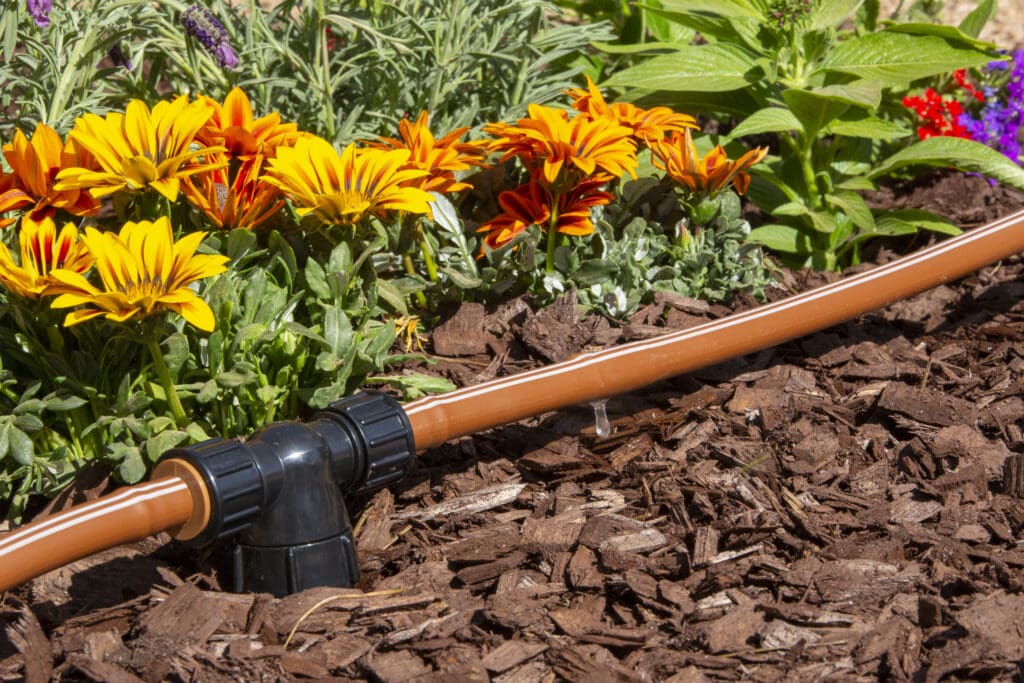
Giroux also recommends retrofitting spray zones in landscape beds into drip irrigation systems.
“This eliminates wind drift and puts the water right where it is needed the most, the root zone,” Giroux says.
Monitoring Tools and Manual Management
Barendt notes that sensors like rain and freeze sensors can help interrupt irrigation after rainfall or during freezing temperatures, while flow sensors can detect when there is a leak or mainline break in real time.
“Flow sensors are also more widely available today, but still not commonly used,” Barendt says. “It’s a small investment to ensure that system flow is as expected. A high-flow situation could be a broken mainline, broken lateral line, or broken nozzles resulting in flooded landscape. Not only is this damaging to the landscape itself but can also waste a significant amount of water. Capturing low flow situations is also important to ensure that plant life is receiving water when expected.”
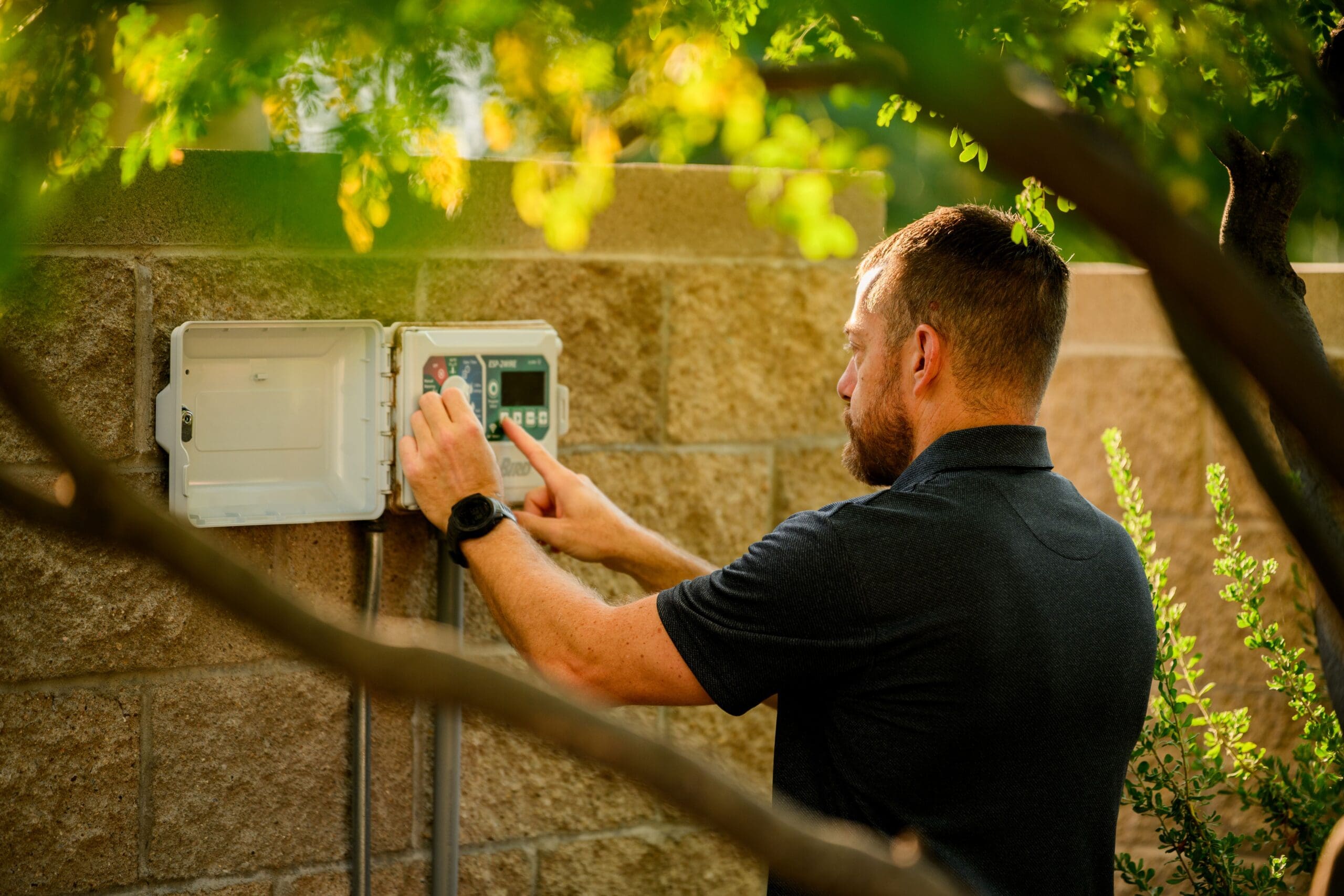
Even if a client doesn’t have or doesn’t wish to add a smart controller, you can still provide significant water savings through manual optimization. Barendt says you can take the ‘Triple A’ approach of anticipate, adjust and achieve where you forecast seasonal changes and adjust accordingly. He says you can also take advantage of the controller’s seasonal adjust function.
“Use the controller’s global percentage adjustment (e.g., scaling down to 80% in September),” Barendt says. “This fine-tunes the system globally without the hassle of reprogramming every individual station.”
While all of these changes can help with water efficiency, Battistoni cautions against making blanket claims of how much water can be saved, as Mother Nature is the biggest X factor.
“If Mother Nature decides it’s not going to rain for three months, we’re still laying the least amount of water down necessary to keep it green, but that’s going to be more water usage than the previous year,” Battistoni says.
The goal should not be to promise a universal savings percentage, but to ensure each system applies the least amount of water necessary to keep the landscape healthy by using the right mix of technology and ongoing adjustments based on site conditions.