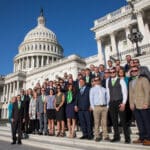
There is strength in numbers, and in an effort to increase the industry’s advocates, NALP has launched the Advocacy Ambassador Program. The Advocacy Ambassador Program’s goals are to inform, engage and activate NALP members to be the sword and shield on behalf of the landscape industry.
“We want people to have a clear understanding of the good work that we do,” says Bob Mann, senior director of regulatory and technical affairs for NALP. “So many others have taken the opportunity to paint us in light that isn’t accurate whatsoever.”
This program is a rebranding of the Advocacy Contact Team.
“The contact team, by all accounts, was functioning great, but every once in a while, you need to rebrand things and breathe new life into it,” says Andrew Bray, NALP senior vice president of government relations and membership. “We hope that by rebranding and breathing some new life into it and putting in some more structure and resources, it’s going to actually expand it.”
This team-based program will ensure that no one serves alone, with each state having multiple ambassadors and NALP’s support. Participants in the program will receive training materials on the basics of advocacy so they can feel comfortable meeting with their elected officials.
“This is just human nature you’re working with,” Mann says. “It’s just telling people what you do every single day. And there’s no better expert at what you do every single day than you are.”
What Do Ambassadors Do?
Members can participate in the Advocacy Ambassador Program at the state and federal levels. Ambassadors will be both proactive and reactive to various issues as they appear.
State ambassadors will build relationships with state policymakers, engage in local advocacy efforts, and stay informed on state-specific issues. Mann says NALP is happy to help ambassadors set up meetings to form relationships with committee members and put together a legislative day if there isn’t one in existence currently.
“We’re working with the association in Wisconsin to make that happen,” Mann says.
Bray says the level of commitment required will vary by person and what is going on in their state.
“I think it’s critically important to remember that the heavy legwork is always going to be done by NALP,” Bray says. “We are going to be tracking the legislation. We are going to be writing testimonies. We are going to be writing talking points, but when we ask people to take action or we ask people to weigh in, we’re going to need them to do that, and that can be done by email and via Zoom.”
Federal ambassadors will advocate for the industry at a national scale and engage with federal policymakers. It is ideal for individuals who want to make a difference on a broader level. These ambassadors are expected to participate in at least one annual fly-in to Washington, D.C., to meet with lawmakers.
Mann notes that ambassadors can have a lot of fun advocating for the industry.
“It’s a little bit different than your day-to-day,” Mann says. “It involves repurposing a skillset that you have to something different and you have to invest in yourself. I think that there is a certain level of satisfaction that comes from being able to articulate what it is that you need in order to be successful in your business to your elected official and have your elected official work on your behalf. It’s only through repeated effort that you begin to see people move in your direction.”
Ambassadors are not required to contribute to the NALP PAC or other political fundraisers, but Mann says it is appreciated.
“We’re trying very hard through our actions and through our communication to show our membership that when they invest their hard-earned money into something that the government relations department is advocating that it bears fruit,” Mann says.
Mann says it is far more important to give of your time so your elected officials know who you are.
“Yes, you’re busy,” Mann says. “Yes, you have a business to run. Yes, you’ve got to keep an eye on your profit and loss. You’ve got a million people that you need to get back to. Take the time to invest in your business politically.”
Why You Should Become An Ambassador
Bray says becoming an ambassador behooves landscape professionals’ businesses.
“If they want to have a successful business, they need to make sure that the policies and regulations that they’re operating in are as conducive as possible,” Bray says.
Bray says thoughtful, proactive, communicative individuals are ideal for the ambassador program. He notes that advocating is not as scary as you think.
Mann adds you don’t need a political science degree to become an Advocacy Ambassador.
“The skill that our membership has that they don’t recognize is so important is their ability to sell,” Mann says. “That is completely transferable into the political spectrum.”
Many may assume there are already plenty of people advocating, but Mann says there is a vacuum that needs to be filled.
“We need new people to do this, and there’s this intangible, wonderful thing that they can enjoy by being part of this process that it makes the experience of owning their own company that much richer,” Mann says.
Mann stresses you have to be involved in the political process if you want to protect the industry.
“No one is going to come to your rescue except for you,” Mann says.
This article was published in the January/February issue of the magazine. To read more stories from The Edge magazine, click here to subscribe to the digital edition.