


The images you share on your website and social media can have a major impact on who is interested in working with you based on the quality of the photography.
If you decide to invest in hiring a professional photographer to improve your portfolio of work, there’s more to it than just finding someone to take pictures.
“If we’re going to hire somebody to come and take photos, then we need to have a little bit of a plan for how we can utilize them to best serve our needs,” says Chris Major, founder and lead photographer of CM Images, LLC. “Having a discussion with your photographer about that is going to be really, really important.”
Understanding Your Photography Goals
Major says it’s important to determine what message you want to convey with your pictures in order to gain the most ROI.
“Because at the end of the day, it’s not about just taking a pretty picture,” Major says. “It’s something that has to go to work and do things for us. There’s just so much more that we can be doing with our photography, that’s just missing a big mark. We could be telling stories with our photography. We could be gaining sales with our photography. It really has a lot of opportunity to make a lot of extra revenue for a landscape professional who’s harnessing it correctly.”
Major approaches each photoshoot, thinking about what went into the design and how he would want to convey that to a potential client or an awards committee. He will speak with the designer to gain a better understanding of the focal point of the space.
You also need to understand where you want to use these images so you can have an informed conversation when it comes to photo licensing. Major says that depending on where and how a company wants to use the images will determine how high the licensing rate is.
“You pay more the higher the use,” Major says. “The more the use that you have out of it, the more value that you get out of it, the higher the cost it is to have that.”
Telling a Story Through Images
Another aspect of effective landscape photography is telling a story through the pictures.
“I take that mindset when I think about the photography as well,” Major says. “What are these elements that we’re bringing in and we’re introducing that are going to help tell the story about this landscape, and sometimes leaving aspects out will really help keep us on the rails, in the sense that it helps direct our focus towards the thing that we want to talk about.”
Major says a great story includes a hero, a villain, a guide who helps the hero and usually some sort of resolution at the end.
“The villain is a lot of times the negative things that the customer is dealing with, whether it’s being like, ‘Hey, I have an unusable backyard,’ or ‘I’m really frustrated by not being able to use my backyard,’” Major says. “Not only is it physically not usable, but they’re also emotionally distraught. Those are the villains and then our hero of the story is our homeowner. The contractor is going to come alongside to be your Obi-Wan.”
Not making the project’s story about your company allows the lead to feel like this could be their story.
Major recommends taking quality before shots that set the stage. Think through which areas of the landscape will have the most dramatic transformation or will be focal areas after the project is complete, and capture those spaces before construction starts. You should also get shots of your ‘villain,’ whether that’s a poorly draining area or unusable spaces in the property. These make the after shots all the more powerful.
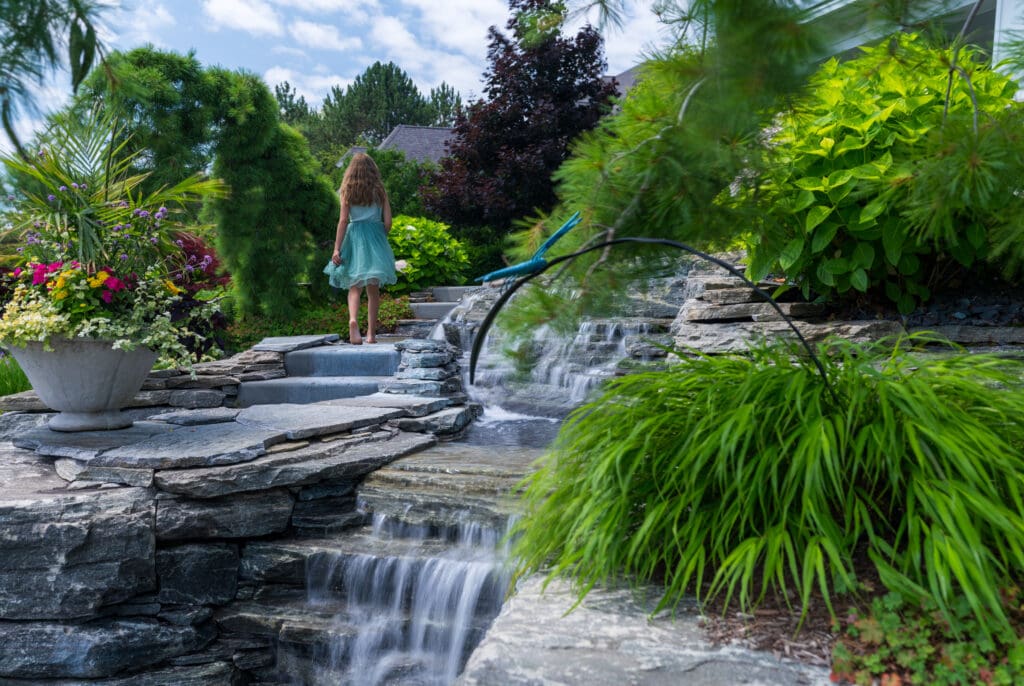
“The more that we can show it in the best way possible will help people understand when they see those before shots and after, it’s going to tell that story very, very clearly,” Major says. “If you can get the client in the shots, that’s a great opportunity to show the client interacting with the space, and then you can even tell more of that story.”
Major says another way to tell a story is to capture pictures of the property beyond just the summer months.
“I really think it’s an opportunity that’s missed by a lot of landscapers to capture those moments, and the more that we can do it consistently, that’s where you can use that in case studies to help show a prospective client, ‘Hey, this is what the site looks like in the wintertime. This is what the site looks like in spring. This is what it becomes in summer. And then this is what it does in the fall,’” Major says.
This can be particularly beneficial when approached by potential clients who want a landscape that has color throughout the seasons.
Common Mistakes
Some of the major mistakes Major sees with landscape photography are when contractors fail to clean up the property in advance or take pictures before the plants have matured.
He says when you should take pictures of a finished project mainly depends on whether you will be handling the maintenance post-installation.
“If you’re maintaining it, then likely it is something that we could wait on, let that plant material grow in at least the season,” Major says. “Two seasons are even better. Some ground cover just doesn’t really kick in until season two.”
However, if you will not be maintaining a site, it is better to capture photos of the finished job immediately afterwards than have no pictures at all.
Major says it’s also critical that the contractor communicates with the client and makes sure they have access to necessary elements, such as the house lights or the irrigation system. Let your clients know what will happen not only on the day of the shoot, but also prior to the shoot to prepare the property.
“Because it all makes a difference, but it all needs to be communicated, especially to these higher-end clients who probably want to know what’s going on on their property,” Major says.
Key Takeaways
- Your photography should align with business goals, telling a story that helps sell work, win awards, or attract new clients.
- Frame projects as a transformation story, with before-and-after photos and seasonal shots that highlight the client as the hero.
- Clean properties before shoots, capture projects at the right stage of maturity, and communicate clearly with clients about preparation and access.
