
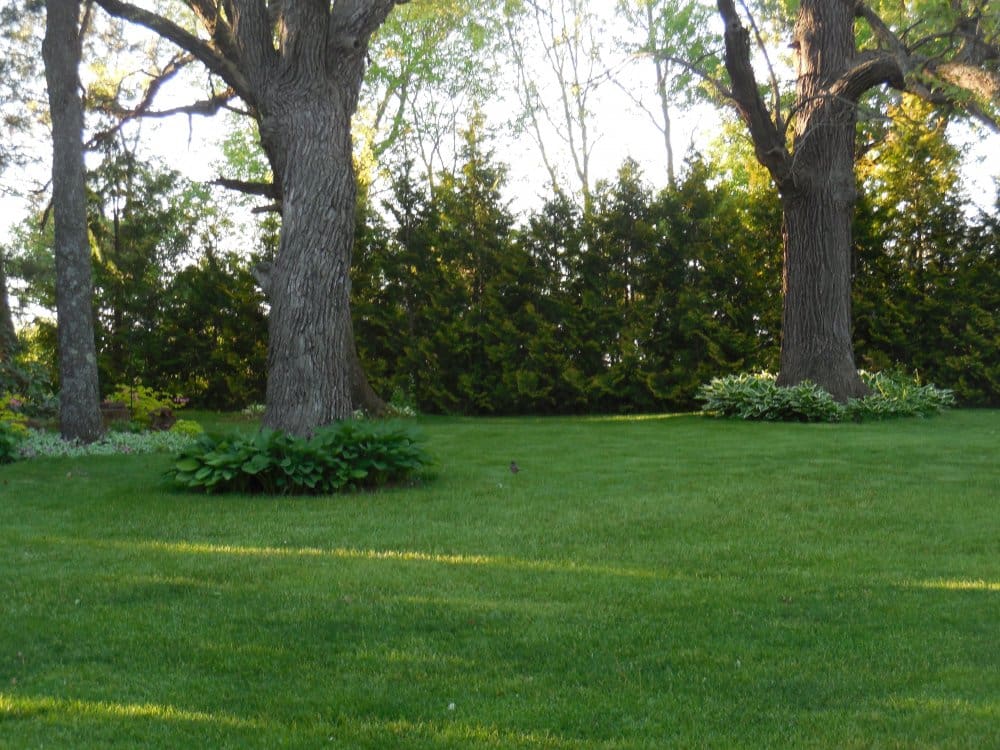
It’s the age-old question you get from customers: ‘Why won’t my grass grow beneath my tree?’
As a landscape professional, you understand that mature trees will compete aggressively with turfgrass for moisture and nutrients, which is why lawns under trees often appear thin and patchy. However, clients may not be aware of how at odds these two plant types’ needs are and assume there’s a simple solution.
While challenging, it isn’t impossible for trees and turf to coexist peacefully. When troubleshooting this dilemma for clients, follow these steps.
Assess the Site Before Promising a Solution
Because turfgrass is fighting trees for sunlight and water, review how shaded the property is and whether it has a dedicated irrigation system.
“Are the trees limbed up high?” says Tara Piergies-Baker, VP of custom clients with The Addison Group, based in Nashville, Tennessee. “If not, elevating the lower canopy is an effective way to deliver the necessary solar radiation to natural turfgrass. High-limbed trees allow filtered sunlight to penetrate, supporting a healthy fescue lawn beneath them — a solution that performs reliably time and again.”
Having an irrigation system in place can also help. Piergies-Baker explains that natural turfgrass struggles without supplemental water in Middle Tennessee, and that stress is exacerbated significantly when tree root systems compete directly for the same soil moisture.
It’s also important to take into account what species of turfgrass and trees your client wants to get along. Piergies-Baker says fescue is the best grass to consider growing under trees, and it should not be mowed below 4”.
Meanwhile, oaks, honey locusts and hackberries tend to be the best trees to grow turf under. Maples and evergreens like magnolia are not recommended. In fact, some species, like black walnut, release chemicals that inhibit the growth of other plants under it.
Understand the Client’s Goals for the Space
Discuss with the client what activities take place on the turf, as Piergies-Baker notes that even with filtered sun and proper irrigation, shade-grown fescue lacks the strength and heavy-wear tolerance of full-sun Bermuda.
“For standard backyard activities — including children playing — limbing up the canopy combined with adequate irrigation will generally establish and sustain dense, uniform fescue cover,” she says. “For high-impact scenarios involving heavy dog traffic or intense recreational use, transition the discussion toward high-grade synthetic turf to ensure long-term durability.”
Piergies-Baker says whether it’s better to encourage the turfgrass’s establishment or switch to an alternative depends on the intended use of the space and the client’s appetite for ongoing maintenance.
“If the area doesn’t need to support pedestrian foot traffic or play, transitioning from turf to an intentional ground cover is a very viable alternative,” she says. “It eliminates mowing entirely, though the client should keep in mind it will still require routine weeding while establishing and maintaining coverage.”
Creating a mulched bed around trees is one way to create a competition-free zone for tree roots, but Piergies-Baker says this is rarely a satisfying design solution. She says a vast expanse of bare mulch is boring and a missed opportunity.
Incorporating layers of shade-tolerant perennials can provide a far more dynamic space under the tree. Consider the light levels and select native plants that thrive in woodland understory settings.