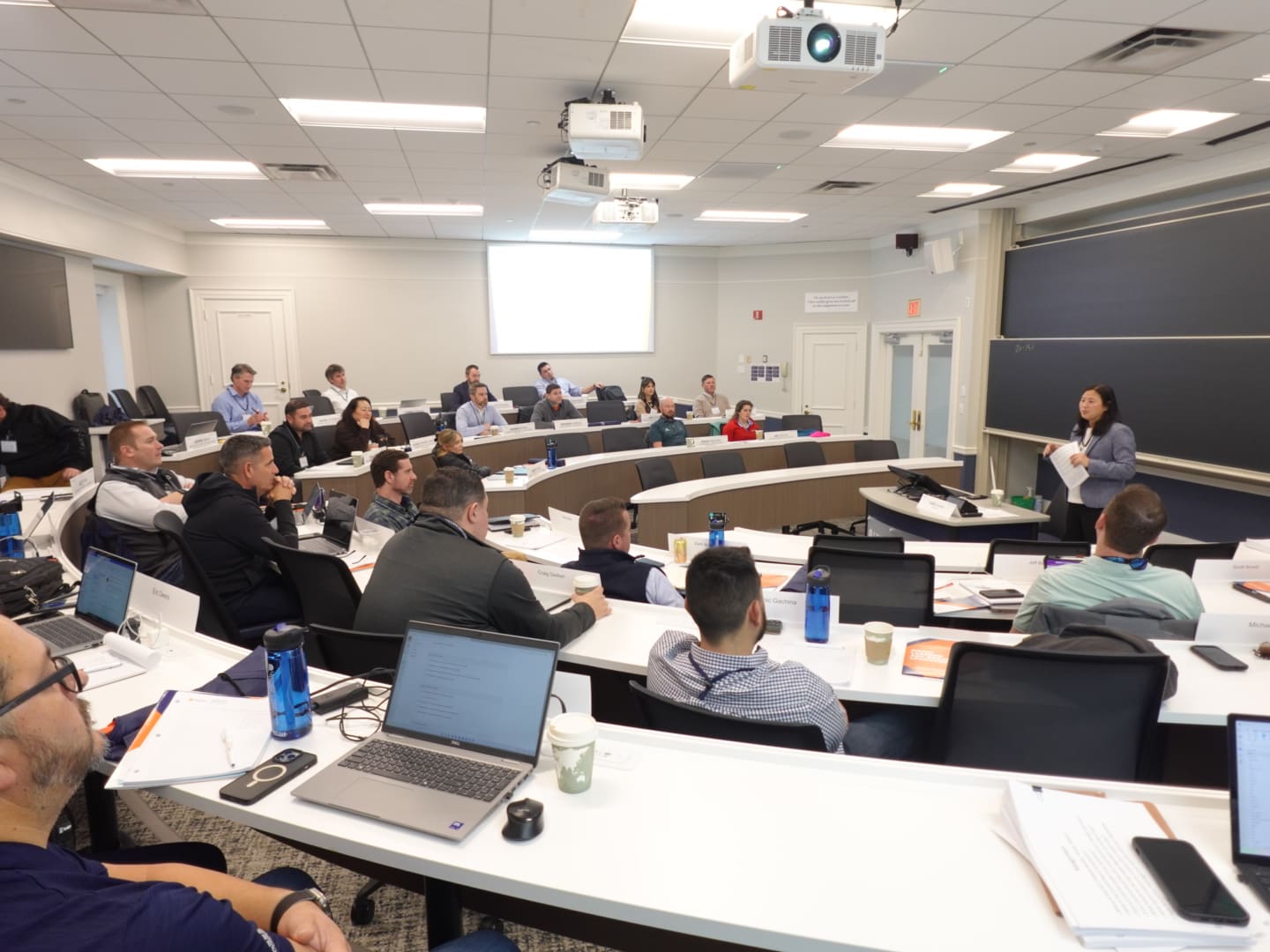
If you want to take your leaders to the next level, you have to go beyond just operational expertise.
The NALP Executive Leadership Program, in partnership with the UVA Darden School of Business, is designed to train leaders to think more strategically and addresses challenges such as developing and retaining high-performing teams, improving financial performance and navigating business decisions.
The program, held on Jan. 11-14, 2027, consists of three days with fewer than 25 other owners, presidents and senior leaders from landscape companies across the country, where participants will network and work through real business cases led by Darden professors.
“Leadership development is one of the most important investments a company can make,” says Kim McCrossen, director of education for NALP. “As a business grows, success depends on leaders who can think strategically, make better business decisions, develop people and navigate change. Companies benefit by building stronger leaders from within, preparing future executives to take on greater responsibility. The program helps transform strong operators into strategic leaders who can contribute to the long-term success of the business.”
Drew Wilson, regional vice president of Ryan Lawn and Tree, based in Merriam, Kansas, who participated in the 2026 cohort, adds that investing in leadership is far more cost-effective than purchasing equipment that only loses value over time.
“While many of us eagerly justify acquiring new tools by calculating their ROI, we frequently overlook or underestimate the significant returns that developing leaders can deliver to a business,” Wilson says.
McCrossen notes that each year NALP surveys past attendees to fine-tune the program.
“We are dedicated to listening to those who attend and taking their feedback seriously to build the best program possible,” McCrossen says.
Learn Applicable Takeaways
Peter Kehoe, VP of sales and operations with LaurelRock, based in Wilton, Connecticut, says going back to school was refreshing and taking real-world business challenges and applying them in an academic setting was both enjoyable and valuable.
“My biggest takeaway, however, was learning to approach business problems from a completely different perspective,” Kehoe says. “The program challenged conventional thinking and encouraged us to think outside the box. I left with several practical exercises and strategies that I’ve since brought back to my own organization.”
Kehoe says one of the most valuable exercises during the program was the planning process before entering sales negotiation.
“Whether it’s a large contract or a smaller opportunity, taking the time to prepare, anticipate different scenarios, and clearly define your negotiation boundaries gives you much greater confidence,” Kehoe says. “It also helps you identify your trigger points, knowing what terms you’re willing to accept and when it’s better to walk away.”
Wilson says when he began preparing his post-event presentation on the event to his peers, the true value of the course became apparent.
“I discovered a logical progression: an organizational design model serves as the foundation, filtering down into team management strategies, which are further reinforced by insights into employee motivation,” Wilson says. “Viewing these lessons holistically creates a powerful synergy, turning a conceptual framework into a practical mindset for daily application.”
Kehoe says the greatest benefit of the program is the peer networking, as the other participants are facing similar challenges.
“Leadership can often feel isolating, and it’s not always easy to find people who truly understand the decisions you’re responsible for making,” Kehoe says. “Spending a week with other high-level leaders creates meaningful conversations, fresh ideas, and a professional network that continues long after the program ends. Those relationships alone are worth the investment.”
Who Should Attend?
When deciding who is best suited for this leadership development opportunity, consider those with strong leadership potential and individuals who are responsible for influencing business outcomes beyond their immediate area of expertise.
“A helpful question for owners to ask is: ‘Could this person have a significant impact on the future direction and success of our company over the next three to five years?’” McCrossen says. “If the answer is yes, the Executive Leadership Program can help accelerate their development.”
Wilson says strong candidates are those who have a genuine eagerness to learn and the capacity to adopt new perspectives. Those with strong networking abilities will be able to maximize opportunities throughout the program.
Wilson adds that if you are a larger organization with established leadership and development programs, the NALP Executive Leadership Program is ideal for mid-level leaders preparing for senior or executive roles. Meanwhile, for smaller owner-operator companies, even senior leadership can find value in the program.
“I believe the ideal candidates are vice presidents of operations, vice presidents of sales, general managers, branch managers, CEOs, and business owners,” Kehoe says. “The program is best suited for leaders who already have a solid foundation in running a business but are looking to challenge their thinking, expand their perspective, and become more strategic decision-makers.”
You also don’t have to limit yourself to sending only one team member to the event per year. While this is an option to make a focused investment in a high-potential leader, sending multiple employees can create greater operational impact when multiple leaders leave with the same shared language and approach to managing people.
“Attending last year’s event with a colleague proved incredibly valuable, as we have since delivered two different presentations within RYAN based on the insights gained at Darden,” Wilson says. “The ability to collaborate and compare notes was essential; we often caught details the other missed or provided unique perspectives that enriched our shared understanding.”
Getting the Most Out of the Experience
To ensure you reap the full benefits of attending the Executive Leadership Program, Kehoe recommends attending with an open mind and asking the question, ‘How can I improve my business?’ rather than assuming your company is so unique that the lessons won’t apply.
Wilson adds that teaching what you’ve learned to others once you return is the key to mastery.
“Once you share that knowledge with others, everything truly clicks, and you will notice those concepts beginning to shape your everyday perspective,” Wilson says.
Kehoe agrees the program fundamentally shifts the way you think about the business.
“This program isn’t another 5,000 feet higher; it’s like going into orbit,” Kehoe says. “From that perspective, you don’t just see your business differently; you begin to see the forces shaping your industry, your customers, your competitors, and even your own assumptions. Once you’ve seen your business from that perspective, it’s difficult to think the same way again.”
Don’t miss out! Spots for the Executive Leadership Program are limited and fill up fast. Register today for next year’s event held on Jan. 11-14, 2027.