


Guest Post by Knowledge Tree Consulting
Picture the owner of a growing landscape company. At 6 a.m., he is loading the trailer. By 9, he is quoting a job; by noon, he is chasing an unpaid invoice; by mid-afternoon, he is smoothing over a crew dispute; and by evening, he is at the kitchen table doing payroll. He is the hardest worker in the company. He is also the single biggest reason it has stopped growing.
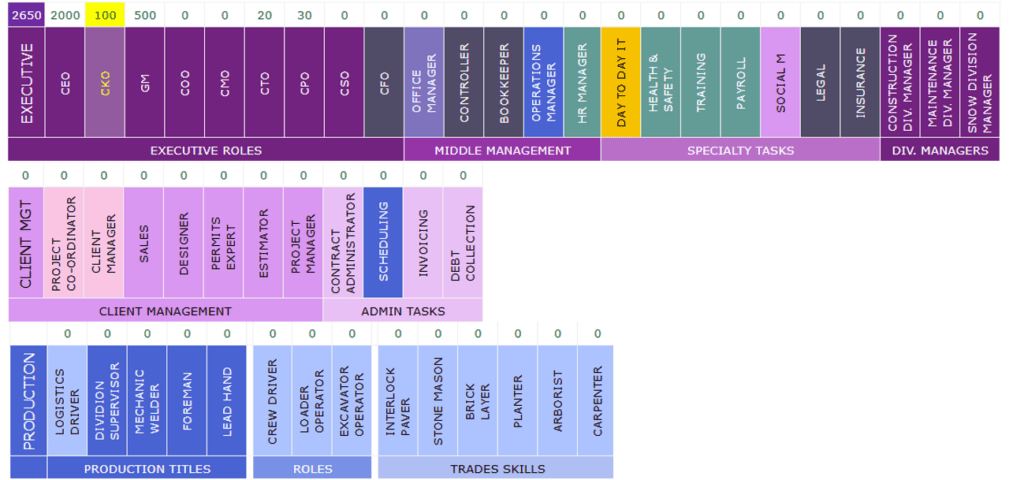
Most small business owners wear 18 to 24 different hats. That is not a motivational statistic. It is the biggest single obstacle to growth we see across the industry. You cannot scale a business that lives inside one person’s calendar. At some point, the only way forward is to start taking hats off — deliberately, in the right order, and handing each one to someone who will eventually wear it better than you did.
Delegate Roles, Not Tasks
The instinct, when you are drowning, is to hand off tasks. Do not. Delegating tasks is a trap: the moment you do it, you have to manage the tasks instead of the people, and the second you run out of work to hand out, your staff go idle and dependent on you to keep them busy. You have simply added a supervising job to the pile.
The goal is to farm out entire roles and have people report to you on outcomes, not activities. Give someone the whole job, a clear standard, and a regular meeting with an agenda where they answer for it. That is the difference between a business that runs and a business you carry. The best CEO is really a Chief Empowerment Officer.
The Order the Smart Ones Follow
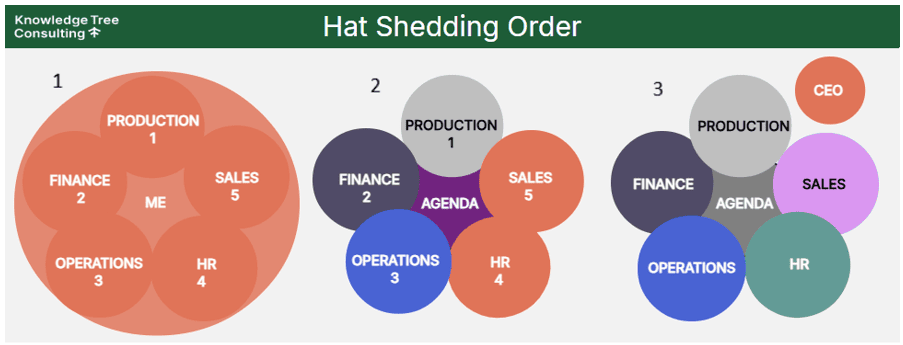
There is a natural sequence to taking hats off. It flexes with the owner’s own talent and the shape of the business, but the pattern holds:
- Production goes first — once you have a competent crew leader who can replace you in the field.
- Finance can be handed off next, often outsourced before you can justify a full-time hire.
- Operations is the most disruptive role in the business, so shedding it well is non-negotiable if you want to manage growth instead of being managed by it.
- Sales is the one owners let go of too early. Quality revenue is the lifeblood of the company — keep your hand on this hat longer than feels comfortable.
One caution from experience: do not combine operations and finance in a single person. Operations lives in constant interruption; finance needs uninterrupted focus. Bolting them together sets a good employee up to fail at both.
The strongest early teams are usually two people with offsetting talents — a compliance/finance/HR type paired with a sales/production/operations type. In this industry that pairing shows up again and again as a husband-and-wife team, a sibling duo, or an office administrator with sharp executive instincts running the back office while the owner runs the field.
The Mistakes That Sink Delegation
Handing off a hat is not the same as it being caught. Three failures show up over and over:
1. Tolerating a culture of poor communication
- Slow response times, or no response at all.
- No willingness to commit to a timeline when asked for one.
- Not using email to keep clients, staff, and management in the loop.
2. Roles that are unclear, undefined, or overlapping
- People “helping out” instead of staying in their lane.
- Decisions that stall because nobody is sure who owns them.
- A quiet erosion of accountability.
3. Weak or non-existent meeting structure
- Without a set agenda, work becomes a stream of interruptions.
- And the team loses the one forum where it learns from itself.
As Ray Dalio put it: if you are worrying about something, or someone else is worrying about it, then it is being handled. The manager’s real job is simply to make sure the ball never gets dropped.
The Hats You Never Take Off
A handful of responsibilities stay on the owner’s head no matter how large the company grows: culture changes, growth strategy, strategic partnerships, key personnel decisions, and major capital expenditures. The logic is simple. Each of these can pose an existential threat if it is handled badly. Financial ruin and reputational damage are not risks you delegate.
Before You Take the Next Hat Off
Shedding a hat too soon is as costly as clinging to it too long. Run through this checklist first. If you cannot tick most of these, you are not ready yet.
- Cash flow and finance are under control.
- HR is stable.
- Operations are running smoothly.
- You have the time and the genuine willingness to train your replacement.
- Recruiting can actually bring in the talent you need.
- You are prepared to trade money for less time and less grief.
- The person you promote will end up better at the role than you are.
Talent and desire must align. A hat only stays off if the person you hand it to actually wants to wear it.
Your Job Changes Shape
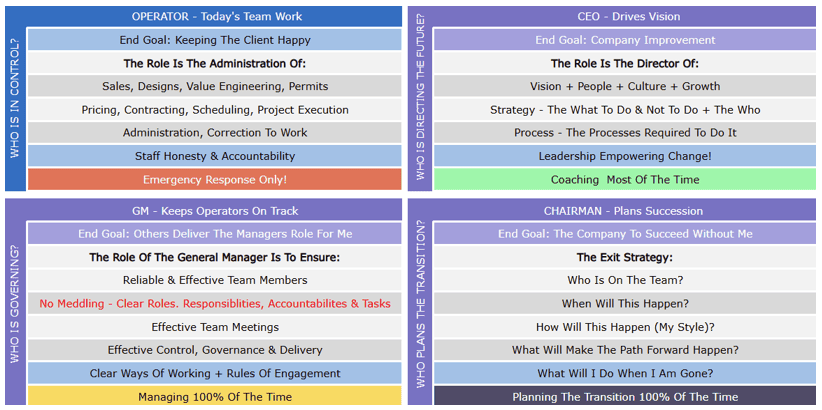
As the operational hats come off, the owner’s role does not shrink — it transforms. You move from an operator keeping today’s clients happy to a general manager keeping the team on track to the CEO driving vision, people, culture, and growth, and eventually toward a chairman whose job is to make the company succeed without you in it.
That progression runs on leadership itself: learning different leadership styles, understanding the people you lead, thinking strategically and tactically, and investing in knowledge instead of trying to figure everything out alone. The owners who accept coaching on this move faster — the ones who insist on self-teaching every lesson pay for it in lost years. It is a mindset, and it is the thing that separates a company that plateaus from one that keeps climbing.
If You Are Juggling Too Many Hats Right Now
The advice is short, and it is hard:
- Decide honestly how much you are willing to work. For most owners the real number is 60 to 80-plus hours, and that is not a plan — it is a countdown.
- Learn to time-block your key roles so the CEO work never gets crowded out by the operator work.
- Pay for the talent you are missing. The right hire is a trade of money for time and peace of mind, and it is almost always worth it.
Every landscape company eventually meets the ceiling of its owner’s capacity. Some owners hit it and stall there for a decade, still the best laborer on the crew. Others take the hats off, in order, and watch the business grow past them. The difference is rarely talent or market. It is the willingness to be coachable, to let go, and to build the meeting rhythms and role clarity that let the ball keep moving without you touching it.
The order in which hats come off varies by owner. The barriers — loving the work, fearing mistakes, refusing to let go — are the same in every business. Great leaders learn to beat them.
Knowledge Tree Consulting helps landscape business owners get out of the field and into the CEO seat — building the role clarity, meeting structure, and leadership habits that let a company outgrow its founder’s calendar.