
Landscape companies that integrate robotic mowers into their operations can experience true productivity gains, but success with this technology depends greatly on how it is implemented.
While robotic mowers come with a learning curve, investing the time and effort into making them work for your operations now can help pay off in the long run.
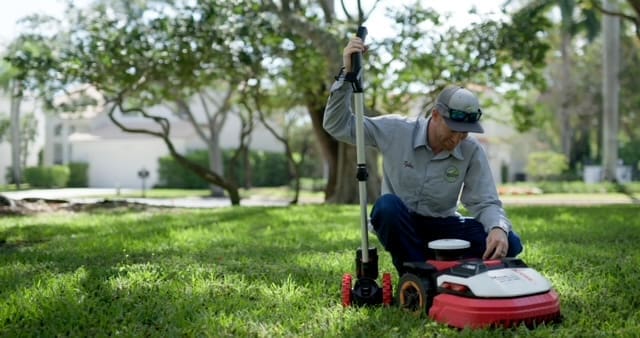
“It’s not a matter of if, it’s a matter of when,” says Tyler Reiter, owner and director of operations for Florida Image Landscaping, Inc., based in Palm Springs, Florida. “Over in Europe, one in every four homes has a robotic mower, and we’re just now getting on board with this. This is happening. I think if companies don’t start doing this now and adopting this, they’re going to be left behind, and I don’t mean that as a scare tactic.”
Colby Kirwan, owner of Kirwan Design and Landscaping, LLC, based in Wagner, South Dakota, agrees he’s seen a growing desire from customers, particularly younger generations, who want minimal effort with maximum results.
“Let’s be honest, in this day and age, kids are doing 17 sports and six days a week all summer long,” Kirwan says. “When are you going to mow your lawn? That’s the last thing you want to do at eight o’clock at night on a Friday when you finally get off work. What if it was just done for you? They still want that nice lawn, they still want that irrigation, and they still want the nice landscape and everything else, but they sure as heck don’t want to maintain it.”
Rethinking Crew Roles
One major element to making the most of robotic mowers is reallocating your labor force in a meaningful way.
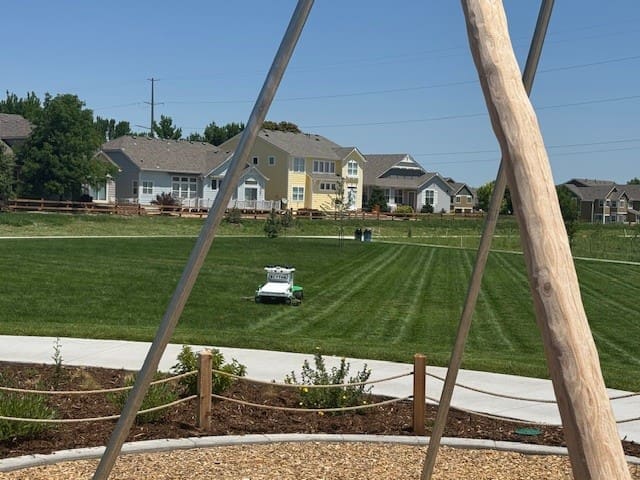
Timber Toste, owner of Mow Bot Ltd, based in Longmont, Colorado, says their goal is to run a two-person crew with two Scythe robots and complete between 20 and 25 acres per day.
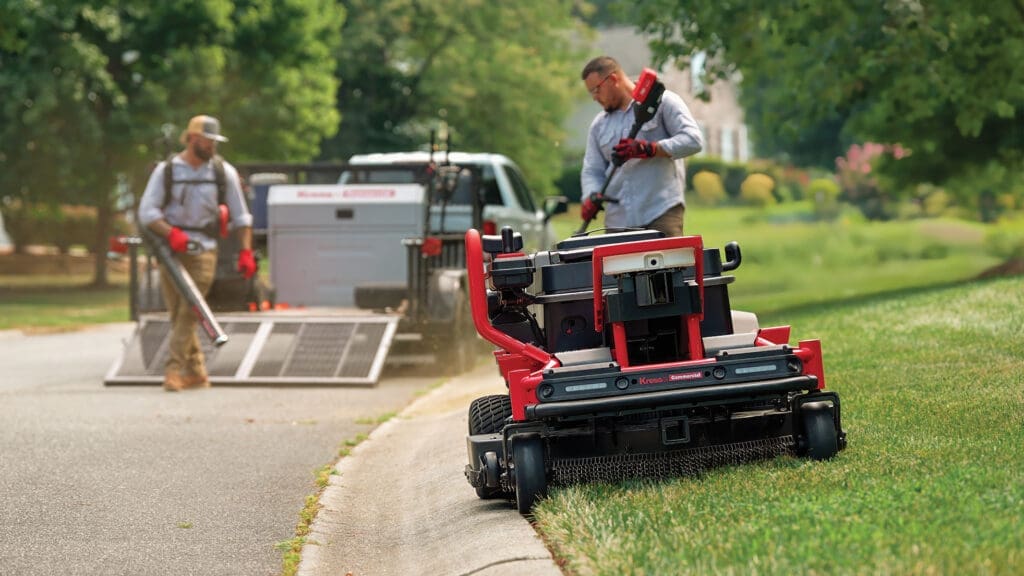
“Depending on the area, the two robots might be running in fully autonomous mode while the technicians focus on weeding, trimming, plant health, or other general maintenance tasks,” Toste says. “In other areas, both technicians might be doing manual mowing. This is one of the other reasons why we chose the M.52, it is both an autonomous mower and a stand-on electric mower, no need for different mowers.”
Toste says when the mower is in autonomous mode, they have a technician onsite monitoring it and can shut it down if needed.
Reiter says they haven’t scaled down the size of their crews, but now employees can take their time with tasks such as hand pruning and cleaning the lenses of the landscape lighting on the property.
It’s important to educate your crews on how these machines aren’t stealing jobs but allowing them to work on more significant tasks.
“It’s making your maintenance personnel more efficient because they can use their intelligence and their time doing something that’s more important than sitting on a lawn mower,” Kirwan says. “It’s not a replacement for people; it’s a benefit to help maximize people’s time and make them more efficient. Maintaining an Automower is a lot less time demanding than mowing a three-acre football field.”
Kirwan says instead of going every week to a property, they’re sending a smaller crew every other week to maintain their robotic mowers and handle the edging.
Reiter says they have had to re-onboard and retrain team members, both old and new, to look for opportunities for detail work on properties.
“It’s almost like a horse with blinders,” Reiter says. “They’re so focused on one direction, and just opening up their blinders and saying, ‘Hey, look, there are more things than just looking straight down.’”
Where Robotic Mowers Work
Another key to efficiency with robotic mowers is understanding which properties they are best suited for. Your customer base, region and mower brand you go with will determine some of the limitations to consider.
Toste says not all spaces can or will be mowed by robotic mowers. The most efficient spaces for their Scythe mowers include large acreage mowing, areas without a lot of obstacles, sports fields, large open parks, and dryland/native mowing. Meanwhile, spaces with dense tree canopies or other obstacles tend to not be efficient as the mowers have to make too many adjustments.
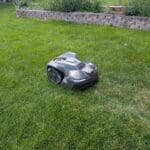
Kirwan says the only property they’ve had an issue with is one with a large maple tree that the Automower could not navigate around, but it has been able to handle all other terrains. He says they’ve had particular success selling large models to homeowners who have two to three acres.
Reiter says the two main spaces where they currently don’t make sense are mowing alongside highways and interstates due to the debris, and areas with dense tree cover, as it currently has to rely on vision technology to navigate these types of locations.
“As the technology progresses and as companies like Kress get better with their technology, we will no longer have those issues,” Reiter says. “Pretty soon, especially with Lidar and tree mapping and things like that, you’re not going to need to worry about that. It’s just going to see underneath it.”
Reiter says 80% of his properties will be mowed robotically by the end of this year.
“I have robots crossing roads in HOAs, I have robots crossing bridges and intricate pathways,” Reiter says. “You’d be surprised what I do with these things to get them to cut grass.”
When selecting the right mower model for the property, Reiter recommends sizing up rather than pushing a mower to its maximum rated acreage.
“It may seem like a little bit of a more of a financial burden in the beginning, but you save so much more, and you have that peace of mind of ‘I know the mower is going to complete this mowing and not have to worry about the mower keeping up with cutting the grass,’” Reiter says.
Where Implementation Gets Complicated
Even once you’ve identified where your robotic mowers are well-suited, it’s not quite plug-and-play. Reiter and Toste stress the importance of mapping your autonomous mowers.
“There is an art to mowing a large property efficiently,” Toste says. “The technician onsite must map each property to develop a plan for what gets mowed autonomously and what gets mowed manually. We seem to map properties several times before we get a good workflow.”
With stationary mowers that stay on the property, Reiter says you have to consider charging station locations. He’s found in some cases, having two charging stations on a proper helps increase their productivity.
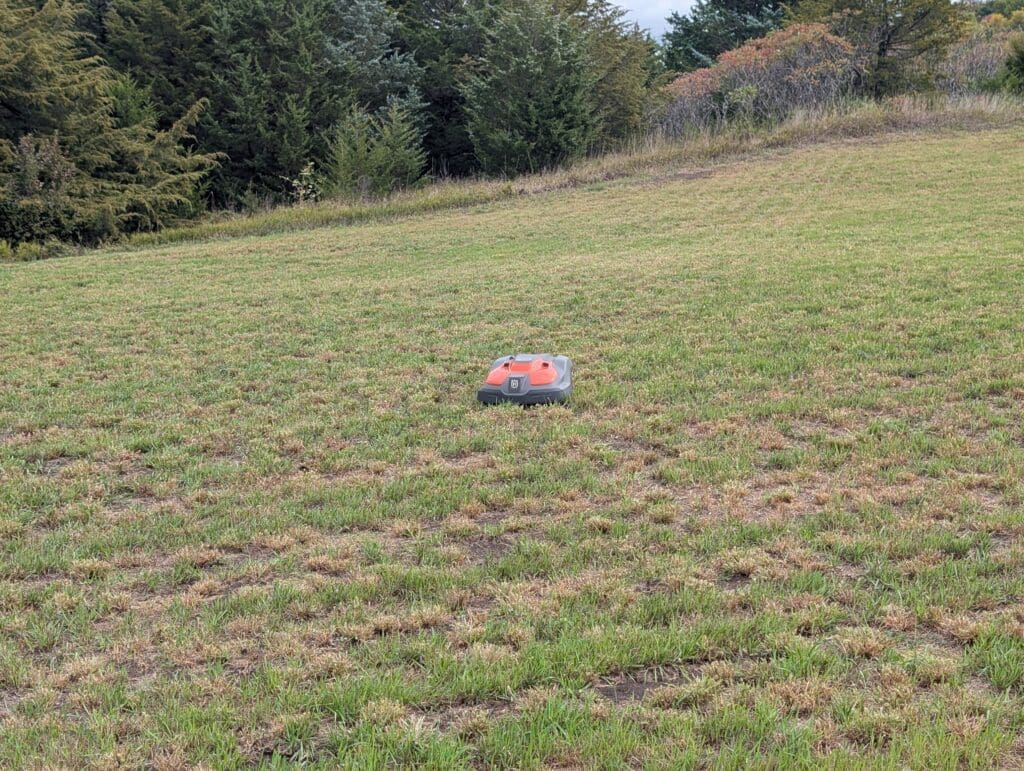
For robotic mowers that are transported from site to site, you have to consider the power management needs. Toste says they currently charge their two M.52 mowers at night to full capacity using a 240V connection at the shop.
“As the fleet expands, so does the power needs at the shop, and not every shop has the electrical capacity to expand,” Toste says. “We are also running the new electric GMC truck to understand how we can use some of the battery storage in the truck to expand our changing capabilities.”
For commercial properties in particular, you may also encounter issues with public curiosity impacting the machines’ ability to work.
“People are fascinated by them,” Toste says. “While it’s great for marketing, it means we sometimes have to deal with pedestrians stopping to watch, touch, or test the safety sensors of the machines while they are trying to work.”
Kirwan says the biggest challenge he’s faced with robotic mowers is the demand on his time, as he doesn’t have a manager who can take ownership of this service line currently. Reiter adds that when app updates are rolled out, crews do have to take the time to understand the new layout and changes.
“Sometimes when they change the logic from a firmware update, you just have to understand and read it,” Reiter says. “You have to read the error message. You can’t just scroll through it and you have to take the time.”
Advice for Others
If you’re wondering if robotic mowers are viable for your operations, do your research to see if there is demand in your market and explore what brands are available in your market.
Reiter stresses the importance of finding a brand that can provide quality and consistency. He says that while each brand will have glitches you’ll need to navigate, the technology will only continue to get better.
“Do the math,” Toste says. “If the current options on the market for robots do not work for your area, wait a few years and the price on the robots will come down. If the math works, start slow, develop the in-house talent that understands how to efficiently deploy the units.”
Reiter recommends starting small and building your confidence in the machines.
“Put it on your property,” Reiter says. “Play with the mower. Watch how it works, watch how it fails, and then do a slow deployment. Do five houses here. Do three houses there. Do it at one HOA common area. Slowly get that deployment out there and get your feet wet. Don’t just rip the Band-Aid off and say, ‘I’m all in,’ because I feel like I did that and I ate it really hard and went through so many unnecessary bumps I didn’t have to do.”
Key Takeaways
- Successful implementation requires operational changes — not just new equipment. Contractors must rethink workflows, retrain crews and develop systems for mapping, monitoring and maintaining robotic mowers.
- Not every property is a good fit for robotic mowing. Large open areas tend to perform best, while dense tree canopies, obstacle-heavy spaces and debris-prone roadside environments can limit efficiency.
- The best approach is to start small and scale gradually. Contractors recommend piloting robotic mowers on a few properties first, learning the technology thoroughly and building internal expertise before expanding deployment.