


Brandon Moore, managing partner of Schendel Lawn & Landscape, based in Topeka, Kansas, doesn’t have an ideal company size set for his company, as he never wants to limit where they can go. However, he does say that in seven years, they want to reach $27 million in annual revenue.
Moore originally had no expectation of working in the landscape industry after graduating from college. While he’d operated his mowing business since he was 14, he majored in economics and biology, and entered the corporate world after graduating.
Yet when things in the corporate world weren’t panning out quite as he wanted, Moore and his business partner, Aaron Jones, had the opportunity in 2002 to acquire a landscaping business to bolt onto their mowing operation.
“My dad was willing to put up a house that he built about a year and a half earlier for collateral for me and my business partner,” Moore says. “I don’t want to say it put the pressure on, but it certainly was an incentive to go out there and work and grow a business.”
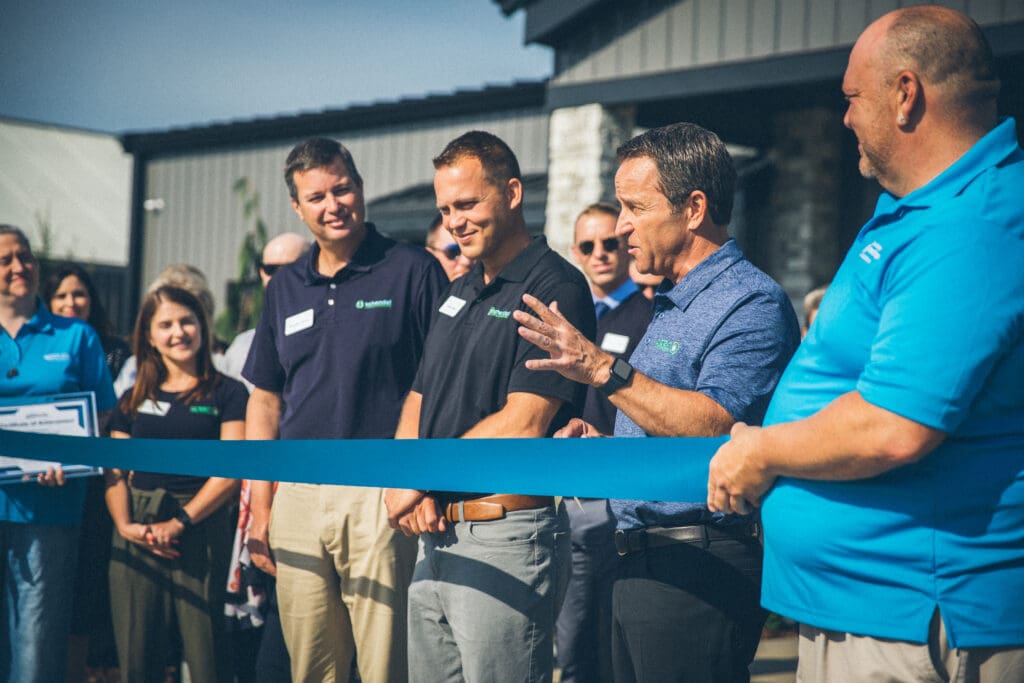
Moore says while he wants to see the company grow and be profitable every year, his definition of success is when he sees individuals advance within the business.
“I want to make sure that we’re growing each year, and not necessarily to pad my pockets, but to create opportunities for everybody who has worked with us is what gets me to the office every day,” Moore says. “It’s not profit; it’s when I see somebody who hired on with us five years ago in an entry-level position on a mowing crew or on a landscape maintenance crew and that person has worked his way up to be a production manager and then maybe a branch manager.”
Service Offerings and Growth Trajectory
The company offers everything from mowing, irrigation, and weed control to landscape design and installation. Schendel has a customer base that is 50% residential and 50% commercial.
“The best customers we have are the ones that will let us come in and just manage their property,” Moore says. “We’re doing irrigation, we’re doing their fertilization and weed control, their landscape maintenance, mowing and just everything so when our guys go out on property, they know that if they see something wrong that it’s our responsibility.”
Moore says their most popular services revolve around their fertilization, weed control, and lawn maintenance. He says they’ve made a point to educate clients that their weed control services are more of a partnership.
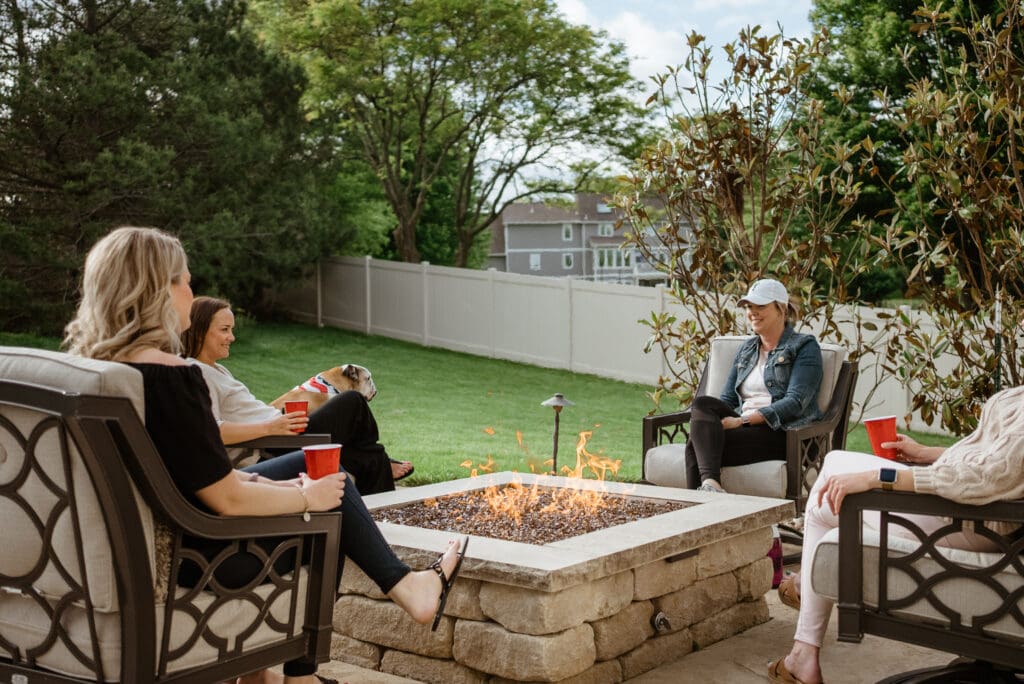
“We can come out, and we can apply the products and do all the right things, but if you’re not watering your yard, if there are bare spots in the yard that you’re not attending to, then without a good partnership, the ultimate goal of having a really lush and nice lawn isn’t attainable.”
Schendel also offers financing for landscape projects. Moore says while not a ton of customers take advantage of this tool, it helps middle-income households with mid-range projects.
“A lot of times, what it does achieve is it allows them to do a few extra things that they might have gotten cut because of their budget,” Moore says. “It has expanded those $15 to $25,000 projects into $25 or $30,000 projects.”
Schendel also acquired their sister company, Green Pest Solutions, five years ago, which offers both indoor and outdoor pest management and has grown it from there.
“I know there are a lot of companies out there that do lawn care, companies that do pest control, but from what I’ve seen, it’s mostly they’ll spread granules around the outside of the house,” Moore says. “They’ll treat the outside of the house. Well, our pest control is full-service. We go inside. We inspect, and we do everything that needs to be done to make sure that their properties are free of pests, inside and out.”
Around 20-30% of their customers utilize both Schendel’s and Green Pest Solutions’ services.
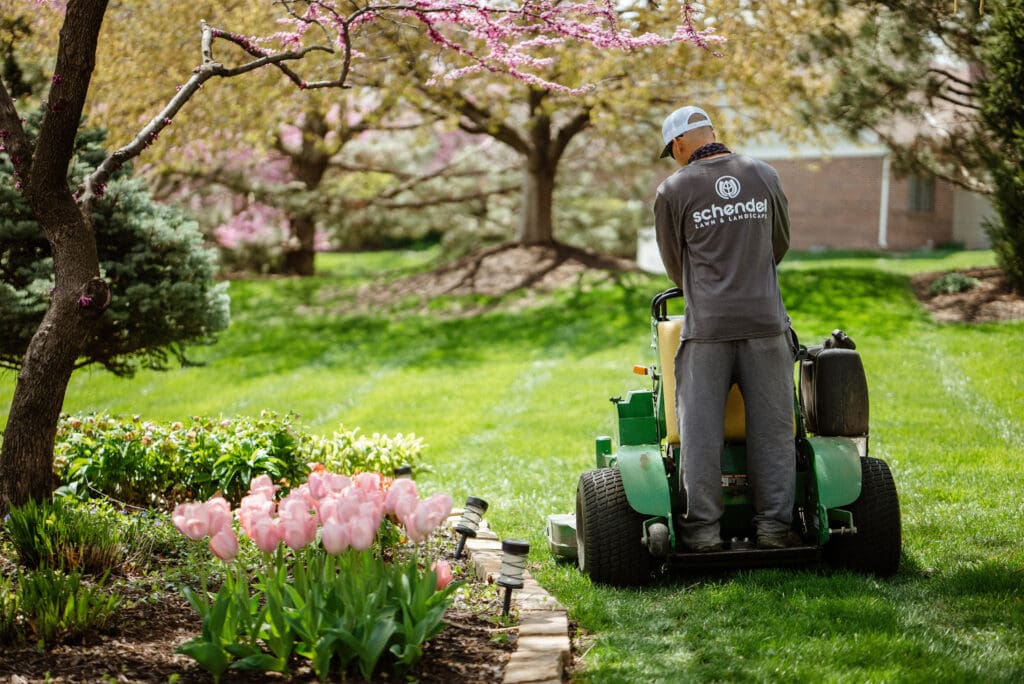
Moore says if he were starting over from scratch, he’d prioritize recurring work more.
“The landscape installations are wonderful,” Moore says. “They’re stuff that makes your website look nice and pretty and all that stuff. But at the end of the day, you have to go out and resell that work, and it takes a lot of resources to do that. So we really like that recurring revenue.”
Moore says in the past, they used to do a lot of RFP work, but have moved away from that.
Schendel’s current annual revenue is $14 million, with $10.5 million on the lawn and landscape side and $3.5 million on the pest side. Moore says in seven years they want to hit $17 million in revenue in lawn and landscape work and $10 million in pest control.
Moore says they are considering adding a third location in Kansas City, where they currently operate only on the pest control side.
Keys to Success
Moore says retention is one of the ways they have been successful, as they work to retain both quality employees and customers. Schendel’s currently has a client retention rate of 88.8% and their goal is 90+%.
“We know that if we have a hole in our revenue bucket that it’s a lot harder to fill that up,” Moore says. “We focus on following through on our promises. 90% of the problems we face come from a lack of communication or just poor communication.”
He notes it was a game-changer once they could hire people whose sole responsibility is to go sell and take care of their customers. Moore says they are always striving to ensure their product is as good as it can be.

Moore says having a long-term presence in their local communities has also benefited the company.
As an NALP member, Moore says he’s learned the most from networking at industry events like ELEVATE and Leaders Forum. He says they’ve also taken advantage of the Trailblazer program, meeting with Maurice Dowell of Dowco Enterprises, Inc. and Jerry Schill of Schill Grounds Management.
“It was 10 years ago that we went and talked with Maurice and Jerry, and we can still send them an email, even though, especially in Jerry’s case, his company’s gotten huge, he’ll still return our emails,” Moore says. “It’s just fantastic people within the industry.”
Recruiting and Retention
In the peak season, Schendel employs around 150 people. They also utilize the H-2B program, which makes up 15% of their seasonal workforce.
Moore says they strive to hire individuals who believe in their mission, values and show up to work every day to take care of their customers. They recruit via advertising jobs on websites, posting on Facebook, attending career fairs and offering a referral bonus.
“If any of our existing coworkers refer somebody, they get a $500 bonus,” Moore says. “If it’s somebody in a supervisor position, we up that to $1,000. And then just networking and asking there are a lot of times where clients of ours have a kid or a niece or nephew who is looking for a job that will come to us.”

Schendel has numerous employees who have been with the company for at least 15 years. Moore says they are able to retain their staff by compensating them fairly, treating them well and providing a viable career ladder.
“We try and be flexible with their schedules,” Moore says. “If there’s somebody who needs to get off to take a child to a doctor’s appointment or whatnot, we can be flexible there. That’s one of the things that we are lucky enough to do in our industry. But as much as anything, it’s when somebody hires on, giving them a clear-cut career path that they know that ‘Hey, if I’m starting off in this position, this is what I need to do to move up to the next position, to get better pay, get better benefits, get a better working situation.’”
He notes that as they’ve grown, they’ve had to adjust their processes and procedures.
“When we were smaller, it was really easy to communicate within departments, and you might even have a manager who was managing multiple departments,” Moore says. “He would see a problem out there, and that was right within his world to fix as he’s there, whereas now as we’ve grown, we’ve segmented a little bit more, and we’re having to fight how to communicate better within the company.”
Moore says they’ve become very intentional about preserving their company culture and have formed a coworker council of 10-12 people across the company who can communicate with the leadership team what they’re hearing in their department.
Key Takeaways
- Schendel Lawn and Landscape prioritizes recurring services like lawn care, fertilization, and pest control to reduce reliance on constantly reselling one-off projects.
- With an 88.8% client retention rate and many employees with 15+ years of tenure, the company focuses heavily on communication, follow-through, and culture.
- Industry networking through NALP events and programs has played a key role in shaping Schendel’s leadership mindset, operational improvements, and long-term vision.