
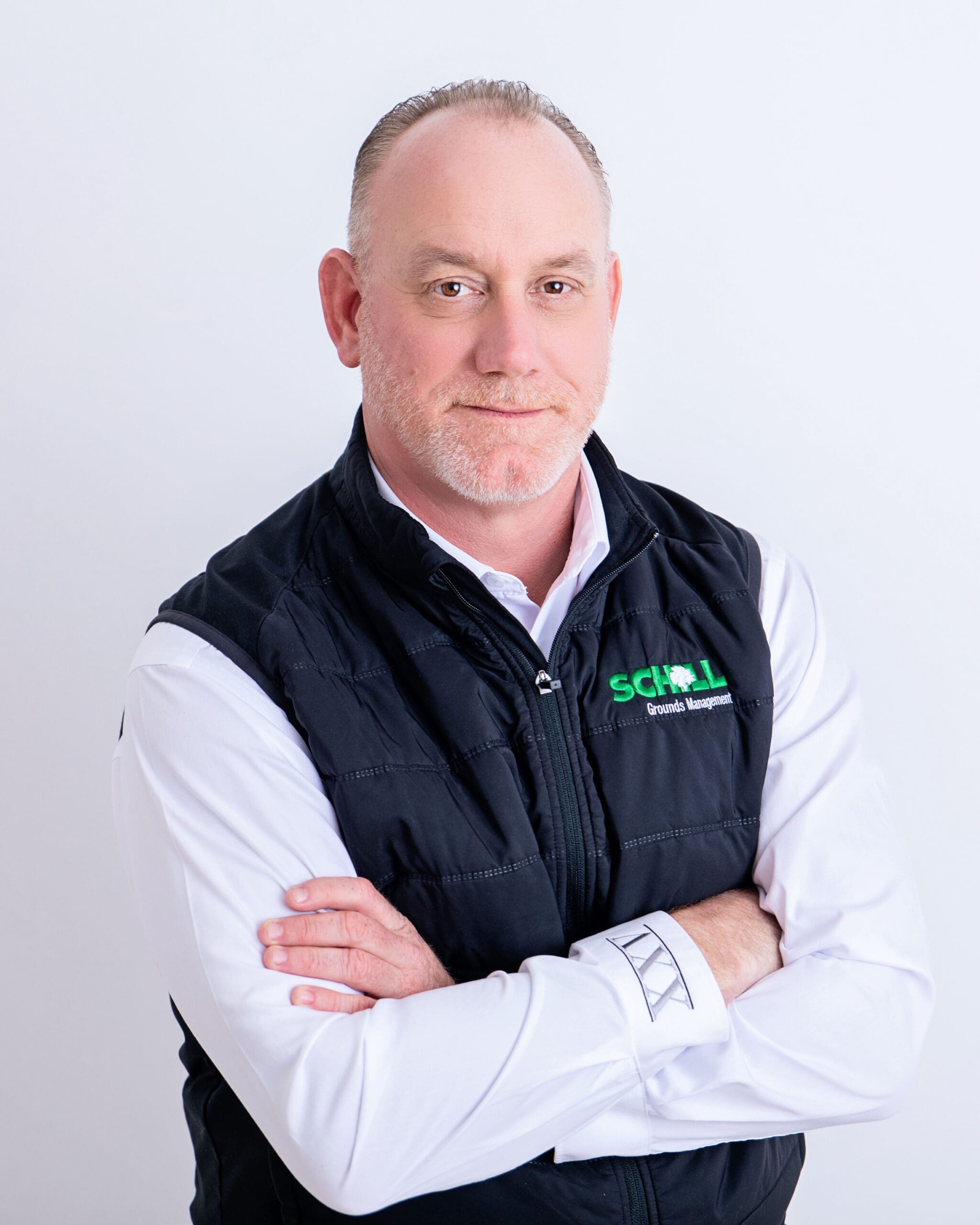
Jerry Schill is the president and CEO of Schill Grounds Management, based in Westlake, Ohio. Schill started the company with his brother, Joe, in 1993. They developed a reputation for high-end design/build landscape construction and maintenance services.
In the 2010s, the company shifted its focus to commercial landscape maintenance. Then in 2020, Schill Grounds Management began to grow beyond the state of Ohio through acquisitions. After completing more than 16 acquisitions, the company is one of the nation’s largest commercial landscaping companies and operates across eight states and in Canada.
What was it like working with your brothers early on in the business?
Truthfully, I couldn’t imagine starting the business without them. Obviously, there’s a significant amount of trust, and there’s the support, the ability to bounce ideas off one another. One of us was more operationally focused, and that was me. My brother, Joe, was more sales-focused. I think it was a really good, complementary relationship that allowed us to really focus, even from an early stage, on the business, not necessarily always working in the business.
How did you navigate splitting the company from your brother Joe?
I guess from an outsider’s perspective, it could be viewed as splitting. As the business continued to evolve over 16-17 years, so did he and I. We introduced commercial maintenance to the organization in late 2011, and my passion had shifted to the maintenance side of the business, and his remained on the design/build side of the business. Truthfully, the two separate passions within the business created some inherent challenges, like where do you focus your time and energy? How do you split and divide resources?
It made sense for us, although for a period of time, it was a little bit difficult to think about, having been in business for 17 or 18 years together, to essentially go in different directions to follow our passions. At the end of the day, it’s just part of the natural evolution for us. What it allowed us to do was get laser-focused on what we love to do, and I think that’s the key takeaway here. If you’re in a partnership or relationship where you have, conflicting passions or conflicting values, it becomes extremely difficult to be successful. As a result of he and I splitting up and parting ways and deciding to go in separate directions, both businesses have thrived.
How do you define success today compared to when you first started the company?
Just like anything, there’s an evolution. For me, that evolution when you start asking define success today, I heard this concept around ‘me, we and them.’ Early on, when my brothers and I started, it was really about us; we needed to survive. You’re in that survival mode. You’re building the foundation. You’re really trying to grow the business. Then it moves into this ‘we’ stage, where you start making some key hires. You’re really starting to really focus on building, not just a landscaping company, but you become entrepreneurs, and you’re really trying to build the best business that you possibly can. In order to do that, you have to surround yourself with good people. I think where I’m at today, part of this is just a byproduct of being older, I’m 55 today, but it’s about them. As I think about my career, and I look back at the journey and realize really how fortunate we were to get to where we are today, I don’t take that for granted, and I’m still truly humbled by the success that we have ahead.
For me today, success means everybody around me gets the opportunity to win. That’s what success looks like for me today, and at the end of the day, we talk about it all the time. As a leadership team, our job is to replace ourselves, and in order for our organization to continue to grow, we have to look for the future leaders of this organization and give them the tools and the resources that are going to help them elevate their own careers within the business. I think we would be doing the business a disservice if I didn’t start thinking about succession planning and continuity planning in terms of thinking about setting up the future leader of the organization to be successful. I would be doing the business a disservice if I didn’t work myself out of a job.
What’s a strongly held belief you’ve changed your mind on over the years?
I would say this concept of expense versus investment, as we grown the business, I realized you cannot overpay for the right talent in your organization. When you find talented people, it is an investment in the organization, because those talented individuals, those investments are what are really going to allow you to propel the business forward.
As owners of these businesses, we tend to get so bogged down in the day-to-day, and it’s hard to think past what’s in front of you. When you surround yourself with amazing talent and you’re making investments in those folks, versus viewing it as an expense to the P&L. What you’ll see is top- line revenue and margins all the way down through the P&L are going to continue to improve because you’re able to focus on the things that you do best.
When we talk about this concept of expense versus an investment, a lot of owner-operators who run great lifestyle businesses, and there’s nothing wrong with that whatsoever, every dollar or every penny that they spend is viewed as an expense or something that maybe comes out of their pocket versus a growth-minded business owner who wants to continue to grow the business and create greater opportunities for the organization and their customers and the communities they support. My mantra has always been ‘do good.’ You make these investments into the business, primarily around talent, and the business will grow; it will take care of itself.
How would you describe your leadership style?
It depends who you ask. Some people may tell you I’m a micromanager. Some people may tell you that I’m a control freak, and I’m probably all of those things situationally. Some people may tell you I’m a seagull, where I kind of swoop in and then swoop back out. At the end of the day, I would say I’m a very open-minded leader. I do have expectations, and I do want to make sure that we’re doing everything we can for our employees, we are improving the customer experience and actively involved in creating a better community. I would say I lead with a lot of emotional fortitude.
I have a lot of empathy, and I can see the shades of gray within the organization and the people that work here, but at the end of the day, I have the ability to make the tough decisions. Whether I like it or not, the organization depends on me to be able to do that, so we can continue to advance the organization. We’re 1,600 people today. It’s bigger than any one individual, including me. We all have a responsibility. I take that responsibility very seriously. We’re responsible for not just 1,600 team members, but also their families and their children. It’s thousands of people who are counting on us to make the best decisions possible. I would say it requires a lot of that emotional fortitude to do that.
What caused you to want to go the private equity route?
In 2012, we really set out to build this ‘business in a box.’ It was how do we build a highly-scalable, highly-affordable business model that we could take, not just in the west side of Cleveland at the time, but really focus around surrounding the Cleveland market and taking as much market share as we could to expand it across northern Ohio, and then eventually down through Cincinnati.
As I started doing that, we started looking at some acquisition opportunities in different markets. Acquisitions are a great way to enter a new market because you’ve got people who live, work and play in those regions. They’ve got an established customer base. When we started thinking about doing acquisitions in some of these adjacent markets, it became apparent that acquisitions were extremely expensive, extremely complicated.
When I began looking at closing a deal north of Columbus, we had some challenges with the bank. Although we were flush with cash at the time, the banks weren’t really all that excited about loaning us the money to go buy another landscaping company that was 75-80 miles away. I took a step back, and I had joined the Vistage Group. It really was transformative throughout my career. In fact, I’m still a Vistage member, but they started giving me options and ideas on alternative ways to fund the acquisition.
After a year and a half or so doing that, I decided to go out and begin looking for a partner who would provide the capital that was necessary to take the business concept that we had built and scale it, not just across Cleveland, but across, eventually, the Midwest. That’s what really got me bought into the private equity. I think there’s a huge misconception with private equity. All you need to do is go on social media to figure that out. But what I will tell you is I have had an amazing experience with our current partner, and it has been an amazing vehicle for us to raise the capital needed to go out and invest in other great organizations. I wouldn’t do anything different than what we’ve done here over the last five years.
How do you decide what types of landscape businesses you want to acquire?
We are looking for quality companies that are largely focused on commercial maintenance. If we check the box on the mix of the business, the next steps in that process are people, people, and people. A lot of owners are looking for some sort of business continuity or succession plan. They typically seem to be at a point in their lives where, over the next year or two, they’re looking to step out and retire. So when we are looking at acquisition opportunities, we are investing in their management team, the people that we know are going to take the systems and the processes and the tools that we provide them and continue to grow and operate the business. Again, all of us are here to work ourselves out of a job. So, it’s all about investing in people.
What advice would you give to others trying to grow a successful business?
Get involved. Get engaged. Join peer groups. Go to your local association meetings, attend seminars, get online and do some continuing education courses. Go to go to all these events, and set a goal to find five people that you’ve seen around the industry or heard about. These people are so approachable and will sit down and tell you anything and everything that you want to know. We have all been there. We’ve all done that. Ask questions. Do not be afraid to sit down or pick up the phone and call somebody that you look up to. I would say one of the most satisfying things I did, especially with NALP, was that I was a trailblazer. When you’re mentoring and helping individuals grow their business, you are getting it in return 5x. There’s always something to learn.
What advice would you give to other landscape companies looking to grow via M&A?
Take your time and understand what that means for you and the organization and anybody else that you are looking to acquire. It’s not for everybody. I would say if you are a growth-minded individual and are really looking to dramatically grow your business, you believe in the business model that you built, and it’s scalable and it’s portable, you should do your homework and look into the private equity side of the business.
The easy part of a transaction is the buying the business part. The hard part is integrating these businesses into your ecosystem. That is not just the tech stack or the alignment with the branch model. It’s the cultural aspect of these things. We are dealing with real people. This is a service business, a route-based business. It takes human capital to go out and execute this plan. So being able to go in there and thoughtfully talk to folks and get to know them and immerse yourself into their existing culture. It may look easy standing at the curb, but it is not for the faint-hearted.
What are you most proud of when you look back at your career and the company’s journey?
The lives we’ve been able to impact. We’ve got folks who work with us and a lot of our brands who started their careers with us 30 years ago and are still around. We don’t just talk about creating opportunities. We’re actually out doing it. We’re putting the money where our mouth is. When I think about my journey and my decision to continue to really grow and scale the maintenance side of the business, my goal was to provide and create the same level of opportunities for our people that we had created for ourselves. My brother, Joe and I, we have always fundamentally believed that we owe it to our people to continue to create opportunities for them, and we’ve done a really good job of doing that.
What has been your biggest challenge leading Schill Grounds Management?
The biggest challenge for me as we’ve grown and scaled across eight states and Canada has been trying to maintain that level of connection to everybody who works for us. It is a very humbling experience to know that you have folks who wake up every single day, rain or shine, 20 below zero or 100 degrees, and go out and perform for our customers and the rest of the organization. I still love getting to the branches. It’s just getting harder and harder to do that.
I would say the second part of that is, as you continue to grow and you make investments in people, you have to be able to trust and then verify. I have gotten a lot better at that over the last couple of years. Even as the owner, the CEO, the founder, whatever you want to call yourself, you can never stop working on yourself. You have to be willing to evolve just like the business is evolving, and when you surround yourself with really smart people, you want to surround yourself with people who complement you, so you can step away from the business and really focus on your unique ability.
Where do you see Schill Grounds Management in the next five years?
I want to be a billion-dollar company. We are a maintenance driven organization that does a little bit of snow. That’s why we’ve been able to remain extremely disciplined, and not just in our geographic expansion, but in the tools, the resources, the tech stack, the people we hire, all of those different things are super important. But I truly believe that we can get to a billion dollars. Some people have even said to me, ‘Well, that seems like a very superficial kind of goal.’ It’s not a goal to grow to a billion dollars to be selfish. It’s really to do good, and that’s ultimately what I’m trying to accomplish.
What changes would you like to see in the industry?
What I would encourage people to do, and what I wish people would do more of, is spend less time focusing on being the best landscaper they can be and focus a lot of their time on being the best business person that they can be. Be the best entrepreneur that they can be. When we do those things, we continue to professionalize this industry.
I would just encourage people to not just embrace their passion of doing great landscaping work, but focus on continuing to elevate their entrepreneurial experience, and they will be able to do incredible things.
This article was published in the March/April/May issue of the magazine. To read more stories from The Edge magazine, click here to subscribe to the digital edition.