

By Randey Wall, NALP Accredited Degree Program
The Spokane Community College Landscape Management program was re-accredited in 2025 by the National Association of Landscape Professionals. The accreditation process required the submission of program information, student learning outcomes, and the completion of an extensive self-study prior to an on-site evaluation by a team of industry and educational professionals. The team determined that the program met or exceeded the standards established by NALP for Accredited Degree Programs and recognizes the college for its administration, faculty and support personnel for their commitment to experiential learning, community outreach and mentoring of future leaders of the industry. The program will continue to receive the benefits of accreditation for the next seven years.
Spokane Community College is a public community college established in Spokane, Washington. The college is located on 148 acres along the scenic Spokane River and within the city. It is surrounded by several National Forests and Wildlife Refuges. It provides education and training for communities in eastern Washington. The campus is very beautiful and well-landscaped with a great variety of trees and shrubs. It has recently achieved the status of Tree Campus USA. The college currently has over 9,000 students, with over 200 students enrolled in agriculture/horticulture.
The landscape program was established in 1975. It began as a composite of the floral and greenhouse programs and has evolved over time. Students can earn an Associate in Applied Science degree and or a certificate in landscape management or spray technician. Three new programs were offered after 2017 as a result of industry demand: ag technology, small farm production and arboriculture/urban forestry. The college offers classes using the quarter system versus semesters and students take 95 quarter hours to complete their associate degree in landscape management. However, many students prefer to complete more than one degree in horticulture. Classes in the landscape program focus on “hands-on” learning activities, but students also take classes online to accommodate their schedules.
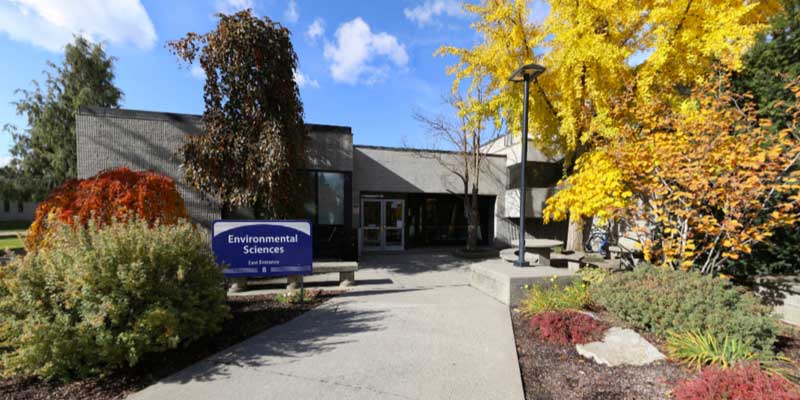
The program is housed in the newly renovated Environmental Sciences Building. The grounds around the building have been designed and landscaped by students in classes. The trees, shrubs and herbaceous plants are used by classes for instructional purposes as well as provide attractive outdoor study and meeting areas. The program has a florist shop as part of the greenhouse complex. It contributes to campus life by providing a variety of flower arrangements, flowers and plants for students, faculty and the community. The program has a wide variety of tools and equipment that the students learn to use. As the trend toward sustainability has increased, the program has invested significantly in commercial battery-powered equipment.
The Horticulture Club is active and provides professional and social activities for students in horticulture and agriculture. Through the club, students attend professional meetings, go on field trips, take part in community service projects, and engage the campus in promoting the environment. Students also participate in the National Collegiate Landscape Competition. Students enjoy travelling to the event and interacting with students from throughout the country both competitively and socially.
The landscape program has three full-time faculty and a technician assistant. There are eight adjunct instructors teaching in the program, with an additional three instructors for program-related classes. The instructors are highly qualified and have industry experience. The program also has an extensive advisory council to ensure that students receive appropriate education and relevant training. The program has been successful because of a passionate faculty that is connected with the profession and community. That passion creates an environment that cultivates success for their students and alumni.
The program was first accredited by the National Association of Landscape Professionals (then the Associated Landscape Contractors of America – ALCA) in 2004. It was re-accredited by the association in 2012. The college is accredited by the Northwest Commission on Colleges and Universities and governed by the Washington State Board of Community and Technical Colleges.
