

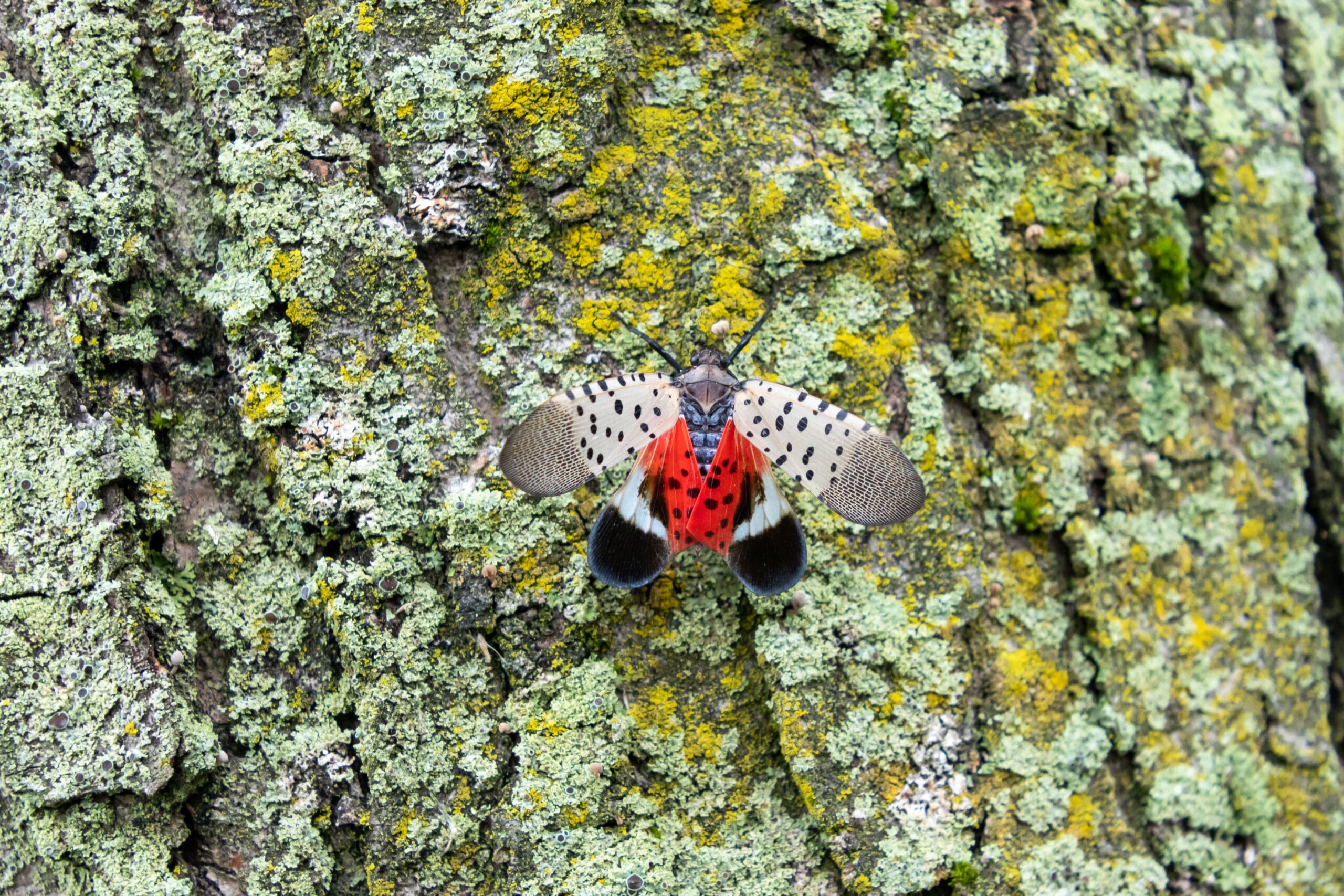
While the emerald ash borer poses a serious threat to ash trees, clients often wrongly assume the spotted lanternfly (SLF) is another destructive insect on their property.
If you receive complaints about this particular bug, work to determine the true reason the customer is concerned about them being on the property before acting. Some may be afraid of the bug itself, creeped out by its aggregations or concerned about the honeydew and sooty mold impacting the aesthetic of their landscape.
“Based on your understanding of this ‘why,’ you can educate on what is happening in relation to that specific dynamic and effectively communicate how available management options may (or may not) help with a specific problem,” says Chris Riley, a research scientist specializing in entomology/ecology with Bartlett Tree Research Laboratories in Berryville, Virginia.
Addressing Misconceptions
There’s no question that large swaths of spotted lanternflies can be a major nuisance to your clients. The honeydew they produce while feeding can attract a number of stinging insects. As the honeydew collects on surfaces and other plants, it can become a sticky mess that is colonized by sooty mold.
“Generally speaking, they do not pose significant threats to tree health,” Riley says. “I have heard a couple of anecdotes of heavy feeding causing mortality in young tree of heaven, but outside of that, I can’t think of any cases where large populations resulted in direct tree mortality.”
Riley explains that SLF are similar to aphids or scales. Their feeding takes the resources trees would otherwise use for growth, reproduction, defense, or another process. However, it rarely reaches the scale to seriously impact the health of a tree.
Riley adds unfortunately spotted lanternflies are here to stay just like the brown marmorated stink bug. He says there will be years where the population crashes and others where they surge.
Lifecycle of Spotted Lanternflies
SLF has one generation per year. Their eggs hatch in the late spring early summer as black and white 1st instar nymphs.
Riley says these nymphs will grow and molt through two additional instar stages.
“The 4th and final nymphal instar stage is dramatically different from the rest, with a brilliant red color mixing with the black and white,” he says. “By mid- to late-summer, this stage starts to undergo its final change into adulthood.”
The adults are the largest form and have fully developed wings. In the fall, females lay egg masses on all kinds of surfaces. It is these egg masses that can lead to an active infestation.
“If that includes cars, trains, or other objects that travel over longer distances, it is entirely possible that if left undisturbed, the egg mass will hatch out the following spring,” Riley says.
The first SLF infestation was found in 2014 and they have slowly spread through states including Pennsylvania, Maryland, Virginia, New Jersey, Delaware, New York, Rhode Island, and Massachusetts. To see the most up-to-date spread of SLF, click here to see its county-based distribution.
“In my experience working with arborists, many that have been anticipating SLF arriving to their region have found they will often show up along railroads or highways as these can be some of the largest avenues for new material entering an area,” Riley says.
Responding to Infestations
There aren’t many advanced warning signs of an SLF infestation will take place. Riley says you will easily see the adults on trunks and branches if there is an infestation.
“As actively feeding populations build, it is hard to miss the honeydew being produced; however it is worth remembering that many different species (e.g., aphids, scales, whiteflies) produce honeydew as well,” Riley says.
If no management efforts are made, Riley says property owners run the risk of dealing with larger nuisance populations. Riley says that high populations feeding year after year is undoubtedly a stressor and enough stress on the tree can open the door to secondary issues.
He says one proactive strategy is to remove SLF’s preferred host is the invasive tree of heaven (Ailanthus altissima) from uninvaded or recently invaded areas.
“Unfortunately, SLF will feed on a wide variety of host plants, so even if all tree of heaven are removed from an area, the chances are good that the population won’t be wiped out,” Riley says. “Even so, the act of targeting and removing one invasive plant species to potentially help control an invasive insect species seems like a winning strategy long-term.”
He adds that the removal of female tree of heaven should be prioritized as they produce seeds. Male versions of the species can be used as trap trees.
“These trees can be treated with a systemic insecticide that will kill the SLF life stages that aggregate and feed on it,” Riley says.
Impact on Trees and Managing Spotted Lanternflies
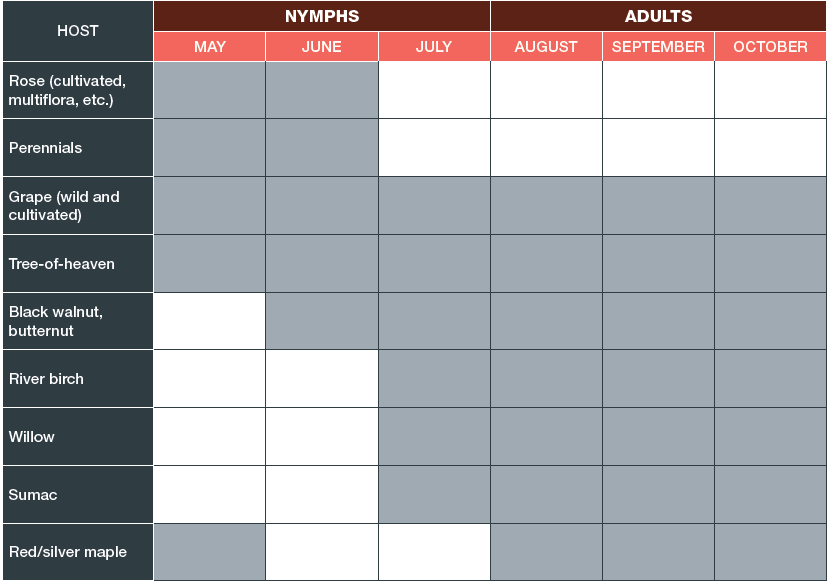
Riley says SLF have been recorded feeding on a massive host list, but have a strong preference for certain species. These preferred hosts shift depending on the month.
While spotted lanternflies themselves aren’t likely to kill a tree, their honeydew and the subsequent sooty mold that forms can be more of a threat.
For instance, if an azalea is underneath a heavily infested maple tree and gets coated in sooty mold, it has the potential to cause harm to the plant.
“Imagine the sooty mold behaving like a cover on the green tissue that blocks sunlight from reaching the foliage,” Riley says. “If enough of the plant is covered, then its ability to undergo photosynthesis will be diminished and the health of the plant may suffer over time.”
Currently, there is no solution for removing sooty mold. Riley says the best approach is prevention.
Management of SLF should begin with scouting a property for preferred host trees. Riley says as SLF moves into the area, document which trees are the distinct favorites. He says it’s not uncommon for a couple of red maples to be ‘hot’ in a large planting of the species.
“These observations can help plant health care practitioners effectively target any pesticide treatments (either topical or systemic) so as to maximize efficacy while minimizing the volume of material needed,” Riley says.
Landscape professionals can also utilize traps or physically remove egg masses to reduce the population, but Riley says milage will vary based on a number of factors. Researchers are also exploring the usage of fungal pathogens and arthropod predators to help control the population.
“For any trees that are heavily attacked, focus on proper cultural care (mulching, watering during drought, alleviating compaction, etc.) to promote overall health,” he says.
