
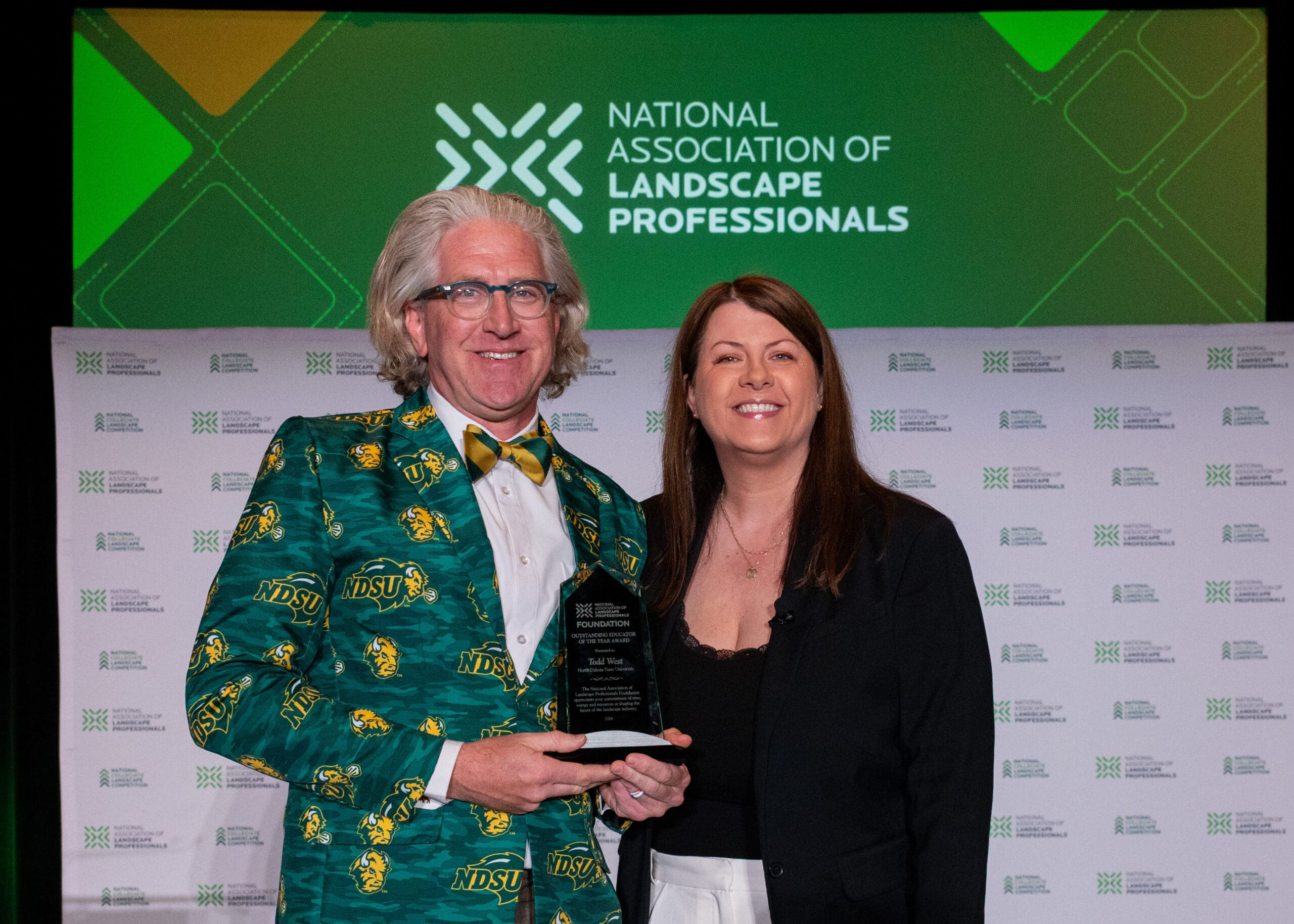
The NALP Foundation named Todd West, Ph.D., professor of horticulture at North Dakota State University, this year’s Outstanding Educator of the Year.
West earned an undergraduate degree in botany from the University of Wisconsin-Platteville and earned his master’s and Ph.D in horticultural science from Southern Illinois University. He has taught at NDSU for 15 years and taught at West Virginia for eight years prior.
West is the director of the NDSU Woody Plant Improvement Program as well as the horticulture undergraduate program. He is also consistently involved in the school’s Horticulture & Forestry Club, attending each weekly meeting.
His teaching style focuses on practical, real-world applications and fostering critical thinking skills. West works to connect his students with industry professionals whenever he can, including organizing a ‘green career fair’ where local landscape firms and tree care companies meet students.
West was recognized for his contributions to the future of the industry during the 50th National Collegiate Landscape Competition.
When were you first attracted to horticulture?
I discovered horticulture in the summer before my senior year as an undergraduate student. I was majoring in botany, and the horticulture program at my university was looking for a campus garden manager intern for their horticulture gardens. I had no idea what horticulture was, but I was planning on staying in town where the university is that summer, because I was getting married that May before my last summer, and I was looking for a summer job.
I figured, ‘Heck, a botany student can manage gardens and a greenhouse and do this whole horticulture thing.’ And I found I was very wrong. I found out that I had a lot to learn, that being book smart with botany didn’t help plants grow and thrive. It was a very rewarding experience for me. Unfortunately, though, it was too late for me to change my major to horticulture. That’s when I interacted with the horticulture faculty there, and out of them I found out I could go to grad school. I had no idea about the career opportunities in horticulture because I was in a botany program.
Did you know that you wanted to be an educator or was it something you stumbled into?
I stumbled into it because when I was working on my master’s, my major professor he required us to do all of his plant propagation labs. I was so mad because I’m like, ‘I don’t have time for this. I’m doing my coursework, I’m doing my research, I don’t have time to do your job.’ I’m picturing him sitting in his office with his feet on the desk while I’m running all of his classes. But then that’s when I learned I loved teaching. I loved interacting with the students. I loved seeing their eyes get wide, ask questions and get these ‘aha’ moments.
What do you love most about being an educator?
It’s those ‘aha’ moments. But I just love interacting with students. I find every year, they seem to get younger and younger, but I just love interacting with them. I love those ‘aha’ moments, but more importantly, I love providing opportunities for them that they didn’t even know existed, such as with NCLC.
What is your proudest moment as a horticulture educator?
It’s really difficult to narrow to one proud moment. I would say one moment is watching my students interact with industry at events such as NCLC. I think seeing them graduate with a job, but also seeing them as alumni years later, being happy, having a vibrant career, and knowing that our program provided that.
What is the No. 1 lesson you hope students take away from your classes?
I’m going to be cliché. I will say, ‘Never stop learning.’ Because when we stop learning, we stop growing. When we stop growing, we become stagnant. When we become stagnant, we die. But also, I have two mantras for my courses, and I tell them, one of them is going to be on my gravestone. One is the ‘right plant, right place, right reason.’ Everybody always says, ‘right plant, right place,’ but we have to add right reason. Then from my arboriculture science, I say we learn from the right plant, right place, right reason and now we ask our question for the rest of our careers, ‘What is normal?’ So having those two mantras ingrained in their heads, I think, allows them to really be effective in what they do, and helps them with that critical thinking.
It’s looking at a plant and going, ‘The leaves are too small; that’s not normal.’ So then why? ‘This plant has reduced growth; that’s not normal. Why?’ It’s really providing them that opportunity to have that critical thinking, to be able to diagnose what’s going on.
What is your biggest challenge as an educator?
Really, for me, I have two really big challenges. The first is fighting administrators and educating them that horticulture and the landscape industry are important and that programs like ours need to be supported. The second is simply getting young people exposed to our industry and having them discover that it’s a rewarding career.
What do you think is a significant barrier preventing young people from being interested in the landscape industry?
I think it’s simply a lack of exposure. High schools don’t promote horticulture or the green industry as a viable career. They are told all about pre-med and engineering. For us, at least our program, I think this is pretty typical across the nation, students generally don’t find horticulture until they’re exposed to plants in another course. That’s how I found it. Or they’re just simply like, ‘I don’t like what I’m doing.’ And then they do finally explore, and then they find out that this is a possible career. We need to find better ways to get into classrooms at younger ages and show how rewarding the landscape industry and horticulture really is, but more importantly, also get the counselors understanding that it is a real job. It’s not just mowing lawns.
What is the best way the landscape industry can partner with educators?
I think the best way is to continue their relationships with their local and regional programs. Find ways to get into the classrooms. I’ve been so blessed to have so much amazing support from the industry with providing gear, tools, plants and sponsorships for NCLC. They provide everything I need to do what I need to do, but we need to figure out how do we get to these to other younger kids.
What does it mean to be named the Outstanding Educator of the Year?
Being named the Outstanding Educator of the Year is a huge honor for me. I’ve been coming to NCLC for 18 years, and to me, honestly, it feels like I’ve been inducted into the green industry educator hall of fame. When I look at the names of previous winners, I’m like, ‘Wow, these are big shoes to fill.’
In five years, where do you see horticulture education?
So much is going online. There are also a lot of companies that I’ve interacted with over the years that have said, ‘You don’t need a degree in horticulture. We’ll teach you what we want you to know.’ So I am a little concerned. Programs have been decreasing, and a number of programs across the nation have been closing. I would hope that we will still have horticulture programs. We definitely need to adjust and change with the times and really get more exposure out there so people understand how important horticulture is.
In the next five years, where will you be?
Hopefully, exactly where I am today. I love teaching. I love interacting with undergraduate students. I love taking them to NCLC. For me, my program, I release new woody plants to the nursery trade. I love my research program. I tried the administrative role for a short time, and I found I missed the direct interaction with students too much that I feel that I plan to stay in the trenches until I retire.
What advice would you give to other horticulture educators trying to get young people interested in the landscaping field?
Don’t be afraid to engage with young people. Involve your current students from your program in creating activities involving middle school and high school students. I think holding events such as a tree climbing day, a tree planting event, there are so many activities that we can do to promote what we do. What is great is that if we do this, it also provides opportunities for undergraduate students to give service back to their community, but also provides them with teaching moments.