

Our Level Up series shares the strategies that help landscape and lawn care companies get to the next level.
Andy Blanchford, CEO of Blanchford Landscape Group, based in Bozeman, Montana, doesn’t have an ideal company size he’d like to reach, but he does expect the company to be close to $10 million in five years with about 60 employees.
“The reason for the growth is just creating opportunity and taking advantage of the opportunity that’s here,” Blanchford says. “This place continues to blow up.”
The company reported revenue of $4.2 million in 2024 and aims to reach $5 million this year.
For Blanchford, success is not about top-line or bottom-line revenue, even though it’s important.
“It’s creating a community of people that loves what they do and loves the outdoors and loves connecting with nature and connecting with people and creating good lives for the people that work here,” Blanchford says. “That they can make enough to afford to live here. They have a life balance that their work contributes to their health and well-being, not detracts from it.”
Company History and Service Offerings
Blanchford studied landscape contracting at Penn State, and the desire to start his own landscape company was always in the back of his mind. The opportunity presented itself when he moved to Montana.
“I was working for another company, and things just weren’t going real well with that company,” Blanchford says. “I was really managing the company, but the owner was making that difficult by doing some things that I didn’t agree with.”
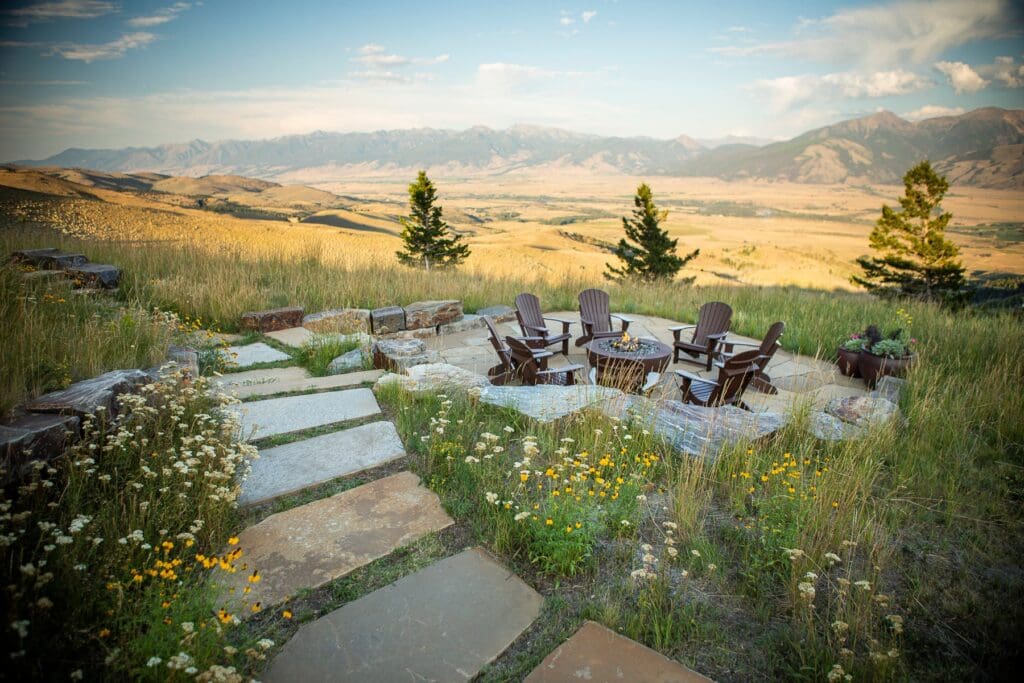
After two years, he left that company to start his own. Many of the client relationships he fostered continued on with Blanchford Landscape Group.
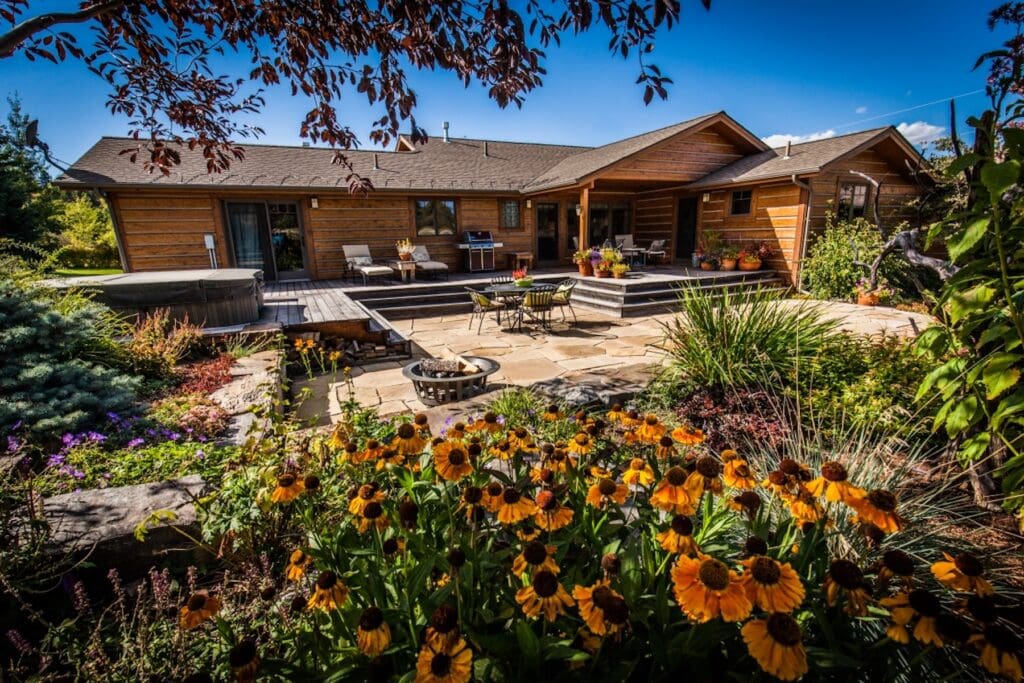
Now, the company serves primarily high-end residential clients, with most houses starting at $2 million and up. Blanchford says they care for a lot of secondary homes as well.
With the secondary homes, Blanchford says one thing they struggle with is less communication with the client. With no one on site, the team doesn’t get regular feedback on how they’re doing.
“When the clients aren’t around, we really are working for the property manager,” Blanchford says. “So that’s a different set of objectives. It’s really our job to make the property manager’s life as easy as possible and make them look good for choosing us. That’s a little different than making sure that the containers are perfectly deadheaded or we have the right pink petunias in for Mrs. Jones. They don’t really care about all that. They want a good impression for their owner, and they want to feel like their owner is getting value.”
Design/build work makes up 50% of their revenue, with maintenance at 30% and holiday décor at 20%.
The company purchased a Christmas Décor franchise where the territory limited their residential work to only Blue Sky. However, Blanchford Landscape Group can provide commercial holiday décor services outside of Big Sky.
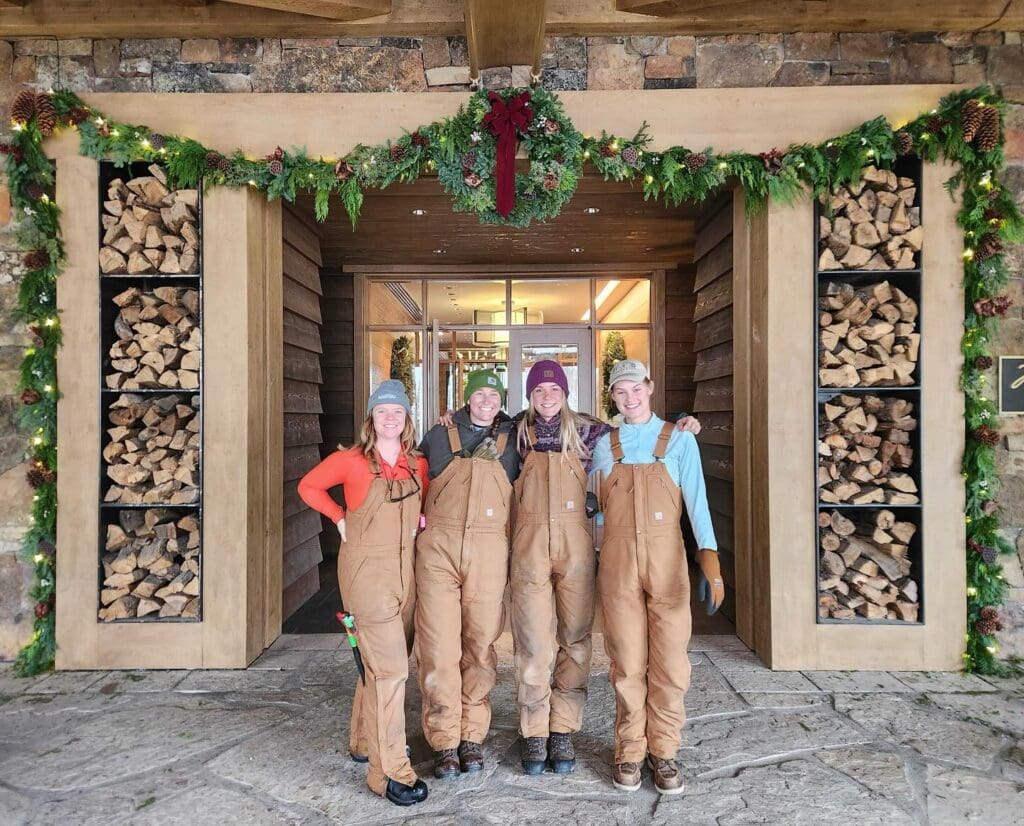
“We’ve grown our decor business to almost 50% live material with indoor trees, live wreaths, garland, all that kind of stuff,” Blanchford says. “Most of our competitors don’t do that, so we will do that for residential clients in Bozeman as well.”
They source their live greenery from growers in Oregon and decorate it themselves.
On their garden service and décor side, their portfolio is split about 50/50 between primary and secondary homes.
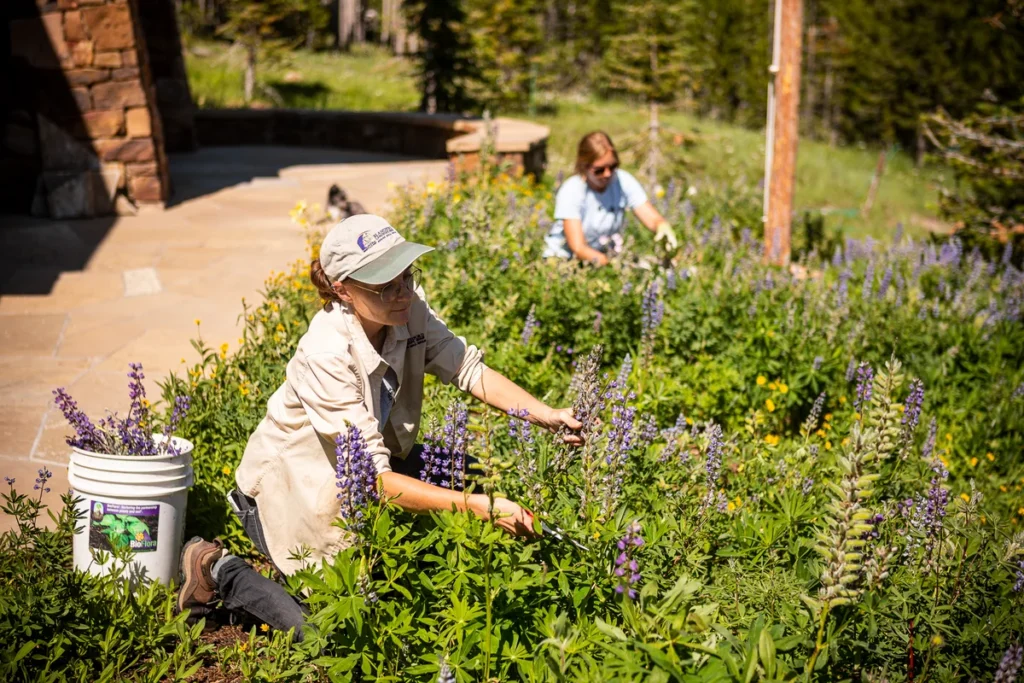
Typically, as a project is nearing completion, they will introduce the client to the account manager and they’ll present them with a garden services proposal. Blanchford says one of the reasons clients select them is because they seamlessly move the client from installation to a maintenance contract and keep it looking great.
“We also have a lifetime warranty on our plant material when they sign up for our garden services, so that pushes a lot of them in that direction,” Blanchford says.
Blanchford says they haven’t had any issues keeping their lifetime warranty. The one exception it doesn’t cover is animal damage, as anything from voles to deer, elk, or even moose can damage the plants in their area.
Growth and Challenges
In the past, the company’s growth has been a little erratic, but the fastest growth occurred when Blanchford stepped away to work remotely in 2014. He worked from Japan until 2020 and then moved to Germany.
He says it was good that the company was able to grow, but also hard to come to terms with the truth that he wasn’t as pivotal to the business as he thought.
“Everybody’s replaceable, and often business owners put themselves in this place of ‘Nobody can do it like I can do it,’” Blanchford says. “We create that story and live out that narrative, whether it’s true or not. And it’s true until something happens, and you can’t be there all the time.”
When the company experienced this jump in growth, Blanchford says it was only partly sustainable.
“What stressed people out and wasn’t sustainable was the lack of clarity from me,” Blanchford says. “What are my intentions? When am I going to come back? Or am I coming back? I didn’t know following my wife’s career, and I didn’t set any expectations.”
The lack of big-picture direction resulted in the company shrinking by 30% in 2023.
Another challenge that arose in 2023 was when they attempted to add on interior plantscaping as a service. They purchased an interior plantscaping company from an owner-operator looking to retire, and their construction foreman was set to take over the interiors business.
Unfortunately, the employee left without telling his clients and simply stopped servicing them. After seeing the damage that was happening, Blanchford transferred the remaining accounts to another landscape company.
“That was a frustrating exercise,” Blanchford says. “I really thought I was helping this young man do what he wanted to do, and that felt good to me. I don’t know what I would have done differently.”
Blanchford admits that being away for eight years worked really well, until it didn’t. He says he wasn’t paying attention to the culture, and their general manager didn’t have enough clear direction on where the culture was going.
The company’s growth also masked some of the issues for a while.
When he returned, he took over the build sales and the sales manager role. Slowly, he is working himself back to freedom by having a great leadership team in place.
Looking back, Blanchford says he would have worked to stay more connected to the team and come back more often. He thinks things started to crumble in 2020 when the pandemic prevented him from returning to the company for 18 months.
“I would make sure that I was communicating vision and culture all the time, and staying less tactical,” Blanchford says.
Blanchford encourages other owners to ensure they’re not indispensable because if you’re sidelined due to an illness or an accident, people need to be able to know how to do your job.
Keys to Success
Blanchford says one main reason for their success is that their market continues to grow.
“The opportunities are exponentially greater than they were when I started,” he says.
After COVID, an influx of people moved to the area as they realized they could live there and work remotely. The return-to-office mandates haven’t impacted their customer base, as most of the people they’re working for are in top-tier management.
Blanchford expects that they’ll grow by 15% this year. He says while the market is slightly softer, they have so many projects in the pipeline that he doesn’t anticipate any issues.
“We’re planning on about $1 million a year every year for the next five years,” Blanchford says.
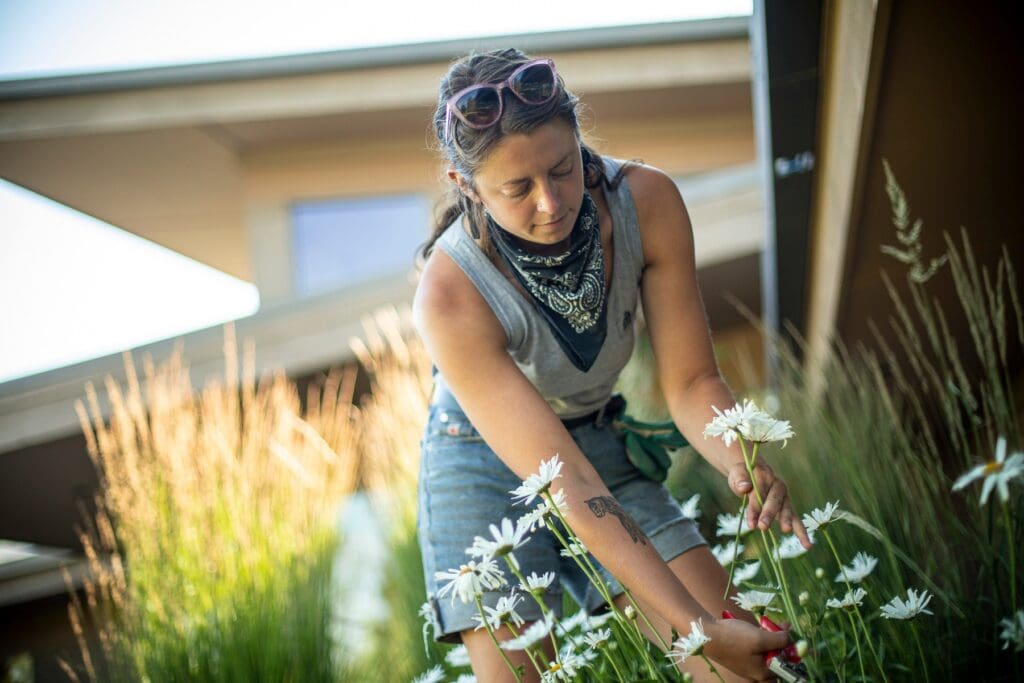
Another critical element to their success is having quality people.
“It was never so obvious as when I left the company, and it started to grow,” Blanchford says.
He says he’s found that the more top-grade people they have, the more they grow and the more willing they are to hold out for more good hires.
Blanchford adds that when you don’t hire top talent, you might have someone who doesn’t feel successful. It is harder to retain these people, as they want to go somewhere where they do feel successful.
Blanchford says their NALP membership was also a huge factor in their company’s growth in the beginning.
“I would not be in the peer group I’m in without NALP,” Blanchford says. “That’s the biggest value is just that network that I built around the country.”
Recruiting and Retention
When the wheels began to fall off in 2023, they turned over a lot of their production staff, including some long-time veterans. Blanchford says it was a case of ‘what got you here won’t get you there,’ causing them to rebuild their staff last year.
One challenge the company has dealt with over the years is having enough expertise for particular roles, such as irrigation.
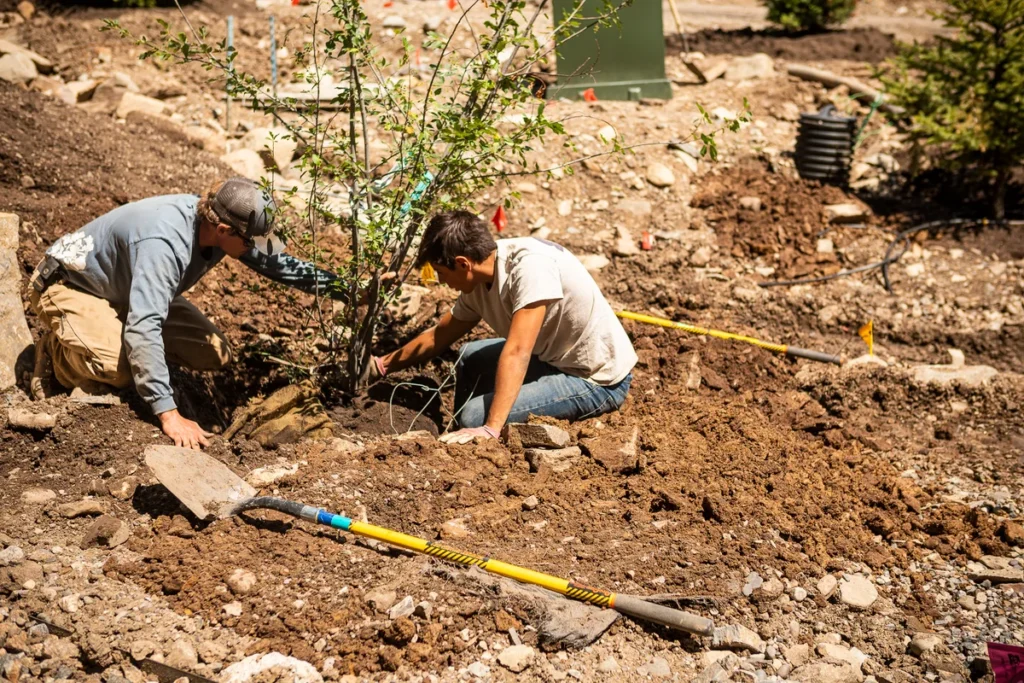
“Creating depth in our organization, having more than one person with the same with the skill sets, is something we’re working towards and just really hiring expertise,” Blanchford says.
Currently, the business has 35 employees on staff.
“We upped our wages by 30% and our cost of labor did not go up as a percentage,” Blanchford says. “I think we’ll get 75 or 80% of those people back this year. We’ve really turned it around, and it’s by being selective for good people; it really makes a big difference.”
He says it did take them the better part of the season to solidify their build team.
“Before September, we had hired 18 people to get nine,” Blanchford says. “But we always had someone in the pipeline. We always had someone to interview.”
Blanchford says that they shifted to a social media strategy in 2024 for recruiting, and it’s helped. He outsourced this aspect to Constant Flow Marketing.
They also have an employee referral program where, if a new hire works for a season or a year, the referring employee receives $1 an hour for every hour they worked. Blanchford says this helps the referring employee be more invested in the new team member’s success.
Since returning, Blanchford has been working on rebuilding their culture by having weekly training meetings and monthly socials after work on Thursdays.
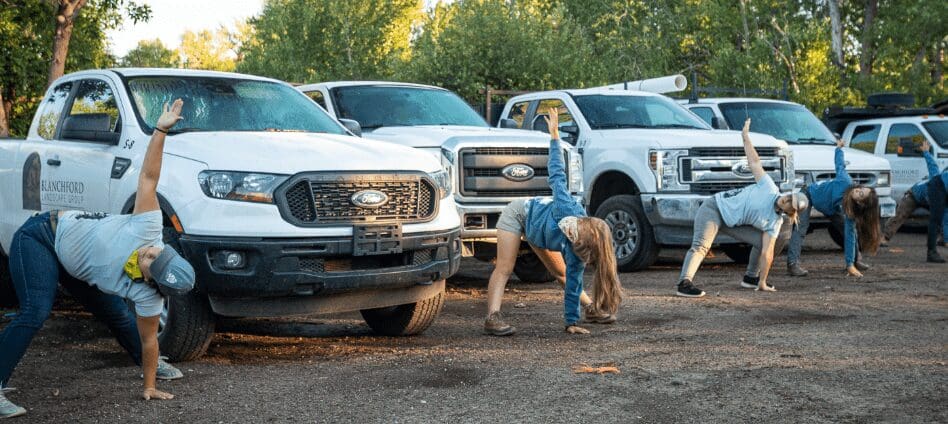
He says part of the reason they retain their employees is because it is a fun place to work. Throughout the years, many team members say the reason they work for Blanchford Landscape Group is for the people and the friends they’ve made there.
“It’s about treating people well,” Blanchford says. “It’s listening to them. We have scheduled regular check-ins monthly to quarterly, where we’re asking people how they’re doing and what can be different. When they ask for something, we either say, ‘No, we can’t do that,’ or ‘Here’s what we’re going to do about it.’ I think it’s making people feel heard and enjoying the work that they do.”
Blanchford says they plan to focus on the fundamentals to maintain their culture as they grow.
“I think the people that we’re going to attract in the future are people who value structure and organization and process, and it won’t be quite so loosey goosey, and as long as we can remain focused on our team’s well-being, then I think we’ll be able to keep people and that will be our culture.”
Click here to read more Level Up stories.
