

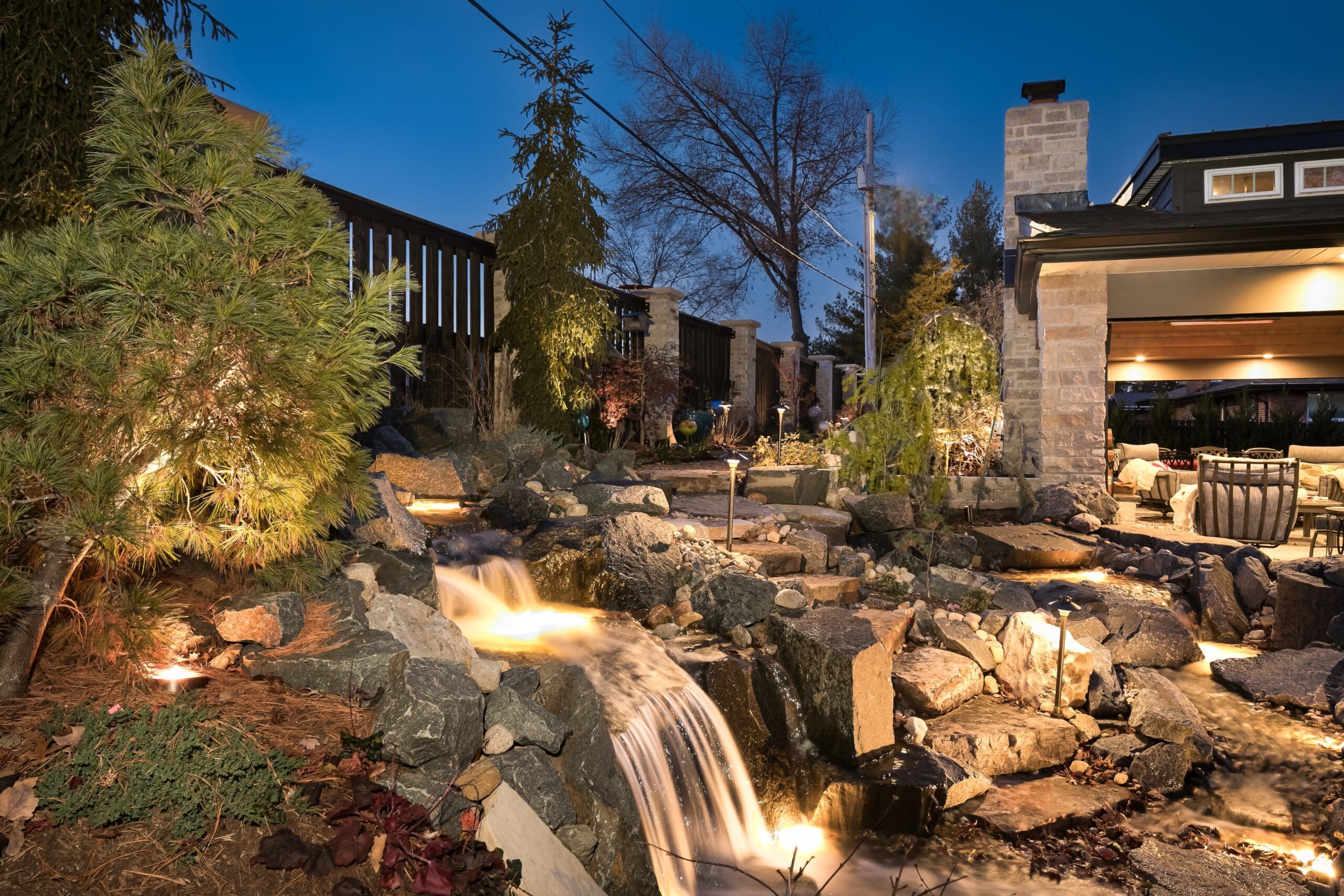
Photo: Frisella Landscape Group
Gone are the days when landscape lighting was simply a nice addition. Now it has become as necessary as irrigation.
“Landscape lighting not only increases home security and value, but it allows our clients to view their landscape in a whole new way, using varying lighting colors and techniques to create depth, breadth and a soft, romantic environment for entertaining, or enjoying from your bedroom window,” says Robert Karleskint, lead sales and designer for lighting, irrigation and audio departments at Frisella Landscape Group, based in Richmond Heights, Missouri.
If you’re looking for ways to improve your landscape lighting designs, check out some of the frequent missed opportunities and mistakes that can occur.
Not Selling the Value
One of the first steps to improving your landscape lighting designs is to stop treating it like an add-on feature.
“Don’t call it an upgrade,” says Landon Kirby, owner/CEO of Knob Hill Landscape Company, based in Springfield, Illinois. “Just really focus on the importance when you’re selling that design, just like any other feature. When you’ve done a landscape design, and you’re trying to sell that to that homeowner, hopefully, you’re hitting all the things that they wanted. Lighting, yes, sometimes it’s an upgrade, but when you stop selling it that way and stop thinking of it that way, it really just flows right into the project.”
Encourage your clients to include landscape lighting in their initial project, as it enhances the aesthetics, security, and functionality of the space, while ensuring a cohesive and thoughtful design.
“If you don’t light up your landscape, 50% of the time, it’s literally in the dark,” Kirby says. “Even if you’re not out on your patio enjoying it, you’re looking at it when you pull up from dinner, or you’re in your house, and you’re looking out at your patio, or your softscape, and you’re able to enjoy it in the evenings. It’s not about just being there at night. You get to enjoy that investment for 24 hours a day, if you wanted to. If you don’t light it up, you’re only seeing that investment half the time.”
Kirby notes that their design software also helps sell the beauty of landscape lighting.
“I think definitely our process of including it as a standard is something that I would encourage people to do,” Kirby says. “Everybody loves the lighting. I’ve never had one person say, ‘Nope, I don’t like it. Take it out.’ They might take it out for a budget reason, but not because they don’t like it. When you have the software and the capability to do that, you’re going to see it just helps your overall sales.”
Failing to Think Beyond Safety
Landscape lighting is a practical feature that allows clients to navigate the space safely after sunset. However, it can also set the mood, add warmth and highlight various points of interest on the property.
Designing with only safety in mind does the landscape a disservice.
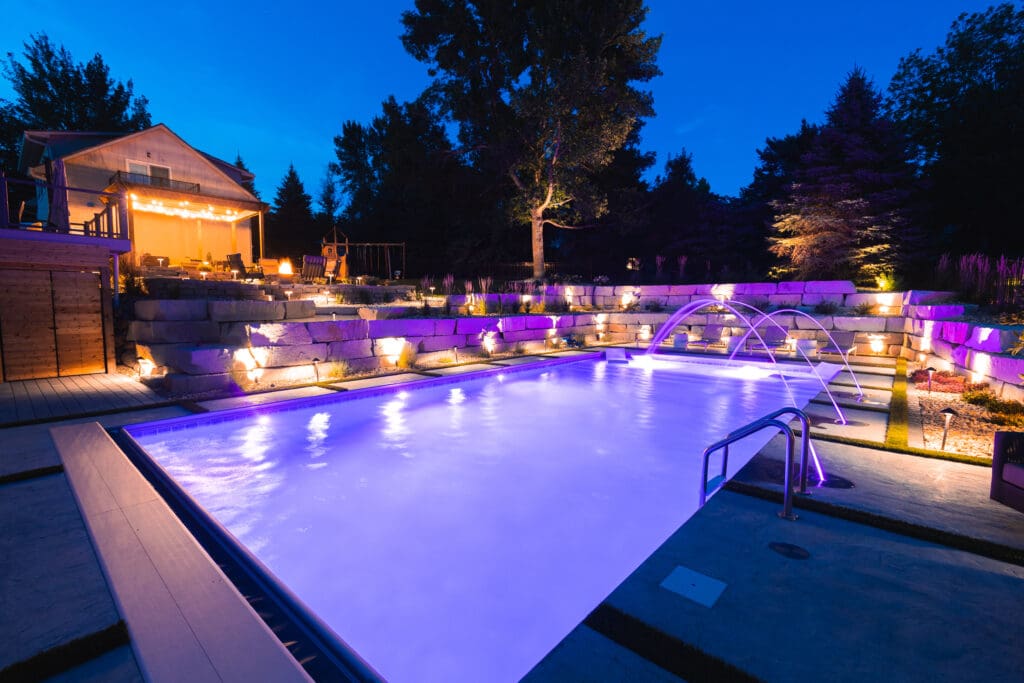
“It’s to extend the enjoyment of the landscape, into the evening hours and without the light, you’re not receiving the full benefit of your landscape because you can’t see it once it gets dark,” says Jeff Rossen, CEO of Rossen Landscape, based in Great Falls, Virginia. “Even from inside the house, we try to create focal points out of certain windows of the home where, when you look out, you’re seeing a tree just brilliantly lit up. In the fall, when the leaves change colors, the lighting really enhances and accentuates the color in the trees.”
Karleskint adds that whole home lighting is radically different from a few motion sensor spotlights or a door light that only extends 8-12′ in illumination. Landscape lighting not only beautifies the home and plantings but also eliminates dark corners to hide in.
“We light between windows, around entries and walkways to ensure no area is dark and ideal for break-ins,” Karleskint says.
Over-Lighting
On the flipside of things, you can also easily end up over-lighting a landscape. Cole Jenkins, associate landscape designer with Weller Brothers Landscape Professionals, based in Sioux Falls, South Dakota, says this can result in a harsh glare.
Hot spots can occur if you put too much light on the front of the house.
“Don’t overdo it,” Rossen says. “Sometimes less is more.”
Rossen says one of his goals is for the landscape lighting to be understated.
“I try and make it blend and just kind of go away,” Rossen says. “We tend to go with more simple, understated fixtures, unless the client specifically has their heart set on something.”
Poor Placement
Oftentimes, where the lighting fixtures are placed can make a major difference between a space looking visually appealing or unbalanced with bright and dark spots.
“Improperly lighting areas on the second story, path or driveway, i.e., lighting the home up to a covered porch, where the ground lighting cannot reach and creates a dark spot on the home,” Karleskint says. “These need 2nd story mounted lights at a lower wattage that will make the ground lighting look as though it is complete and gradual from the ground to the roof line.”
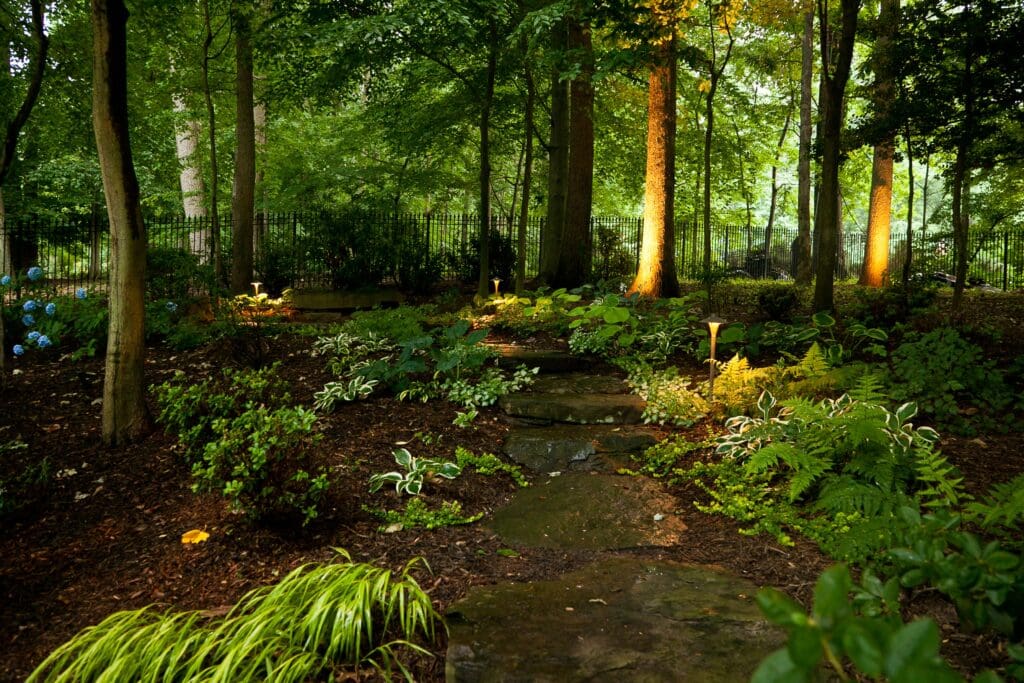
Photo: Rossen Landscape
Kirby recommends that if you’re adding lighting along a driveway or pathway, alternate their placement slightly to avoid a runway effect.
“Sometimes that same path light can be replaced with a smaller wash light, or puck light, or something that is lighting, let’s say a Japanese maple tree that’s right off the path,” Kirby says. “You can use that same light and give you a different texture.”
Rossen notes putting the lights too closely together also creates a runway.
“Poor fixture placement is a big one and can result in unbalanced illumination, while failing to layer different lighting types — such as uplighting, downlighting, and accent lighting — can make a design feel flat,” Jenkins says.
Jenkins recommends prioritizing quality over quantity as strategic placement is much more impactful than excessive fixtures.
“Every design should be measured by a fixture’s lumen output and should be arranged appropriately across the home and landscape,” Karleskint says.
Installing Obsolete or Mismatched Fixtures
Always stay in the loop on the latest innovations with lighting fixtures. Rossen notes that with newer technology, you can control how bright the lighting is instead of being limited by the bulb wattage.
Kirby says solar-type fixtures, photocells and analog controllers have all gone by the wayside as clients want to be able to control their lighting via their phone.
Karleskint says they have moved to use solid brass, silicone waterproofed fixtures with an oiled bronze or powder-coated, color-selected finish because alloy, powder-coated fixtures and integrated bulb fixtures had a high need for full replacement.
For a cohesive look, Jenkins recommends matching color temperature.
