


Written Nov. 6, 2026
Early on Tuesday night, as results began to pour in, it became abundantly obvious that it was not going to be a good night for President Trump and the Republican Party. It’s important to remember that, on average, the President’s party in power loses three Senate seats and 33 House seats. With this in mind, and all the polling that was in the field, it was clear that the House was going to flip, but the Senate also flipped, and when all the votes are counted, this could be a historic wave election. Now let’s break down the results.
The Senate
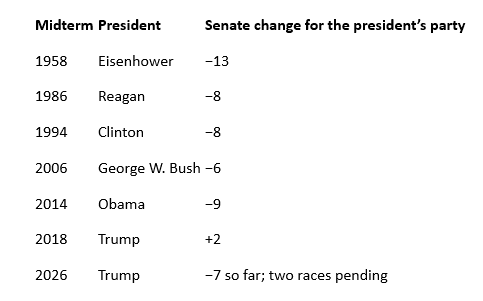
Democrats won a major Senate victory, ending Republican control and giving them a powerful check on President Trump for his final two years. As of Nov. 5, the Democratic caucus has 54 projected seats, Republicans have 44, and Alaska and Mississippi remain uncalled. Democrats have gained seven seats and could finish with as many as 56. The new majority takes office in January 2027.
Democrats flipped Iowa, Kansas, Maine, North Carolina, Ohio, South Carolina, and Texas, while protecting their existing seats. The breadth of that victory is particularly significant: it extended well beyond the traditional battlegrounds into states that have elected Republicans to the Senate for decades. Kansas last elected a Democratic senator in 1932; Texas last did so in 1988.
The Historical Comparison
A seven-seat gain makes 2026 a substantial Senate wave, although larger midterm swings have occurred:
What Democrats Will Prioritize
Schumer has already identified lowering the cost of living as the Senate’s first priority. The specific legislative agenda is still developing; the following combines announced Democratic goals with my assessment of how a Senate majority would pursue them.
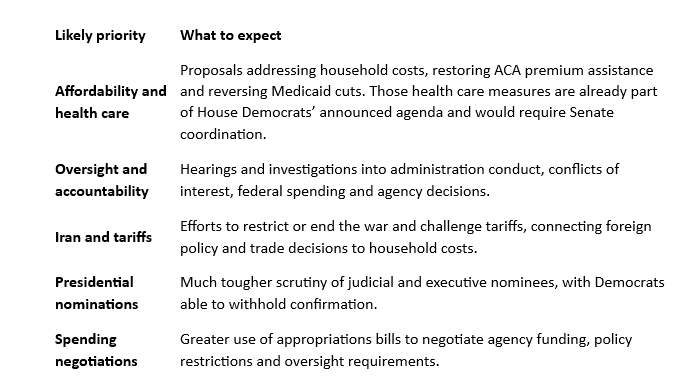
The announced affordability, health care, Iran and tariff goals are reported by Spectrum News; the oversight direction is also reflected in reporting on Democrats’ plans. The nominations and spending expectations are assessments of the powers a Senate majority would hold.
Their strongest immediate tools will be oversight, nominations and negotiating leverage. Most contested legislation still needs 60 votes to overcome a filibuster, and Trump can veto bills. Overriding a veto requires two-thirds support in each chamber. Even a 56-seat Democratic Senate would therefore need Republican cooperation for major laws opposed by the president.
Who Will Lead Them
Chuck Schumer is the clear favorite to return as majority leader, with Brian Schatz expected to become Democratic whip, succeeding retiring Senator Dick Durbin. These are expected outcomes, subject to the caucus’s leadership elections. The scale of the victory substantially strengthens Schumer’s position after earlier pressure for a leadership change. There will also be significant movement on all the relevant Committees that NALP works with (Agriculture, Appropriations and Judiciary). NALP will be providing a better understanding of the composition of Committees when Congress returns next week, with full Committee assignments not likely to be known until after Jan. 3.
In the House
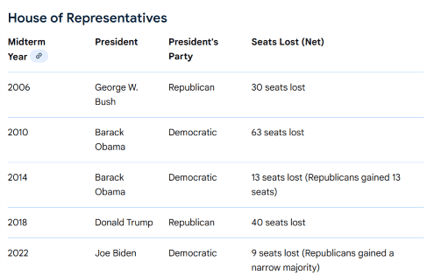
Democrats regained control of the House through victories in battleground districts across the country. The decisive wins came as President Trump’s approval rating fell to 38%, historically low for a president in the midterm election. Voter concerns about the economy were especially pronounced, with 89% of voters citing the cost of living as a major or critical factor in their decision-making.
History once again repeated itself in the House, where the president’s party traditionally loses seats during midterm elections. The House has consistently followed this pattern. The Senate, by contrast, has historically been more unpredictable, although changes in partisan control are generally less dramatic. The chart below highlights the number of seats lost by the party in power over the past two decades of midterm elections.
All 435 seats in the House of Representatives were up for election. Democrats entered Election Day holding 214 seats and successfully flipped numerous Republican-held districts while remaining competitive in battleground races and several unexpected regions. Democratic victories were recorded in states including North Carolina, Pennsylvania, Texas, Michigan, New York, Ohio, Kentucky, and Colorado, among others.
Several races remained uncalled for more than two days after Election Day. Republicans had redrawn congressional maps in states such as Texas and Florida in an effort to improve their electoral prospects, but redistricting ultimately did not prevent significant Republican losses.
As of Nov. 5, at 6:28 p.m., Democrats had won 253 seats, including more than 40 flipped districts, while Republicans had secured 155 seats. Because 218 seats are required to control the House, Democrats surpassed the threshold comfortably, with 27 races still outstanding. Notably, several Democratic pickups occurred in districts previously considered safely Republican.
Why are some races taking longer to be finalized? Mail-in voting, which expanded significantly during the COVID-19 pandemic, remains widely used, particularly in western states. In some jurisdictions, election officials lack automated equipment capable of opening and processing ballot envelopes efficiently. As a result, bipartisan teams of election workers, typically one Republican and one Democrat, must manually open and verify ballots, extending the counting process.
What We Have Heard So Far
House Speaker Mike Johnson announced during a staff call on Wednesday that he will not seek to serve as minority leader when the new Congress is seated. His decision sets up what could be a contentious leadership contest between House Majority Leader Steve Scalise (R-LA-01) and House Judiciary Committee Chairman Jim Jordan (R-OH-4) for the top Republican position.
Meanwhile, House Majority Whip Tom Emmer (R-MN-06) and House Republican Conference Chair Lisa McClain (R-MI-09) are seeking to retain their leadership roles as Republicans transition into the minority. However, Emmer faces a challenge from Republican Study Committee Chairman August Pfluger (R-TX-11), while Representatives Erin Houchin (R-IN-09) and Greg Steube (R-FL-17) are challenging McClain for her position.
On the Democratic side, House Minority Leader Hakeem Jeffries stated that he expects Democrats to ultimately secure at least 255 seats once all votes have been counted.
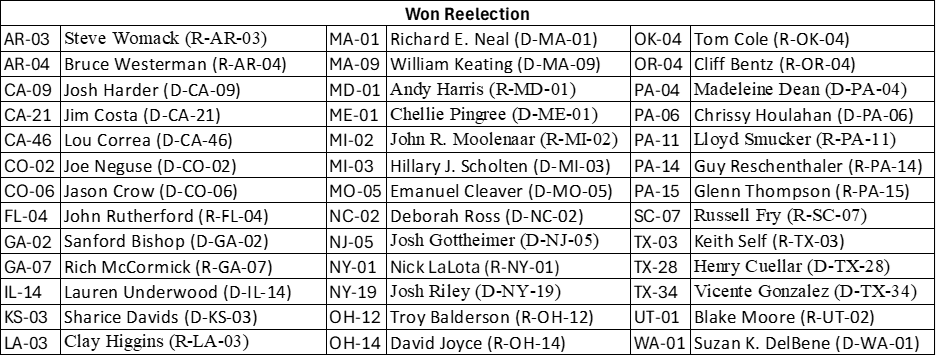
See below a list of our champions and supporters, along with the outcomes of their races. Members highlighted in yellow represent competitive races, while those highlighted in green were successful in their reelection bids.
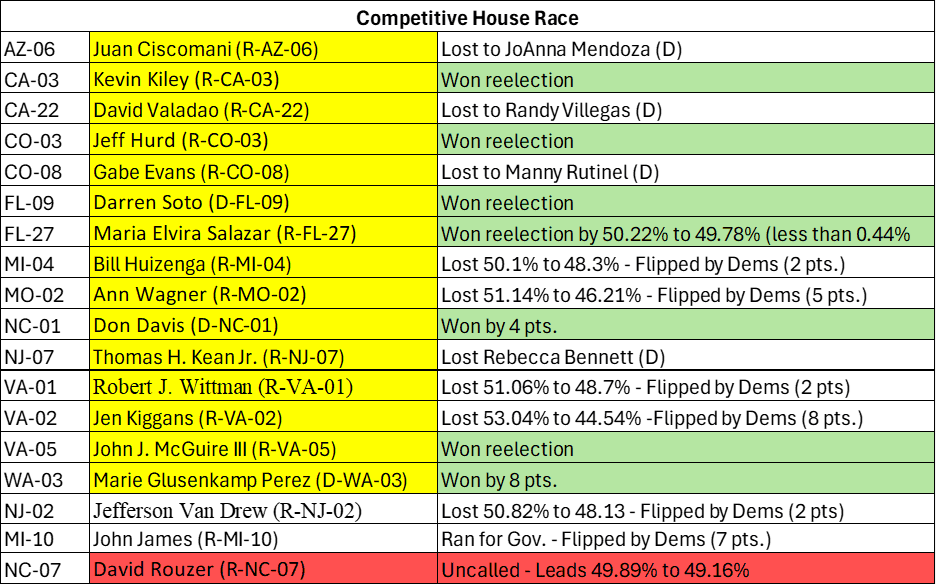
Two notable outcomes are worth highlighting. Although it was not widely expected to be competitive, NJ-02 flipped to Democratic control after Representative Jefferson Van Drew (R-NJ-02) lost by two percentage points. In Michigan, Representative John James’s decision to run for governor left his seat open, allowing Democrats to flip the district from Republican to Democratic control by seven points. Additionally, NC-07 has not yet been called. Representative David Rouzer (R-NC-07) currently leads Kimberly Hardy by 0.73 percentage points.
The champion members listed below won reelection comfortably, facing little significant opposition.
Looking Ahead
The full impact of these elections will become clearer as governors and lawmakers set their priorities for 2027. NALP will continue working with state partners and policymakers in both parties to advocate for practical, science-based policies, protect members’ ability to operate and grow their businesses, and keep landscape professionals informed as legislative and regulatory proposals take shape.
Subscribe to The Advocate newsletter for further follow-up as results are finalized and internal party jockeying for power plays out over the next two to three months.