
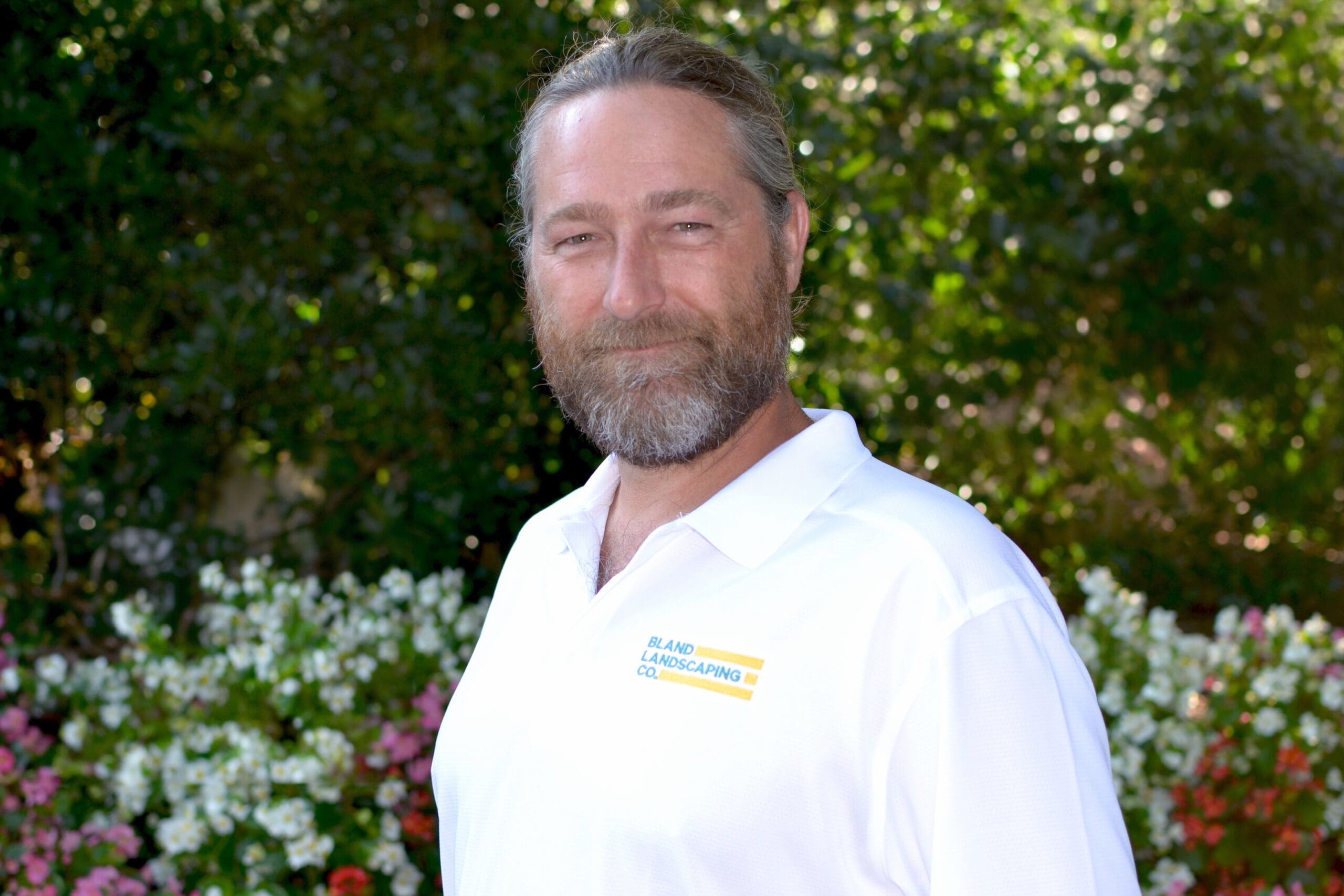
Kurt Bland is the CEO and president of Bland Landscaping Company, based in Apex, North Carolina. Bland started working for his family’s business when he was 14 during the summers. He earned degrees in agriculture business management and horticulture science from North Carolina State University before he and his brother, Matt, took over the business from their parents when they were 29 and 27, respectively.
Bland Landscaping is a full-service provider of landscape design, installation, enhancement and maintenance services to commercial customers, including offices, hospitals, universities and HOAs. The company became private equity-backed in 2017 and has tripled their size through organic growth and acquisitions. They now serve the Carolinas and surrounding Southeastern states.
What are some of the lessons you learned when you had to take on the business 10 years earlier than planned?
Succession is difficult, regardless of planning and preparation. Succession under the duress of an ailing co-founder and parent is even more difficult. I was 29, and there was so much to learn, but we didn’t have the luxury of time to figure things out the way it had been taught to us in a textbook fashion. When you find yourself in that situation, you have to be steadfast and use improv to adapt and take the challenges in stride as they come. They will come.
What advice would you give to other owners looking to pass the business on to the next generation?
The smartest advice anyone ever gave our family was for the next generation to leave the family business following their education and to get work experience in management before coming back to join the family-owned business. I still give this advice to every multi-generational business I speak to, although few take the advice and many of them understand it better in hindsight when it is too late to go back.
What does it mean to you that the company has now been in business for 50 years?
It means I am getting old! For the longest time, we spoke about 50 years in business as if it were some nebulous point in the distance that we might never reach. We set goals, such as 50-50-50, and while we were busy living and working, those goals snuck up on us. Matt and I set out to grow the company to $50M in revenue by the time the company and I reached fifty years old, which is March of 2026. Last year, we did more than twice that with gross revenue of more than $100M. That doesn’t seem like a big of a feat today, but remembering when this business was sub $10M in revenue twenty years ago doesn’t seem like that long ago.
Time has flown by, and to think that the company and I are both half a century old is pretty hard to believe. Reflecting on it makes me genuinely grateful for the countless men and women who have participated now or ever in the growth of this business into something we could only have dreamed about years ago. I feel fortunate and blessed to have been entrusted with the opportunity to steward this team for half of this journey, and I look forward to the next fifty years and seeing what lies in store for our team.
How do you define success today compared to when you first started running the company?
When I took over, success was very much something I measured in income and earnings. It was a small business and our livelihoods as owners of a pass-through entity were very directly linked to each year’s results. We were young, and I was hungry, and at times it was very much about me doing what I had to do to make sure we did well to provide for our families. Nowadays, my role is much less about me and my individual achievements or success. The business is no longer a pass-through entity, and we no longer view it as our family’s purse, therefore success is defined differently.
This probably sounds counterintuitive to some readers because working with private equity certainly puts plenty of attention on the results, but how I define success is much more about the bigger picture of how we are developing leaders and talent and what I need to do as a coach to prepare them to take the business to the next level beyond my tenure at some future date. I am in the latter half of my career, and there is a finite amount of time for me to make the impact I want to make on others. I am very proud of what we have built, and even more proud of what we are building. Today, I define my own success in how well I can help others become more successful, whether that is through coaching them as leaders or by helping them achieve their next goal in life through the sale of their company to Bland Landscaping.
What are you most proud of when you look back at your career and the company’s journey?
I am most proud of the fact that while we haven’t been the fastest, we have built something incredibly durable and with a commitment to excellence in everything we do. We haven’t cut corners to get here, and we have done our best to lead by example and inspire others.
How would you describe your leadership style?
Firm but fair. I believe in humility as a leader and a servant style of leadership, in which we remember as leaders that our job is to meet the needs of the teams we are stewarding.
What’s a strongly held belief you’ve changed your mind on over the years?
I have learned to be wrong and to be okay with being wrong, whereas at a much earlier stage of my career, I was always right and couldn’t stand being wrong. With that has come the willingness not to try to have the last word on things. You get more power by making others feel powerful.
What has been your biggest challenge leading Bland Landscaping?
Staying focused. I have been clinically diagnosed with ADHD, and I am easily distracted. I get bored quickly, and I like lots of stimulation. Harnessing this has allowed me to lead multiple initiatives to grow the company simultaneously in different directions, but that is only possible because of the incredible people whom I rely on, who don’t have the same challenge with distractedness as I do. My brother Matt and my right-hand man Joe Ritchie are both excellent at execution and follow-through. Without them, I don’t think I could have been as successful as we have been as a team. They put up with a lot of crazy ideas and keep me on track.
Where do you see Bland Landscaping in the next five years?
In five years, Bland Landscaping will be twice its current size, operating in more Southeastern states, still focused on commercial landscape management and aquatics.
What prompted you to require your upper management and office employees to volunteer at least 16 hours a year?
Twenty years ago, when we lost our mother, Nancy Bland, to cancer, I was searching for ways to engage and give back. I started participating as a board member in not-for-profits and challenged my brother to do the same. We both joined boards and realized it wasn’t reasonable to get all of our managers involved in volunteer board work, but we could get them involved in volunteerism. We started doing events as leaders, sometimes in a formalized fashion, and others less structured.
Nowadays, it is something that has become ingrained in our leaders, and we let them take on a local flavor. Each region or branch will identify and initiate their own opportunities to make a positive impact through in-kind work a couple of days each year. We always involve managers and administrators, and sometimes include crew leaders and technicians. It makes for great team building while giving back to the communities in which we do business.
Why is giving back to the community so important to you?
In my personal philosophy, businesses have a relationship with the communities they serve and it can be one-sided or two-sided, depending on how it is built. I believe it has to be two-sided. We need talent, so we owe it to ourselves to get involved with educators and students. We need strong communities to attract and retain good talent to live here, so we should invest back into our communities through volunteerism and support. We want safe roads, and therefore, we should invest in a safe fleet and operations. Not everything we do for our community is a donation. Operating a responsible business that does things responsibly is, in my opinion, the greatest gift that we have to offer any community, and I take this very seriously.
What changes would you like to see in the industry?
I continue to lobby and work for a more predictable and reliable solution to our guest worker visa shortage.
What advice would you give to others trying to grow a successful business?
Right now, our industry is experiencing unprecedented change, growth, and development, but it is not without its challenges and pitfalls. Tried and true norms are changing as we experience a different political climate and the influences of a maturing industry that is drawing a lot of outside attention from investors and profit seekers. Those of us who have lived and led through the last few decades tend to see things differently than those who are new to the industry and trying to figure it all out. Scarce labor, expensive fuel and inflated commodity prices are not first-time phenomena, but for some folks these are first-time experiences that can be unnerving.
Stay focused on what you are building and be adaptable as conditions change. Spend more time on talent development and less time on systems. Spend more time on execution and less time on strategy. Spend less time talking with peer groups about what you are fixing to go do, and just do it. Avoid the plethora of shiny objects along the way and focus on actions that drive results. Don’t be afraid to have your own thoughts and avoid groupthink; not every business owner needs a coach. Find balance in all of these things and tune out the noise that is being generated by the cacophony of consultants, coaches, software companies, manufacturers, and events.
This article was published in the June/July/August issue of the magazine. To read more stories from The Edge magazine, click here to subscribe to the digital edition.