
Green roofs offer strong sustainability benefits and can provide long-term advantages to commercial customers, but these can only be achieved if the proper care is taken in their design and maintenance.
Designing Green Roofs
The first step to creating effective green roof designs is to shift your thinking.
“In traditional gardens, we are often working with established soils, predictable conditions and controlled planting schemes,” says Ed Bailey, owner and director of Rewild Landscapes Ltd, based in Leeds, England. “On a roof, conditions are far more extreme and dynamic, which means the design needs to focus on resilience rather than control.”
Some of the key design considerations to take into account are the structural load and building material as well as root zone depth and system type.
“Concrete slab construction usually does not have major weight limits, whereas wood framing would reduce the amount of load you can put on the structure,” says Scott Chambers, a development account manager with BrightView, headquartered in Blue Bell, Pennsylvania. “These calculations are figured out prior to planning.”
Whether the green roof is extensive, with a growing medium depth of six inches or less, or intensive, with a growing medium that may reach several feet in depth, will play a major factor in the plant material you can use.
Alex Fransen, owner of Fransen Group, based in Louisville, Kentucky, adds that the more soil for roots you have, the heavier the load will be, which is also a deciding factor for certain design choices and plant selections.
Chambers says selecting the right plant materials will ultimately make the final product successful. Sedums, ornamental grasses, sedges, salvia, nepeta and native plants tend to perform the best on rooftops.
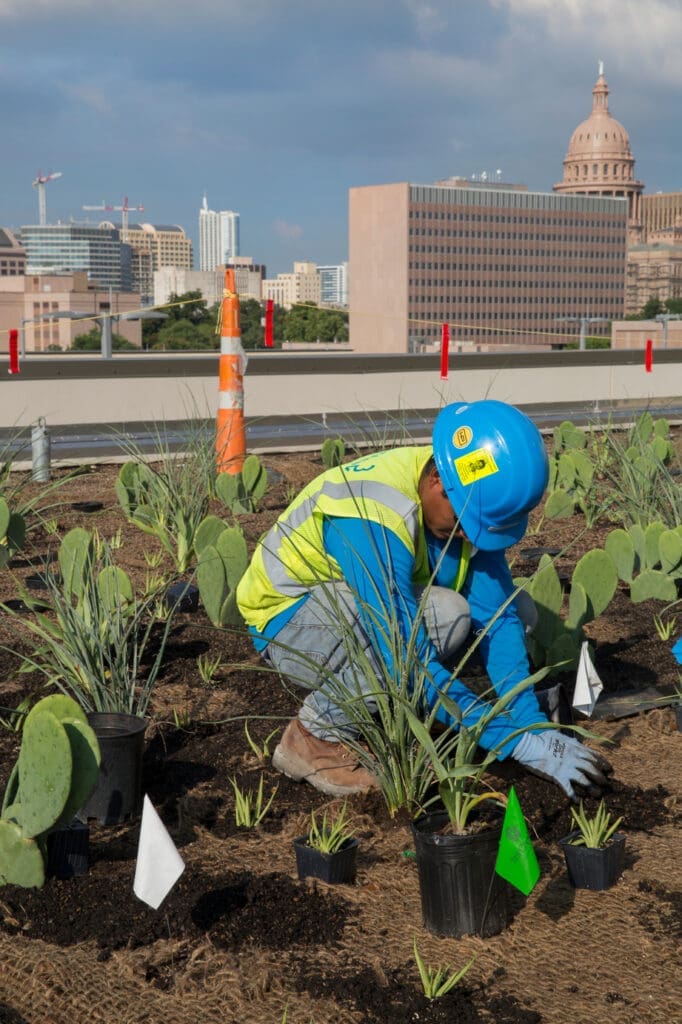
“Your best bet is perennials that prefer dry conditions,” says John Reiter, a maintenance account manager with BrightView.
Bailey says instead of relying on pre-grown systems or uniform planting, his company chooses to focus on biodiversity and create environments that allow species to establish more naturally over time.
“Rather than focusing on specific plant lists, the emphasis should be on creating the right conditions for plants to establish,” Bailey says. “In many cases, this means selecting robust, drought-tolerant species initially, while also allowing space for natural colonization to occur over time.”
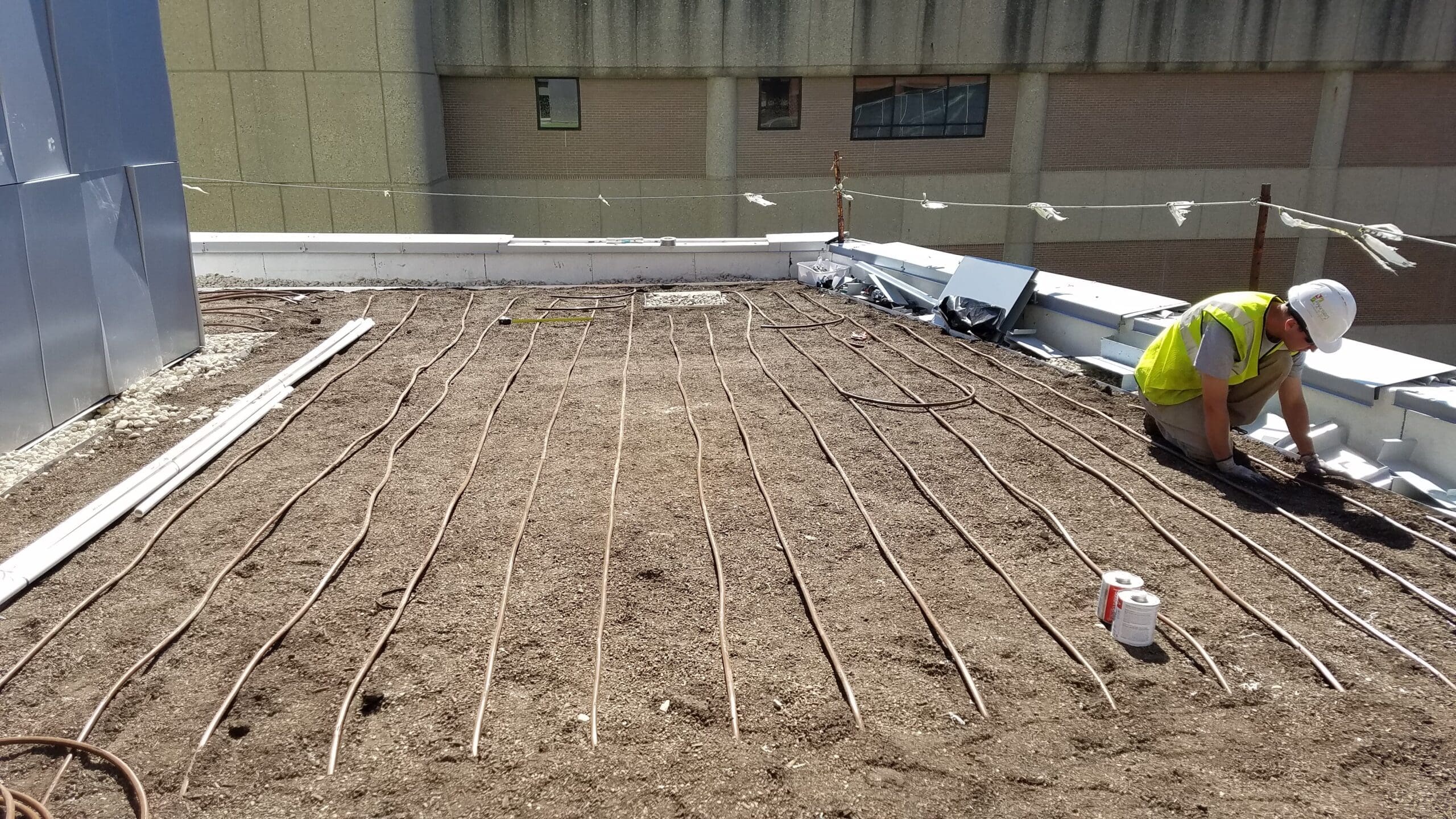
Another design aspect that has to be considered is whether you want to include an irrigation system. Reiter notes this is typically budget dependent, but most green roofs have some form of irrigation.
Fransen says they install drip irrigation systems for all of their green roofs, so no moisture is lost to evaporation or drift. He says these systems are important for plant establishment and during extended dry periods.
“Sometimes in our late summer into fall, we just get two months of 90 to 100 degrees, no rain, and everything needs a little drink, especially the roof, because stuff is just up there baking,” Fransen says.
Bailey says he is looking into how to reduce or eliminate the need for irrigation systems, as many conventional systems rely on irrigation to maintain appearance, but this can work against long-term resilience.
“A more robust approach is to design systems that can survive and adapt to natural rainfall patterns, even if that results in seasonal variation in appearance,” Bailey says.
Maintenance Misconceptions
One of the biggest inaccuracies is when green roofs are pitched as either ‘low maintenance’ or ‘maintenance-free.’
“As soon as they say, ‘low maintenance’ or ‘no maintenance,’ it’s selling the customer that they don’t really need a professional to touch their investment on their roof,” Fransen says.
Fransen says green roofs have begun to get a bad rap with customers when they try to take on the maintenance themselves or have it done for less. Inevitably, the care for the space falls into disrepair.
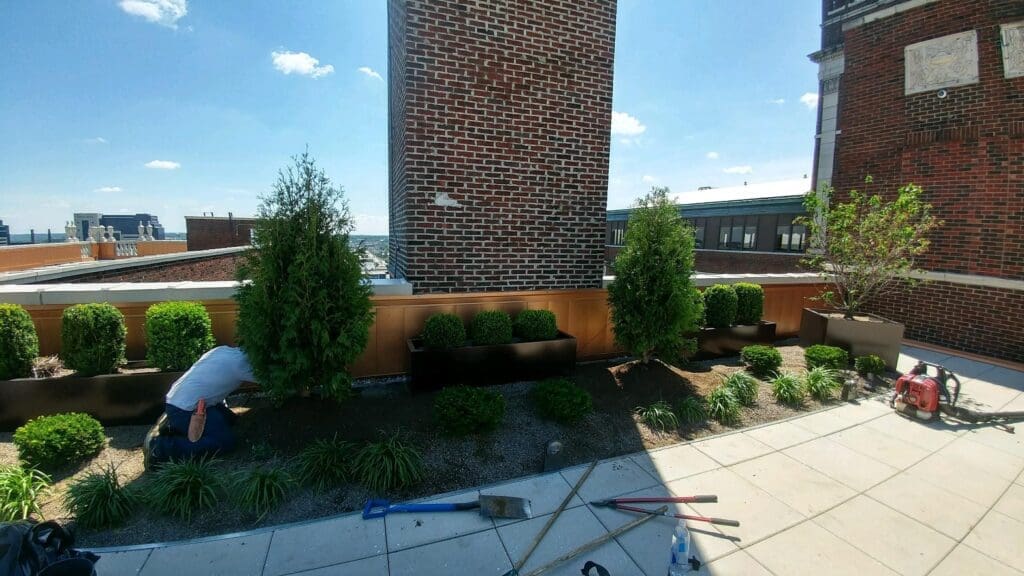
“We have replaced probably three or four that we’ve had to go back and replace after five or six or seven years of it being installed because they were mismanaged or maintained incorrectly,” Fransen says. “That’s a big cost, because obviously, logistics on a rooftop after a building is constructed and complete makes things even more difficult.”
Reiter says they’ve also had to take over poorly maintained green roofs, as often clients assume it is fine to install it and forget it.
“Green roofs require a great deal of monitoring, including plant material health, inspecting drains, soil scour, weeding and general overall health that quickly cause issues if not properly maintained,” Reiter says. “Maintenance costs must also be accounted for.”
Neglected green roofs are typically overgrown with weeds and lack plant material.
“The first thing we do is clean up the existing green roof and reinstall new material where needed, including soil as needed,” Reiter says.
Bailey notes that green roof maintenance is less about control and more about observation and light-touch intervention.
“A well-designed biodiverse roof should not require intensive intervention, but it does require informed management, particularly in the early stages,” Bailey says. “The focus should be on guiding the system rather than maintaining a fixed aesthetic.”
Fransen says one of the main maintenance tasks for green roofs is drainage checks.
“These rooftops have non-traditional landscape drainage, and you have to make sure the roof drains are all free and clear,” Fransen says. “They don’t need to have a bunch of biomass in them, then they can become a fire hazard.”
Other maintenance tasks include inspecting plant material health, replacing lost plant material, weeding, pruning and keeping proper soil levels.
“Monitoring these aspects of the green roof will help sustain the overall health of green space,” Reiter says. “It’s also important to document the first two years of any green roof to ensure success.”
Key Mistakes to Avoid
Green roofs are not your traditional garden, and it is this mindset that can result in the most common mistakes.
“This can lead to over-reliance on irrigation, inappropriate plant selection and systems that require ongoing intervention to survive,” Bailey says.
Fransen says it is critical to set the proper expectations with clients and educate them more about realistic maintenance needs.
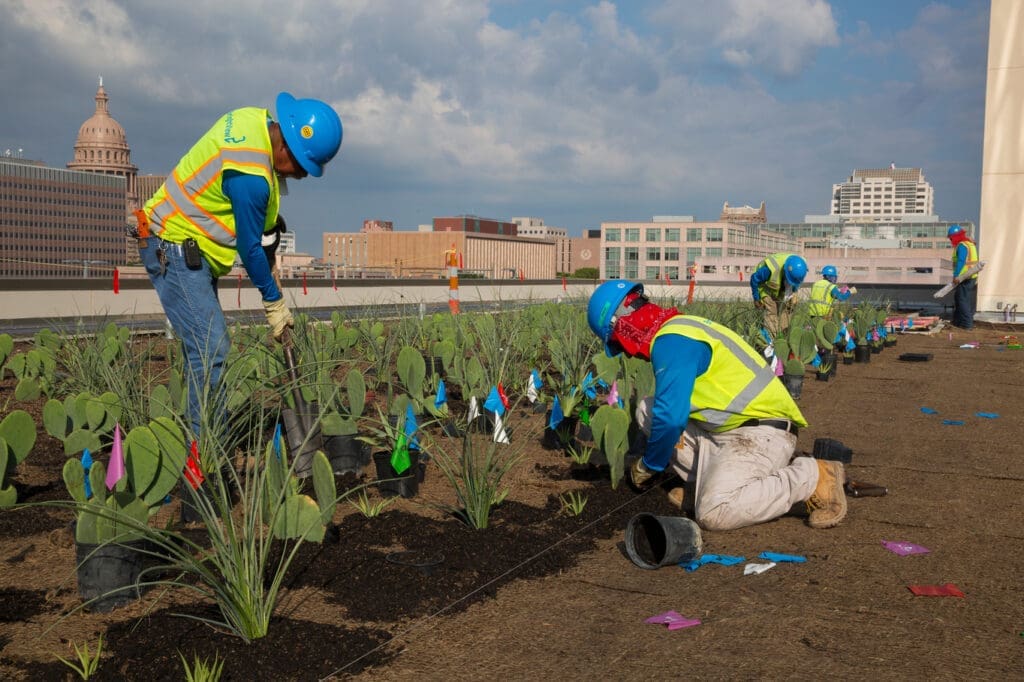
“Every green roof needs a very good maintenance plan,” Fransen says. “I think if we had irrigation and a very good maintenance plan, then they would be viable and beneficial for a very long time.”
Another mistake is when clients prioritize immediate visual impact over long-term performance. Using too many plants to get an instant effect or the wrong varieties for the environment can limit the ecological value of green roofs.
Green roofs are a distinct ecological system, and when they are treated as such from the start and realistic expectations are set, they are far more likely to deliver on their promise. Thoughtful design, appropriate plant selection and a clear maintenance plan are what turn a green roof into a lasting asset rather than a costly disappointment.