

People remember the trailblazers. The ones who were brave enough to go out on a limb and try something no one else was quite confident in yet. Implementing artificial intelligence in meaningful ways is one of those unknowns that only a minority of landscape companies are currently exploring.
In a survey conducted by Aspire, over 1,000 landscape companies reported they believe artificial intelligence will make the biggest difference in field operations, smart routing and scheduling. Despite this attitude, only 17 percent of companies said they are currently leveraging AI.
“I don’t think people understand you can train it and actually store information in there to be used throughout whatever you prompt it,” says Joseph Watruba, founder and CEO of LDI Landscape, based in Kathleen, Georgia. “That’s what got me interested in it. It’s been a windfall after that.”
Chelsea Hartshorn, co-founder of Threadleaf Landscape Design, based in Lehi, Utah, has gone all in on AI. She says everything, from design development to marketing and admin support, now has at least a splash of AI included.
“There’s been a lot more things that have come out that have gotten way better at the design side,” Hartshorn says. “On the admin side, I really feel like AI, in general, does good job at keeping that in the forefront and being very versatile with that as well.”
Internal Productivity Gains
One of the main benefits of AI is speed.
“If I’m going from A to C, I get to B faster,” says Samuel Rankin, founder and president of ETCH Outdoor Living, based in Huxley, Iowa. “I think that’s huge. The faster that I can get up to where I can have maybe a rough draft deliverable, the better. Certainly, it still takes time to deliver something, but my time to market with our team is shorter, so I can then accomplish more things.”

For instance, Rankin says the AI on his iPhone can summarize a batch of texts in a group chat.
“If there’s a problem going on at a site, and you see 10 texts, instead of reviewing all 10, it’ll give you a very accurate summary,” Rankin says. “It misses some of the details sometimes, but it will give you a very good baseline that if you’re in a meeting and you just have time to read 10 words, it will get you most of the way.”
Rather than spending hours on mundane tasks, AI can streamline processes and shave chunks of time off. Depending on your usage, it can save you anywhere from 30 to 75% of your time.
Hartshorn says tapping into automation and integrating AI into their other systems is the key.
“I do think that a lot of the time, people think that AI is really awesome, but unless something can happen because of it, and it’s not just adding to their plate it’s not something that’s very usable at the end of the day,” Hartshorn says.
Watruba says he doesn’t quantify it in terms of time savings, but rather, he is more productive now. When deployed strategically, AI frees you up to focus on other tasks.
Rankin says one of the main ways his team uses ChatGPT is with frameworks.
“The way that I’ve coached to be using it is to let it give you an outline,” Rankin says. “Let it give you the ideas. Let it give you a rough draft, but then it’s really where you got to go in and add the personal touches, where you have to add the specific information that maybe only you would know.”
Watruba says he uses ChatGPT for everything, including planning company parties.
“Just every time I get an idea, I just throw it in there,” Watruba says. “It’s just crazy what it comes up with.”
Hartshorn says she’ll also talk to ChatGPT at the end of the day about some of the issues she encountered at work.
“It can give me some feedback on what I could do differently, or what I need to do to make that a better situation,” Hartshorn says. “Again, it’s about that next step. Ideally, it’s hooked up to my calendar so that it can block out time for me to do that kind of stuff as well.
Accessing Insights
AI can also be useful in analyzing data. Hartshorn says they have a custom GPT they use to review their quarterly financials.
“It helps us with our long-term vision,” Hartshorn says. “It knows high-level ideas, and it can help us specify better steps going forward. It will say maybe look at more support on your internal instead of leaning on subcontractors because one day you want to do this and this. It will give more specific things if you’re able to give it that information.”
Watruba says he’s working to turn his AI into a business partner.
“You can use some products like Mind Cloud,” Watruba says. “They connect with Aspire, and you can actually send it reports, and it’ll crunch the data for you. One thing I want it to do is tell me my three weakest crews every week, and it’ll do it. You teach it what you want, and you’ll get an email showing, ‘Hey, here’s your three weakest crews on production.’ You don’t have to look at reports.”
Watruba says the hardest part is simply getting the necessary data into the system for it to process.
Rankin says he’s dabbled with giving ChatGPT a set of financials and asking for its interpretation. He’s also given an acquisition target and asked if it was a good fit.
“It struggled a little bit,” Rankin says. “I had to give it a few more prompts and a little bit more direction to get the information that I wanted, which then it almost felt counterintuitive that I was I was telling it the answer that I wanted it to give me, right?”
Sales and Customer Experience Enhancements
AI is also being utilized by software companies to launch industry-specific tools for landscapers to help speed up the estimation process.
Rankin says they use Simple Estimate, which utilizes AI to generate takeoffs for residential properties and provide leads with an immediate online quote.
“You just simply plug in your service, address, name, phone number, email, so we get their information, and then it spits out that free quote for kind of all of our services,” Rankin says.
Watruba is working on training his AI to help his estimators on budgeting for all the necessary items.
“In other words, they don’t have to be like, ‘Oh, I forgot the nails,’” Watruba says. “It can prompt you to say, ‘Hey, what about this?’ The estimators can be green and be prompted with all these things that only somebody with experience would know.”
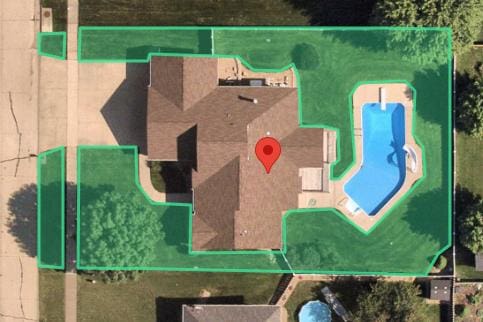
Joel Northrup, founder and CEO of Deep Lawn, based in Austin, Texas, says their sales tool uses computer vision to generate instant quotes.
“We take in aerial and satellite imagery, and our proprietary AI models will automatically measure and detect all of say the turf on a property for lawn care and lawn maintenance companies, the driveway and sidewalk data for snow removal companies,” Northrup says. “We also pull in house perimeter data, particularly for pest control companies.”
Northrup says instead of lawn care companies having to visit a property with a measuring wheel or manually draw on a Google map, AI can provide instantaneous results for homeowners. He says what previously could take 15 minutes to 2 hours can now be provided in seconds.
“It really brings a ton of value to lawn care companies, particularly in the spring when they’re inundated with hundreds of calls,” Northrup says. “It helps the buying experience be a lot more seamless for the homeowner, and also eliminates a lot of wasted time on their end for giving pricing and onboarding new clients.”
With their newfound time savings, Northrup says their end users can focus more on setting expectations with clients.
Northrup says they also have a geopricing feature, so only individuals in your service area can request a quote.
“Consumer habits have changed dramatically ever since COVID,” Northrup says. “I think COVID really accelerated what already was a fast change. I think it’s very important to get ahead of these new curves with consumer demand. I think utilizing AI to sell online is a no-brainer for residential service companies.”
Hartshorn uses another one of her custom GPTs to assist in developing plant maintenance packets for clients. Not only does this eliminate a menial task for her team, but also sets the customer up for success.
Design Support
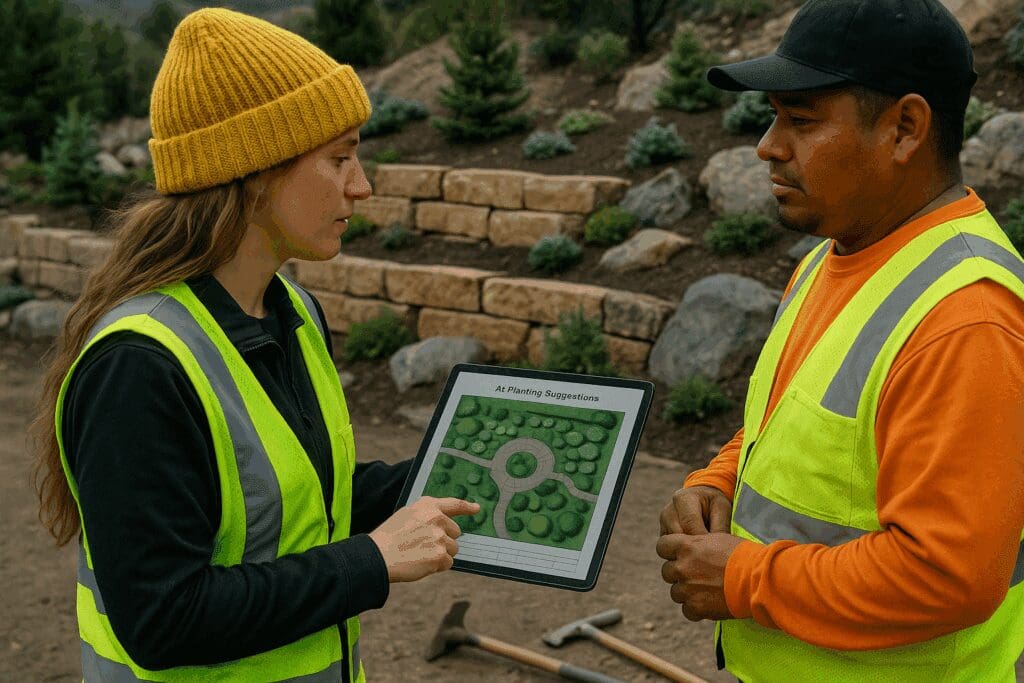
Hartshorn says AI can be a useful tool for design visualizations as well. She says while Midjourney is the best at creative, accurate and specific images, it can’t be too ambitious. She acknowledges this particular aspect of AI is still on the weaker side.

“It hasn’t gotten to a point where I’m like, ‘Wow, this is so accurate, and it saves me so much time,’ because I still have to do the front-end work to make sure that it’s accurate to actually create it right,” Hartshorn says.
Many other AI image generators are better suited for more conceptual purposes, such as Leonardo.Ai. Hartshorn cautions against sharing AI-generated images with clients, as some may take them too literally.
Rankin adds that AI image creation is more helpful for idea generation for a design.
“I think it’s great for getting started, but I think it’s really poor at the finishing touches,” Rankin says.
Hartshorn does have ChatGPT help create plant palettes based on their database.
“If you can hook it up to an online database, we have a couple of nurseries that are in our local area that have a pretty good, up-to-date inventory that I will tell it to pull from and ask it to give us some ideas for a certain area or color, that’s really helpful,” Hartshorn says.
Planning and Training
Watruba says the main function he and his team use AI for is planning. He says he spends 20% of his time on how to be more productive. He’ll often ask ChatGPT for ways to improve a process.
“Normally, I’m using it throughout the week,” Watruba says. “A lot of times, I’ll brainstorm a lot and just store the chats.”
Rankin also says he’ll explore different ideas with ChatGPT.

“I’ll have a business idea, and I’ll use ChatGPT to ask me dumb questions, but then I have to answer about it,” Rankin says. “I use it to actually question my ideas as a sounding board.”
Rankin says they’ve also tapped into AI as a whole management team when revisiting their mission statement and vision statement. He says it’s been beneficial for training purposes as well.
“You can use it as a sales trainer so you can talk to it, and it will give you a rebuttal, and you’ve got to go back at it,” Rankin says. “It’ll give you another rebuttal, and then you got to solve that issue. I think you can use it way more than people think. It’s way more capable.”
Rankin says their branch manager has used AI to create 40 weeks of training.
“We created a big, huge training document, and the framework for that came from ChatGPT,” Rankin says.
Following the Trail
If you want to delve deeper into the possibilities of AI, first try out some of the different platforms available to find the one you like. Watruba says he uses ChatGPT and Gemini since they’re on his phone and connected to his Google accounts.
“ChatGPT is my backbone,” Hartshorn says. “You have to decide which ones you’re going to make your bed in because I utilize AI for so many things. It knows me well enough that it can pretty much do anything for me, as far as the first step.”
Then, you can begin training the AI on the ins and outs of your company and preferences. Rankin says when he started out, he asked ChatGPT what it needed to know about his company to provide him with the best information.
“It asked me a series of 20 questions, and I answered those, and it asked me 20 more questions,” Rankin says. “I answered those 20 questions. It asked me 20 more questions, and then I said stop. I think that was huge because it tailored the responses quite a bit better.”
The more clarity you provide in a prompt, the more specific the answers will be. For example, Watruba trained his AI to create marketing materials where the customer is the hero, following the StoryBrand framework by Donald Miller.
“It’s more than prompts, too,” Watruba says. “You still have to go conferences. You still have to go meet people, still have to read books. You still have to access the brains of other people. If you don’t know who Donald Miller is, never read the book, then you’re not going to teach AI to use that format.”
Hartshorn says another element to maximizing the effectiveness of AI is to have solid SOPs for it to reference.
“Once you have that baseline, you can compare and contrast and make your company better,” Hartshorn says. “But you have to have that pretty good setup to start with for it to pull from so that it’s accurate.”
If you choose to use ChatGPT, take advantage of the different customizations. The custom GPTs are designed for specific and repetitive tasks, like pulling plant lists for various projects.
Northrup recommends starting small.
“Some of our companies have hundreds of locations,” Northrup says. “They will roll out Deep Lawn or products like ours, and they’ll start to utilize AI in maybe one of their locations, one of their markets or one of their routes. Then, based on that feedback and the systems that they build, they can then expand it further. So I would say, definitely look at rolling it out slowly and building good systems around it.”
Northrup advises staying up to date on the latest AI innovations, even if it’s just 30 minutes a week testing out new tools.
Rankin says he stays in the loop on AI through industry news outlets and connecting with peers on social media. Hartshorn says she uses TikTok and podcasts, such as The AI Daily Brief, to stay up-to-date on the latest updates.
“If you’re not looking for new ones, then you’re not keeping up,” Hartshorn says. “They literally change hourly almost at this point.”
Hartshorn encourages landscape professionals to see AI as a tool and figure out where it can help them in their business.
“I’ve been saying this since the beginning: AI won’t replace people, but it will replace people who are not using AI,” Hartshorn says.
“The early adopters win,” Watruba says. “Anything you do, the people who get in first always win. Get in first, master it before everybody else, and you’ll be ahead. The faster you get on the board, then you’re going to be ahead of your competition.”
This article was published in the July/August issue of the magazine. To read more stories from The Edge magazine, click here to subscribe to the digital edition.
