

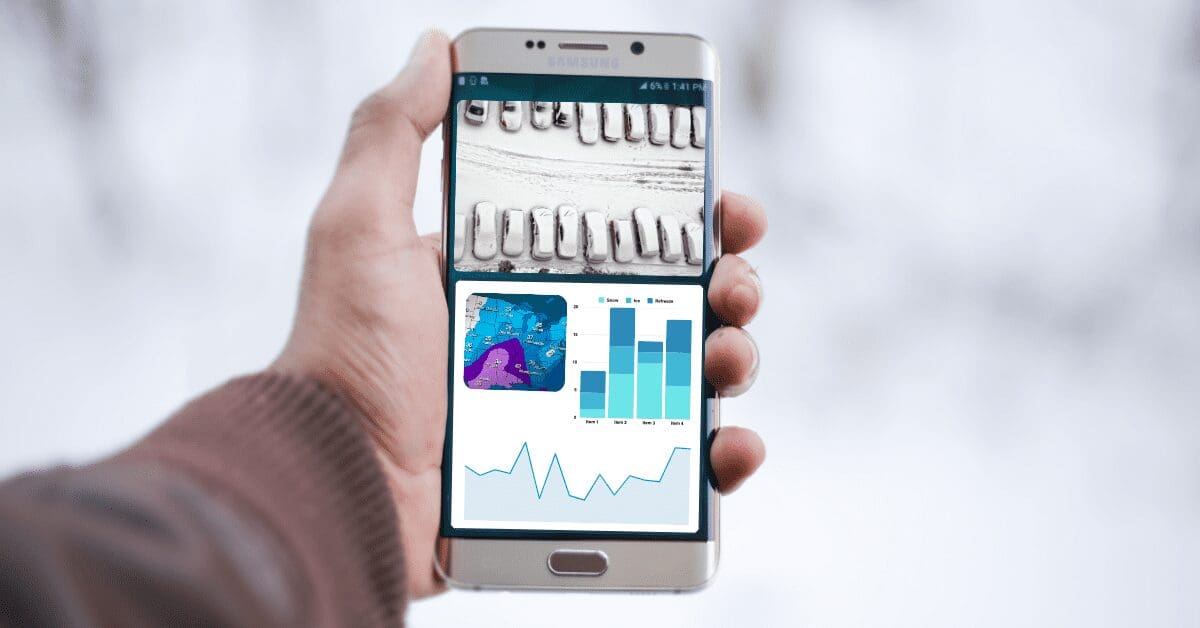
Snow and ice can be incredibly fickle, and often, meteorologists will still be adjusting their predictions with mere hours before a winter storm hits. If your landscape company provides snow and ice management services, you’re well acquainted with being at the mercy of Mother Nature.
Thankfully, there are a number of tech tools that can make your job a little easier when it comes to tracking the weather and showing proof of service to your clients.
AccuWeather
When you need hyper-local snow predictions, AccuWeather is a dependable weather forecasting service that has been around since the ’60s. The site offers advanced radar tracking with snow-specific views and minute-by-minute precipitation tracking for better planning.
A paid version of AccuWeather offers historical data for detailed analysis, snow warning services that are focused on the impact on pavement and travel, and authenticated snow totals. Last winter, AccuWeather’s start and end times of snow and ice had an average error of only one and half hours compared to an average error of more than three hours from other sources.
By enhancing your overall preparedness, you can reduce your liability and make better decisions when it comes to staffing and responding the snow and ice storms.
Windy
Another forecasting tool is Windy, which incorporates data from multiple forecasting models, including the European Center for Medium-Range Weather Forecast (ECMWF) and Global Forecast System (GFS). What started as a pet project is now a worldwide service that allows users to toggle on and off various meteorological parameters, such as wind, humidity, snow depth and more.
Windy is ideal for tracking large-scale storms and snow patterns so you can get a better sense of what is headed to your service area.
Frost Solutions
On the hardware side things, Frost Solutions has several tools to help provide insights for the properties you service.
Their mini-weather station is a modern version of a Road Weather Information System that provides customized forecasts, site photos, and more. They can eliminate the guesswork and send specific alerts such as ‘Notify me when the pavement temperature drops below 32º at any of my locations.’ These stations can be useful if you deal with microclimates or need to justify the treatment of a site to your customers. The mini-weather station can also be used to capture proof of work with before and after pictures.
Their Frost Vision cameras are AI-enabled cameras that can tell you when snow starts to fall or accumulate at your sites. These can provide additional visual coverage the mini-weather station can’t account for.
For accounts that only trigger after a certain depth is reached or have pay-per-inch clauses, there are Snow Depth Sensors, which are Bluetooth-enabled sensors that measure the actual and historical depth of snow on a site.
All of Frost Solution’s products can work independently or as a suite. If you have specific properties that require a higher level of attention or have isolated sites that you want to reduce drive time to, you can access the data from these tools via Frost Solutions’ web-based platform via a smartphone, tablet or computer.
WeatherWorks
Location-specific snowfall data is critical for billing, compliance and client reporting, especially depending on the nature of your customers’ contracts. WeatherWorks Certified Snowfall Totals are another option when providing post-storm documentation for all types of winter service contracts.
After a winter storm occurs, snowfall measurements are collected. A WeatherWorks meteorologist researches the snowstorm, noting the timing, intensity, temperatures, and winds. Additional observations are collected from public and private sources. Snow totals are analyzed and then generated for each city and postal code.
Certified Snowfall Totals are published to their database within 48 hours of the conclusion of the storm. Clients are notified via email so they can log in and retrieve their specific snow totals. These totals can be automatically integrated into billing software for faster invoicing.
Users can access storms from the current season as well as the two prior seasons. They can also generate custom snow depth reports for seasonal contracts.
WeatherWorks also offers VeriFreeze as an add-on, which provides daily information regarding the occurrence of ice formation due to a recent refreeze event, as well as black ice, providing documentation for non-accumulation service calls to help avoid conflict.
WeatherTrends360
While there isn’t a crystal ball available for what next year’s snow season will bring you, WeatherTrends360 does offer year-ahead weather and predictive sales analytics for businesses.
Because traditional, physics-based meteorology is only reliable a few hours or days out, WeatherTrends360 created a statistical modeling algorithm fueled by 124 years of weather data covering every square mile on the planet. They have a total forecast accuracy of 85%.
This software can help you anticipate demand spikes and optimize your staffing well in advance.
