

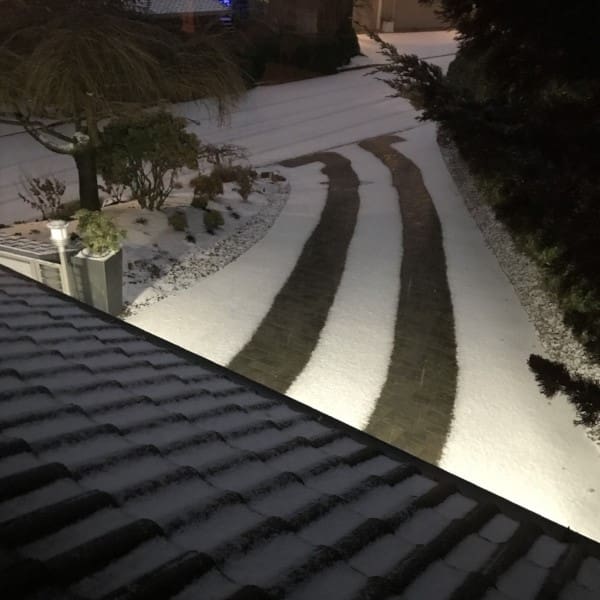
If you have clients in colder regions where snow is a common occurrence or falls frequently enough for it to be a headache for homeowners, one luxury addition to their property you can suggest is a snow melting system.
“Most people that want one will find out that they can’t afford one,” says Ben Bowen, a landscape designer with Ross NW Watergardens, based in Portland, Oregon. “So before you spend time designing the system, put together a ballpark price and share that with them. If they aren’t scared away, then you can put some real time into designing and quoting the system.”
If you have clients who are willing to spare no expense, these systems can be extremely beneficial during the winter.
“Sliding down your driveway, in your car or on your butt, is a scary situation,” Bowen says. “If you are lucky, it is just a funny story, but the risk is real. And here in Portland, more than snow, we get ice. Even level surfaces become treacherous. And quite often, because Portland weather is notoriously tough to forecast, we get surprised by freezing weather.”
While it is definitely a niche product, Bowen says interest has been growing every year as more people in their area become aware of residential snow melting systems. He says they’ve helped five to 10 clients a year design and budget for a snow melting system since 2017.
Installation Tips
Bowen says typically, clients want the system installed for their driveways or walkways.
“You want to be able to use your driveway safely, get your mail safely, and get to your front door safely,” Bowen says. “You can avoid your patio during an ice storm, but being able to get out of your driveway if you absolutely have to gives many people peace of mind.”
He says that for driveways, most people will opt to just have the tire track section of their driveways heated as this smaller installation is more budget-friendly, easier to power, and less disruptive. He notes that with snow melting systems, if the snow comes down too quickly, the system can fall behind, but as long as the melted snow has somewhere to run off to, it will eventually clear.
Bowen says that if you are installing a snow melting system where a concrete driveway already exists, the installation will be a lengthy project. With their installation in 2017, they had to remove the old concrete driveway, excavate for a new paver driveway, install a paver base, then the snow melting system and then the paver driveway itself.
“It took three weeks from start to finish,” Bowen says. “Obviously, if the home is being built and so the system can be installed prior to the driveway installation, the timeframe will be much shorter.”
Bowen recommends for most installations simply removing the previous driveway and installing a new one over the snow melting system.

Photo: Ross NW Watergardens
While it is possible to cut sections of the driveway out, install the system, and then pour concrete or install pavers over the top, it will be difficult to do and have it look right. Bowen adds that if someone can afford a snow melting system, they will be able to afford a new driveway.
All common driveway and walkway materials can be used over these systems, including concrete, pavers, natural stone and gravel. Bowen says the snow melting systems can work on any property, but some may make the installation more challenging.
He says the systems are pretty flexible and can be adapted to pretty much any situation. Bowen stresses not damaging the snow melting system as it’s being installed.
“Once it is under the concrete or pavers, it is protected, and breaks would be rare, but a careless step could cause a break that may not be easy to find,” Bowen says.
There are several different brands in the snow melting system market, including WarmlyYours, ThermoSoft, Warmzone and Warmup Systems.
“I have enjoyed working with Warmup Systems,” Bowen says. “They are very good at helping you install your first system, understanding what you don’t know and what mistakes you are likely to make.”
To install a snow melting system successfully, you need to involve an electrician from the very beginning of the design process. Some homes will have the capacity for a snow melting system, while others may need to upgrade their electrical service.
“Working with a good electrician from the start is key. And then be prepared to go slow as you install your first system. So much of the system will be inaccessible when you are done, so take your time and get it right!”
