

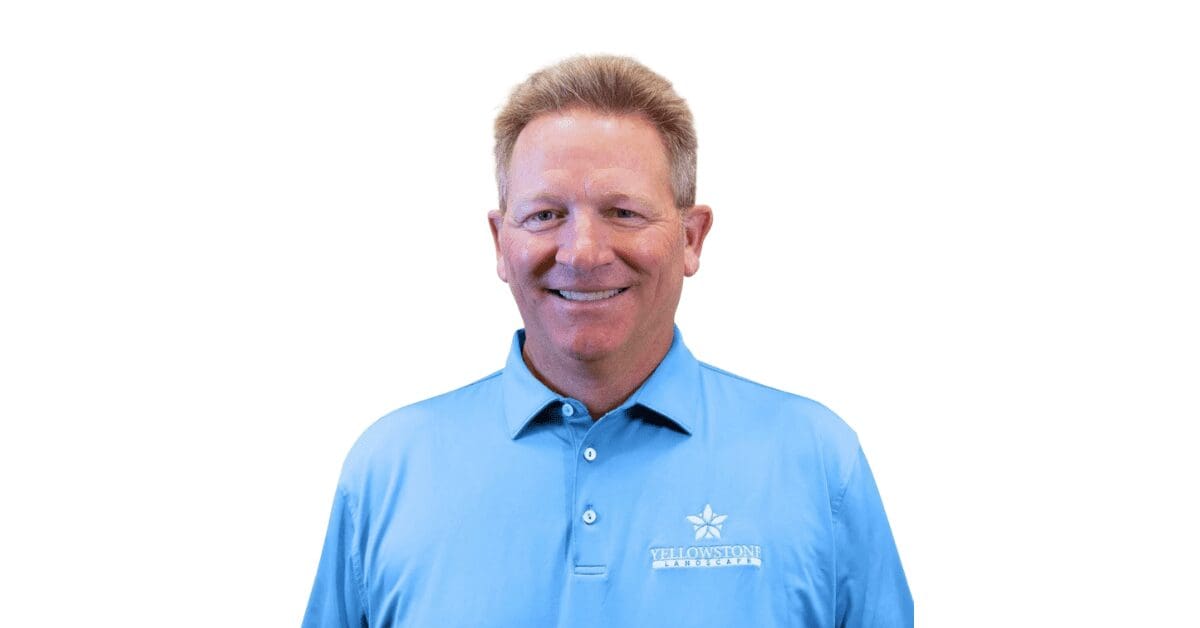
Tim Portland is the executive chairman for Yellowstone Landscape, a national landscape company headquartered in Bunnell, Florida. Before stepping into his current role in May 2023, Portland was CEO for the company for more than a decade.
Yellowstone Landscape is No. 4 in the industry’s top revenue generating firms and specializes in commercial landscaping.
Before joining Yellowstone, Portland was the CEO of United Subcontractors and also was the president of several divisions of Scotts Miracle-Gro, including the Ortho and Roundup brands, Scotts LawnService, and Scott’s International Professional business. Portland has an MBA from the University of Virginia’s Darden Business School and an undergraduate degree from Dartmouth College.
What has been your biggest challenge leading Yellowstone Landscape?
That has changed from the early days. Twelve years ago, it was getting our team to truly believe we could become an enviable business, i.e., one that operates at the highest standards of safety and professionalism, treats our workforce as respected and valued colleagues, always does what we said we would do (and never skips customer specs or commitments), gets paid appropriately and at a fair price by those customers for the hard work we do, generates a reasonable profit and return for our investors, and grows our business and raises the bar higher every year. Especially from where we started, that took some doing.
The last few years, the challenges have changed. Our team believes strongly in what we do, and we’ve done it well. While we are far from perfect everywhere, we’ve had reasonably strong performance on the 5 key priorities we’ve been pursuing for over a decade: Safety, Customers, Profits, Growth, and Team
The priorities haven’t changed, but we relentlessly measure our performance on them every day, every week and every month, and we raise the bar every year on our definition of success on each.
Our biggest challenge now is developing and adding both the management and frontline people to our team that will drive the continued growth and success of our business. Beyond recruiting and hiring, we must educate and train them in Yellowstone’s definitions of success and the tools we use to enable and deliver that success for our customers, for our team, and for our investors.
Unfortunately, we’ve seen many companies in our industry set their bars shockingly low, whether it’s low pricing and poor profitability on the work that is provided; pay, benefits, standards, and/or treatment of their workforce; safety practices (or lack thereof); not meeting the specifications in customers’ contracts; and commoditizing our industry with those behaviors rather than professionalizing it.
We are therefore very focused on training recent hires who are new to both landscaping and Yellowstone, or training new team members who have landscape experience but need to be educated about Yellowstone’s standards and expectations which in many cases are harder than where they came from.
How did you maintain cultural consistency with the former owner-operators who joined Yellowstone over the years?
Anyone can buy a company if they offer enough money or choose to ignore or don’t understand potential go-forward issues, and unfortunately, there is a significant amount of that in our industry. If you looked at all the landscape transactions that were completed over the last several years, far too many have gone backwards in the years immediately following the transaction. The real standard is not if you were able to close a transaction, but how do you perform together with a company after you’ve bought it.
For Yellowstone, that performance focus starts with the introductory stages of getting to know a company and its owner(s), then the diligence that’s performed in both getting to a handshake and ultimately to a closing. We’re often told Yellowstone spends far more time and effort than the market going through with the seller what mutual success looks like 2+ years after a transaction.
What do they want to be doing? What works for their (soon to be our) key people? What do they already do incredibly well that we don’t want to change? Where will Yellowstone add value to the business after the transaction? Is that help they really want and will embrace, or would they really prefer not to go there? How do we want to grow together? What incremental resources are needed to achieve that growth? Whose roles will likely change in the near term and how? What is our mutually agreed financial plan for the rest of the current year and for the next full year? How do we combine the very best of both businesses?
In addition to the normal transaction stuff like purchase price and terms, we require clear and mutually agreed answers to those considerations and more before closing, or we determine it won’t be a good fit and we agree to pass. That mutual alignment on what success looks like and how we plan on getting there has led to awesome relationships with our former owner-operator partners and their teams, the majority of whom still work with us, even though they really don’t “have to work” anymore.
Yellowstone has grown the top and bottom line on all but two companies we’ve acquired since 2015 (and that will be down to one shortly). We are proud that we have an excellent relationship with every former owner operator from whom we’ve purchased a business. That’s not accidental. It’s not a question of if something unfortunate is going to happen after a transaction, but when. It’s usually not anyone’s fault, that’s just part of operating businesses. We don’t scapegoat anyone, we roll up our sleeves together, and dive in together to solve the issue as partners.
We treat our partners the way we would want to be treated. The combination of upfront homework, mutual alignment on plans, a partnership approach to working together after the transaction, and striving for win-win post-transaction success has helped fuel our profitable growth and returns on those investments, and helped achieve strong buy in and long-term excellent relationships with former owners and their teams that have become part of Yellowstone.
What are some of the benefits you see of being a company that is owned by a private equity firm?
Yellowstone has had three private equity owners, and we’ll likely have a fourth sometime in the future. We’ve been fortunate in that we’ve selected strong and supportive partners that were fully on board with and invested in our strategy, and we have delivered for them.
The two best parts of private equity ownership are: 1) There is no bureaucracy. Public companies have a lot to deal with that is not directly part of driving the sustainable operating performance of the business. Family dynamics can create different challenges. With private equity, our board is small, we have no committees, we are efficient, everyone sees the same daily, weekly and monthly performance reports, we are fully aligned on our strategy, and we go execute. Our board helps us with things they have far more experience in, including debt planning and execution, and access to expertise we might not otherwise engage with.
And 2) private equity has some valuable and efficient ways to share the upside of strong performance with the team of hard-working managers that deliver that performance, which can become very motivational for those managers.
When the strategy is aligned and the team is performing, it’s very much a win-win relationship. Private equity has been and will continue to be very beneficial for Yellowstone. And part of Harry’s, Timo’s and my role is to ensure that continues to be the case.
Speaking of them, how has the transition from CEO to Executive Chairman been? What are the benefits of helping lead with Harry Lamberton and Timothy Sheman versus doing it by yourself?
It’s fantastic. First – it’s awesome to have a great team. We were very fortunate to find Harry, and convince him to leave the success he was having at Waste Management and join and ultimately lead us. He’s phenomenal. He’s embraced what we do well, and added new insights and improvements that are making us even better. Timo Sherman is an awesome story, and an even better person.
When I first met Timo he was an account manager in Orlando, and a former construction and branch manager, who had a finance degree. He moved with Yellowstone to become a financial analyst; then headed up our financial planning & analysis; led all of our acquisition analysis, diligence and processes; went and got his MBA and took courses in improving his communication skills; added more responsibilities over time; and more than earned his way to becoming our CFO. All while raising seven children. Along the way, he never dropped the ball, and he kept up with all my insane requests and follow ups for more analysis and insights on our business and for alternative win-win options on potential transactions, at any time of day or night…, which even I’ll admit was quite a lot. His work ethic is legendary, and Harry’s is just as crazy.
We had already built strong field management, sales, finance, systems, and support organizations. Their combined performance has been so stellar I wish we had made the transition even earlier.
It’s been fun to watch them take the lead on both disciplined operations management as well as the key planning and growth resourcing that I used to do, and the quality of the output and the subsequent execution has been better than it ever was. So, I am loving being executive chairman. I 100% support the management team, led by Harry and Timo. They are all really good, that makes supporting them fun and rewarding, and I still get to stay engaged and help the team and the business that I love, in areas where I might actually add a little bit of value. I hope they let me keep doing it for years to come.
What advice would you give others trying to grow a successful business?
1. Understand your business model. That doesn’t apply to just landscaping but to any business. If you want to have real cash or real net income at the end of each job, understand the full cost of providing that service, including overheads, vehicles and equipment, interest costs, taxes, and management, not just labor and materials costs. EBITDA is not bottom-line “profit.”
You still have to pay for the vehicles and equipment in your business, you’re going to pay interest if you borrow any funds, and you will pay Uncle Sam if you make money. It’s amazing to me how many companies we meet that talk about their “adjusted EBITDA,” but in reality have very low single digit or no bottom-line profit after all of those very real expenses. Many don’t seem to understand how poor their business performance really is, most of which starts with very poor and aggressive direct margins.
An example business model to watch out for are landscape companies looking ahead: as autonomous mowers become more of a factor on our jobsites, they will change the business model by saving labor but adding more capital, software, and technical support costs which are not captured as part of Direct Gross Margins, including some that won’t even show up in EBITDA. So, understand how you will generate sustainable and acceptable bottom-line profits not only today, but as our industry and your business evolve.
2. Price accordingly. Don’t let anyone – your managers, your sales personnel, your team, or your customers – undercut that model (they certainly will push back and try), or you will marginalize your business to poor profitability or out of business and undercut the hard work of your field teams. Have the discipline to do so and walk away if it comes to that.
If you discount a job, your management costs didn’t go down, nor did your rent, your fuel costs, your insurance costs, your systems costs, your truck and repair and maintenance costs, your interest costs…, but hey you got volume. That discount just came right off your already low, and in too many cases negative, bottom line.
3. Educate your managers, provide them with full transparency and all the information in the business, teach them what success looks like and why, then hold them accountable for delivering on that with no excuses. I’ve heard every excuse there is, doesn’t make them valid. Lots of people and companies make them, and as a result, end up setting or accepting a low bar.
I do applaud and thank the terrific companies in the landscape industry that teach their teams to execute well. They hold themselves accountable to clearly understood standards, and don’t apologize to anyone for doing so. The result is they reward their teams for doing great work, their investors for betting on them, and themselves for leading that execution, and they have the ongoing resources to keep delivering great work for their customers.
Do what you said you were going to do. With customers. With vendors. With colleagues and teammates, especially your frontline workers. Honor your commitments. When you develop credibility and trust with others, it can go a long way.
Doing those is not always easy, and the world is certainly very competitive. Being disciplined can be very frustrating, and you’ll definitely lose a few opportunities along the way. But do the above, and good things will happen with your business, especially over the long haul, despite those frustrations.
Where do you see the future of the industry with M&A activity? What changes would you like to see in the industry?
The level of competition in the landscape industry is fierce — both for acquiring landscape companies, as well as for winning new customers and contractual service opportunities to grow organically. But that’s always been the case, and what really matters is executing.
Regardless of ownership type or size, companies that are executing will keep spiraling up: winning new work and growing, attracting people to that winning environment, building reputation and references, and having even more people and companies seriously consider joining them.
Companies that are not executing will spiral the other direction, and it won’t matter if they have PE or other backing that wants to invest in buying more companies. The better owner-operators won’t want to join them, and the best field managers won’t want to stay there.
This is a people-based business, so companies who are going to have go-forward sustained success had best be focused on making their operations a great place from which to provide landscape services, as well as a growing successful business.
Changes I would like to see are far more companies operating the way we discussed above. Stop giving away the very hard and demanding work that their frontline teams are providing for customers, allowing the industry to be commoditized, and skipping specifications to justify lowball numbers on customer properties. Be professional with appropriate standards and deliver quality work and results versus the opposite.
Where do you see Yellowstone Landscape in the next five to ten years?
Yellowstone is going to keep doing what we do well. On the one hand, we’re now one of the larger companies in our industry. On the other, we’re still a small company, there are many markets and service lines that we’ve just entered and are barely a blip on the radar, and many that we haven’t even entered yet.
So, our runway for continuing to grow and spiral upward on the priorities that are important to us is vast and will be exciting for many years to come. As we continue to execute, resource our growth, make Yellowstone a great place for really good landscape managers and practitioners, and do what we say we’re going to do for our customers, I can’t help but get very excited about the success that Harry, Timo and our team are going to create and enjoy.
This article was published in the Sept/Oct issue of the magazine. To read more stories from The Edge magazine, click here to subscribe to the digital edition.