


As the terms ‘natural’ and ‘organic’ become more common in grocery stores, it is also sparking consumer interest in finding organic lawn care services as well.
However, does that interest translate into actual profits? Dive into some of the reasons to consider creating organic lawn care, as well as the customer education required to be successful.
Why Offer Organic Lawn Care?
Edward Coady, CEO of Mainely Grass, based in Bedford, New Hampshire, says the biggest reason they decided to offer organic lawn care was to meet consumer preferences and provide that option for homeowners. He says while in some of their service areas, towns and HOAs have added ordinances against synthetic products, they decided to provide the choice of organic lawn care to all their customers.
“We certainly want to just mirror customer preferences and needs, but also make sure we’re not totally giving up on the idea that folks are ever going to believe these products are safe, because they are,” Coady says. “There’s obviously a lot of science behind it.”
He says they work to inform their clients that both traditional and organic lawn care is safe for homeowners.
“I think it’s worth mentioning, ‘Hey, these products are very safe. Otherwise, we wouldn’t use them. We wouldn’t put our technicians at risk. We wouldn’t put our homeowners at risk,’” Coady says. “At least say that, but don’t go further than that. I think people are entitled to their preferences.”
In some cases, offering organic lawn care may not be a choice at all for your company. For example, Blades of Green, based in Edgewater, Maryland, services Montgomery County, which banned the use of synthetic pesticides and herbicides on private lawns.
“You got to keep your head on a swivel,” Leahy says. “There are tons of bills out being introduced every year, trying to chip away at what we do, rather than us choosing to do it and letting the consumer go, ‘Yeah, that’s what I want.’”
Customer Demand and Costs
Around 5% of Mainely Grass’s customer base opts for organic services. Coady says this service is about 10% more expensive than their traditional program.
“The challenge we have is a customer shows up interested in organic lawn care services, and they think they’re making that binary choice, not really understanding the tradeoffs that come with an organic program,” Coady says. “We’ve certainly had folks cancel services because they didn’t see any weed control in the first two months.”
Coady says the idea of paying for something that is a work-in-progress can be a challenge for customers to wrap their heads around. He says in some cases a spouse will sign up for the organic services and then down the road the other partner will call separately and request they switch to the standard lawn care program.
“We assume when someone’s asking about organic lawn care that they’re aware of the tradeoffs,” Coady says. “Where a lot of times it’s very much not the case. We certainly had conversations with folks where it’s like, ‘The lawn care program is not working.’ ‘Well, sir, you’re on an organic program. If weeds are a concern, let’s switch.’ And they go, ‘I didn’t realize weed control wasn’t part of this.’”
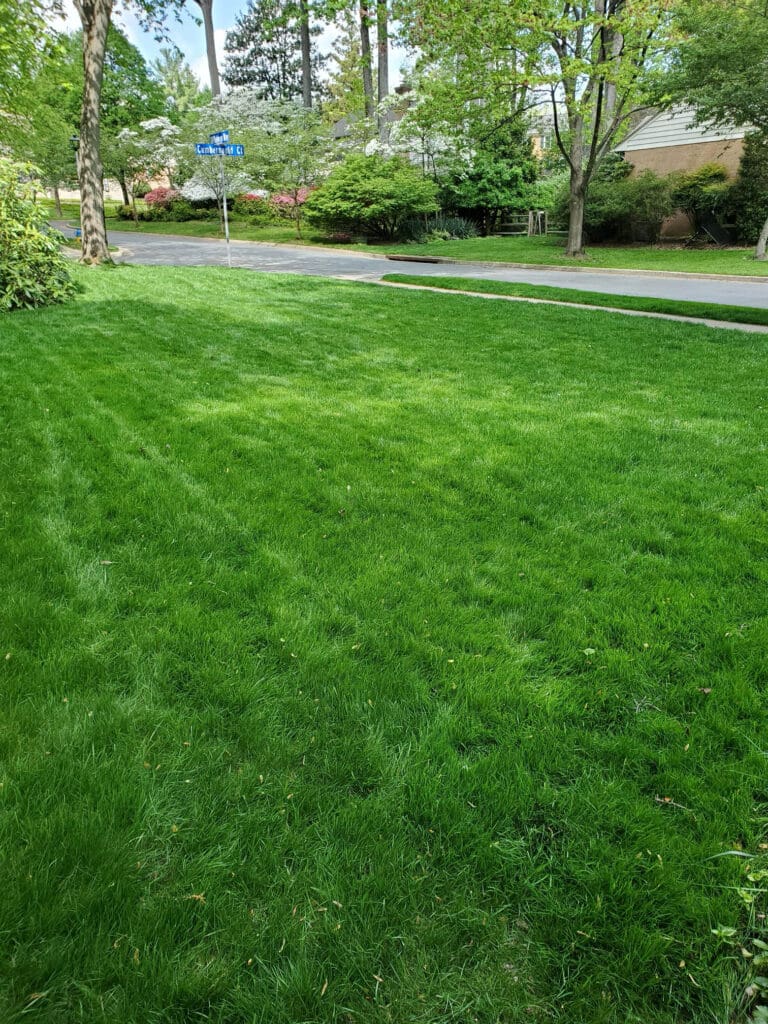
Photo: Blades of Green
Leahy says outside of Montgomery County, only a handful of their customers have purchased their organic lawn care program. He estimates less than 1% of their entire lawn care customer base uses their organic program.
“Our business has been flat since 2020,” Leahy says. “We’ve been up 30%, down 30%, then kind of flat. It’s been a roller coaster.”
Leahy says the drop-off is due to customers having limited tolerance for weeds.
“If you got two bad seasons, they’re like, ‘What am I paying for? I’d rather just do nothing if this is the result,’” Leahy says. “Typically, when we look at it, the lawn was too shady and was just impossible or mainly they didn’t follow the correct suggested maintenance practices.”
Leahy says their organic program is 30 to 40% more expensive than traditional lawn care. He says they’ve attempted to market the service for the past few years to the rest of their customer base when they express interest in an environmentally friendly option. However, when the clients discover it’s more expensive and they have to do more work, their interest wanes.
“If everybody could buy organic everything, they would,” Leahy says. “Why wouldn’t you? But they don’t, because it’s so much more expensive. The price is the biggest obstacle. The real obstacle is them participating in the lawn care process.”
Advice for Others
Leahy says starting straight organic out of the gate is much more costly. He says for those not hampered by legislation, a hybrid approach can be effective. Leahy suggests starting a customer out with a traditional lawn care program to clear the property of weeds and then transitioning to organic services.
“We often recommend the regular lawn care program to get the lawn to a great place,” Coady says. “If it’s still a preference that people would feel more comfortable with organic, we switch to that over time. I think it’s hard to just start with organic in the first place, particularly if the soil is out of whack, or the turf is particularly thin.”
When diseases or pests like grubs occur, the hybrid approach allows you to deploy effective products just like how a doctor prescribes antibiotics to address a bacterial infection.
Leahy says one way to be profitable with organic services is to sell additional services such as organic pest control so you can generate more revenue while on the property.
Leahy notes that lawn care companies in markets where properties are small are more likely to be successful.
“It’s much easier to treat those smaller areas,” Leahy says. “Some companies only treat what customers can easily see. So they’ll do fertilizer everywhere, and then they’ll do weed control in the high visibility areas, so up the front walk, next to the driveway, around the back deck, around the pool.”
Leahy says that organic lawn care is a niche market that is hard to build density in.
“I think it’s a personal decision on the owner of that company and what they believe in,” Leahy says. “If you believe in it strongly enough, you’re going to find a way to get there.”
Key Takeaways
- Organic lawn care meets rising consumer interest, but adoption remains limited. Only a small percentage of customers opt for organic services, and many abandon them due to cost and unmet expectations.
- Education is essential to success. Homeowners often misunderstand what organic lawn care entails and are surprised by the lack of immediate weed control.
- Organic programs are more expensive and labor-intensive. They can cost 10–40% more than traditional programs and require greater homeowner involvement to be effective.
