

Choosing to provide organic services for your clients is not something that should be tacked on at a whim. Executing an organic lawn care program profitably requires a focus on soil health, thoughtful logistics, and effective consumer education.
Building Your Organic Lawn Care Program
Depending on whether you are opting to create an organic program on your own or due to local regulations will greatly determine your product options.
Brad Leahy, vice president of Blades of Green, based in Edgewater, Maryland, says starting out, their organic program only consisted of fertilizer applications, but now they’ve added organic weed controls like Fiesta.
“We’ve learned some lessons from going from blanket treatments of Fiesta,” Leahy says. “It’s extremely expensive, and it turns the weeds black if you spray enough of it. If it gets too hot out, it’ll turn everything black. You’ve got to really know the products and know the appropriate temperatures to apply.”
Now, Blades of Green focuses on fertilizing, soil conditioning, pH balancing and spot treating weeds to keep their costs reasonable. He says they focus on creating a thick lawn by seeding twice a year to prevent crabgrass from taking over.
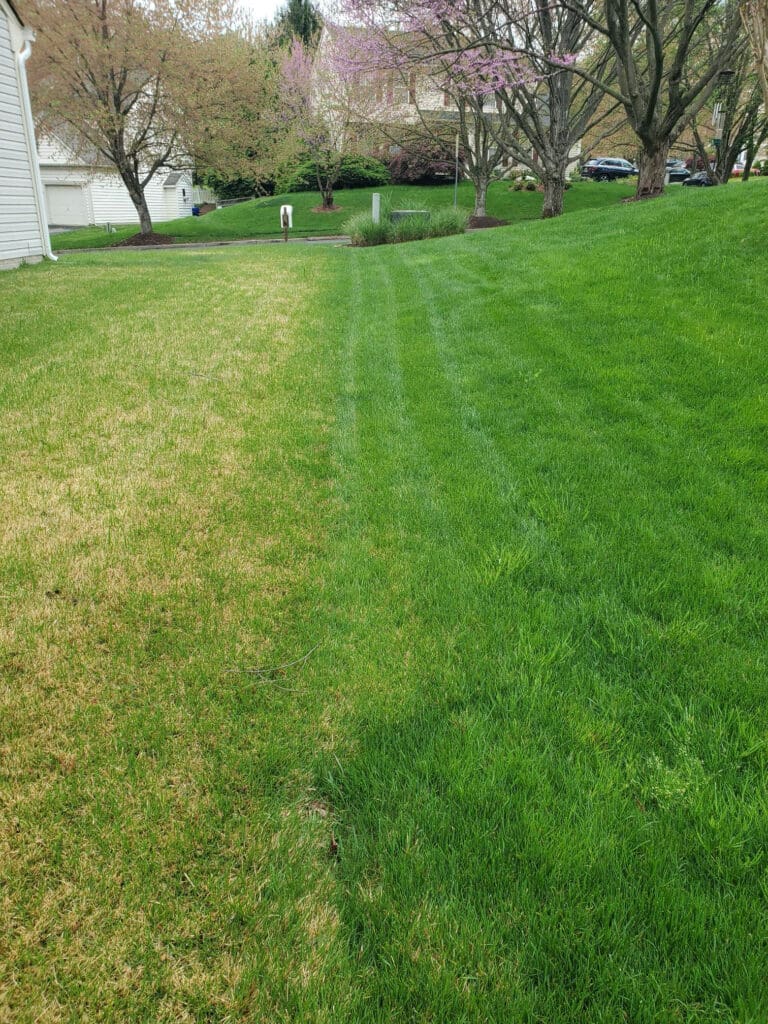
Photo: Blades of Green
“For where we are, seeding is absolutely critical to fill in and thicken the lawn to keep the weeds out,” Leahy says.
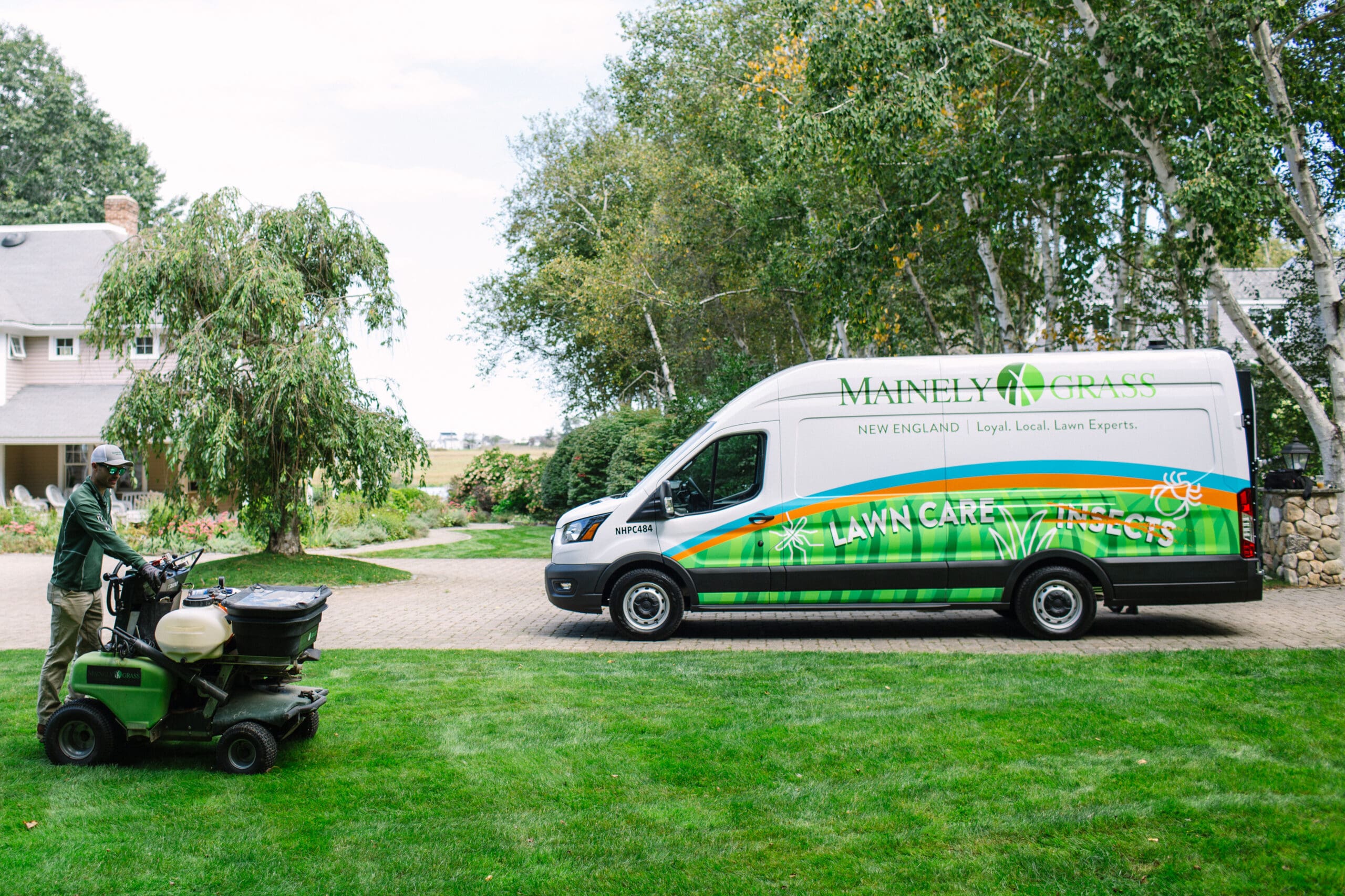
Edward Coady, CEO of Mainely Grass, based in Bedford, New Hampshire, agrees that seeding is a key component of organic lawn care. Bare spots are critical to deal with. Unlike traditional lawn programs, you don’t have effective tools to prevent weeds from encroaching.
Leahy says they soil test every year to determine what needs to be added to bring the soil into optimal condition. For new organic program customers, they tell clients it will typically take two to three seasons before they can start seeing results.
“It all depends on the conditions at that time period, but also what they do and how they maintain their property,” Leahy says. “Do they have irrigation? The number one thing is if they mow it too short and too often, it stresses the lawn out. It creates thin spots and weeds come in.”
Coady says they view their organic lawn care as a holistic process and also start with a soil test to see what is needed to improve the health of the lawn. He says it typically takes at least two years to get results.
Mainely Grass utilizes OMRI-certified organic fertilizer, biostimulants, and lime applications as part of their organic lawn program.
Logistical Considerations
One major hurdle to adding an organic lawn care program is the need for dedicated equipment for this service. Leahy says they use completely separate trucks, as it’s very difficult to get traditional weed control products cleaned out of a tank.
“This is the problem with doing it within your existing customer base and not in a totally different geographic area,” Leahy says. “I can’t roll two trucks to go do two houses here, and then another truck to do these other four. It’s just not efficient. You better make sure you’re charging correctly for the extra drive time that you’re going to incur.”
Coady says they address this issue by having a program that can run the same route, and they have slightly different equipment if needed in the same areas.
“We don’t run organic-only routes because of the density issue,” Coady says. “I would say the organic portion is certainly growing. We’re very proud of our organic program, otherwise we wouldn’t offer it. It is a growing segment, and we are trying to be thoughtful about it. That density piece is definitely a hard part as you think about fitting it into your overall offerings.”
Leahy recommends thinking through round timing as well. If you’re spot treating, technicians need to visit properties more frequently. He notes that organic products also deteriorate faster than synthetic products.
Coady says one of the challenges they face with using organic fertilizer is that the percentage of nitrogen is around 15% at best, compared to a synthetic fertilizer that can have up to 30 or 40% with controlled release.
“You just have to put down so much organic product to reach those necessary nitrogen levels, so that just makes it more expensive,” Coady says.
Coady adds it’s very tough to know which organic products are truly effective as they don’t face the EPA’s rigorous testing standards like synthetic products do.
Leahy says they have test plots where they are constantly trying out new organic alternatives for controlling weeds.
You also need to train your customer service staff to understand the difference between the two programs. Leahy says if a traditional program customer calls complaining about weeds, that warrants a site visit to re-treat. Meanwhile, an organic program client calling about weeds may require some re-education.
“If we did something wrong or we missed something, yeah, of course we’re going to treat it,” Leahy says. “But if we treated it and there are a few weeds popping up on the edges and kind of stuff that we would consider that’s a pretty good job.”
Leahy warns if you’re doing more than two service calls a year on every year on an organic property, you will lose money.
Educating Clients
The most common misunderstanding clients have about organic lawn services is that it will provide the same results as a traditional program, but at a slightly higher cost.
“An organic lawn care program is not going to come with even close to the same level of weed control,” Coady says. “I think the thing for us is just making sure we’re reflecting consumer preferences. Do they understand the tradeoffs they’re ultimately making as they decide between a standard lawn care program and an organic program?”
Coady says you must teach organic program clients that this is a multi-year process and they’re engaging in a long-term partnership. It is critical to set expectations with clients and educate them on what their role is in the lawn’s care.
Organic clients need to be willing to buy into the process, as they are responsible for ensuring their lawn is watered and mowed at the right height.
“So many folks are mowing so short and if those weed seeds just have exposure to sunlight, that’s making the whole problem worse,” Coady says. “The more people can have a proper mowing height to make sure those weed seeds don’t get exposed and remain in the shade is big.”
Leahy adds that one particular challenge is if the homeowner is personally adding more fertilizer or a weed killer to the lawn. When the technician comes to treat the property the following week, it can hurt the lawn. He stresses customers cannot leave fall leaves on a lawn for too long, as it can wipe out a season’s worth of work.
“We’re trying to make sure the soil is in optimal condition as best we can for that property,” Leahy says. “We have some good-looking lawns when the homeowners participate. If the homeowners don’t participate, it’s very hard to get a decent-looking lawn.”
Key Takeaways
- Organic lawn care requires customer buy-in. Success hinges on client education and participation in proper maintenance, which are essential to achieving results.
- Offering organic services often involves separate equipment, increased labor, and higher material costs, requiring careful pricing and route planning to remain profitable.
- Organic programs deliver less immediate weed control compared to traditional lawn care. Companies must clearly communicate this tradeoff upfront to avoid customer dissatisfaction.
