


Earth Day serves as the birth of the modern environmental movement. Prior to 1970, many Americans were oblivious to the threats a polluted environment posed to themselves and the planet as a whole.
For more than half a century, this day has been celebrated as a time to conduct service projects or educate the public on ways they can protect the environment.
It can also be a time for lawn and landscape companies to evaluate ways to improve their sustainability efforts. Below are a handful of companies that are constantly looking for ways to be better stewards of the environment.
Klausing Group, Inc.
Roscoe Klausing, CEO of Klausing Group, Inc., based in Lexington, Kentucky, says they are always looking for ways to improve both operationally and for their clients.
“From an operational standpoint, we’re focused on everything from evaluating fuel sources and managing our waste stream to rethinking the materials we use for things like career fairs, choosing quality, reusable items instead of cheap, disposable ones,” Klausing says. “It’s all part of a broader commitment to responsible and thoughtful practices.”
Klausing Group is always recommending ways clients can use their landscapes as environmental tools such as installing bioswales or rain gardens to manage stormwater.
“We also advocate for native and, better yet, keystone plants, species that have evolved over thousands of years in a particular ecosystem and provide the greatest benefit to native wildlife,” Klausing says.
The company is also currently pursuing B Corp certification, a distinction that requires companies to ensure all their products, practices and profits do no harm and benefit all. They submitted their application in the first quarter of 2024.
“I’m inspired by the idea that a business can do more than just generate high profit,” Klausing says. “It can also be a force for good. That means being a responsible community partner, an employer that pays a living wage, and an organization that takes its environmental impact seriously.”
Klausing says that the B Corp assessment compares their company against a set of best practices, which serves as a roadmap. While they scored well in a number of areas, it also highlighted opportunities for growth and improvement.
Aside from promoting biodiversity and climate resilience with their landscape practices, Klausing Group also supports the environment through their 10% for the Community program. Since 2000, they’ve donated 10% of their net profits back into the communities where they work.
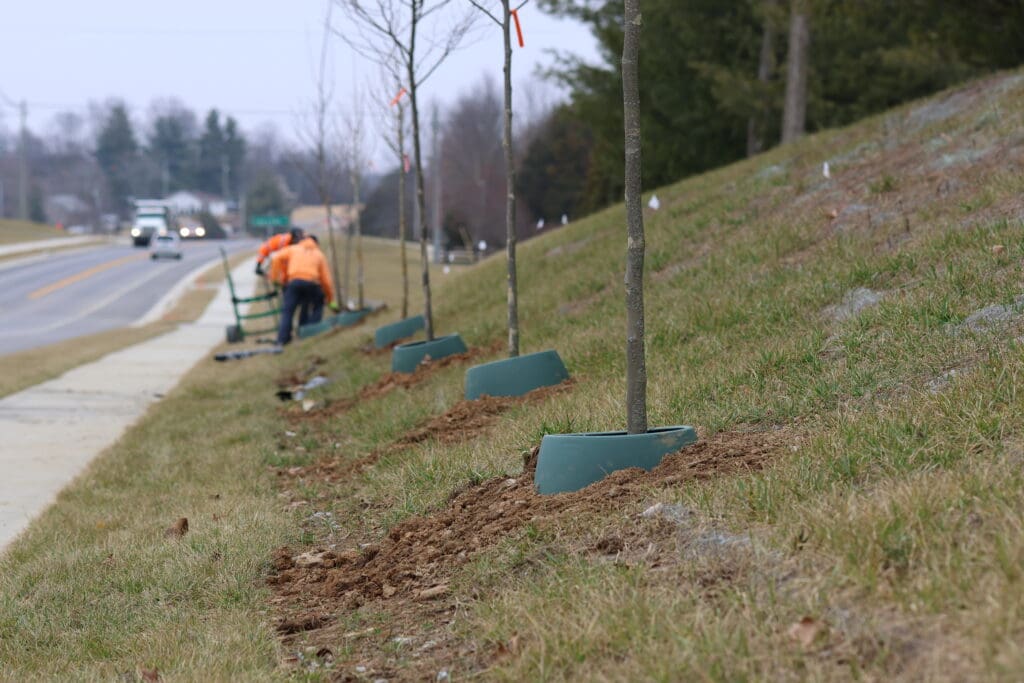
Klausing says previously the program used to be ‘5% for the Community,’ but he realized they were giving way more than that, so they decided to up the ante and formalize their commitment. They’ve also shifted from providing pro bono landscaping services to nonprofits to issuing direct grants toward organizations that use landscapes as green infrastructure, like tree planting.
“Planting a tree is one of the most sustainable, long-term investments you can make,” Klausing says. “Trees improve air quality, reduce stormwater runoff, provide shade and habitat, and enhance overall well-being. It’s a simple, meaningful act with generational impact.”
Recently, they awarded a grant to Trees Lexington, allowing the organization to purchase 150 native trees for a free tree giveaway to community members.
“For us, sustainability goes beyond the environment,” Klausing says. “It’s about caring for all of our stakeholders: employees, clients, suppliers, shareholders, the community, and yes, the environment. True sustainability means operating in a way that creates value across the board, not just financially.”
Marie Chieppo Design
Marie Chieppo, owner of Marie Chieppo Design, based in Sagamore Beach, Massachusetts, specializes in crafting ecologically based designs that work in harmony with nature to create beautiful, healthy landscapes.
She has also been recycling her plant material pots for the past two years. In 2019, she was hired by the Association of Professional Landscape Designers to research and author a report on the lifecycle of plastic plant containers. Through this research, it was discovered that 98 percent of all single-use plastic pots end up in landfills.
Chieppo says most nurseries don’t want to collect and clean the used plant pots, but she returns hers to the only nursery in her state that collects them, compacts and bakes them. Then, East Jordan Plastics picks these up and takes them to their facility in Michigan for recycling.
“It’s a closed loop system,” Chieppo says. “No waste is being imposed on the environment.”
She also introduced one of her growers to fiber pots.
“They are more expensive than plastic, so she offers clients the option of fiber versus plastic,” Chieppo says.
She encourages other landscape companies to consider utilizing alternative pots and recycling their plant pots. For instance, in Connecticut, Prides Corner Farms has created collection sites in Maine and Vermont with bins marked with the plastic type number.
“When they deliver plants to the areas, they pick the pots up, take them to their facility, collect, compact, and bale them,” Chieppo says. “Once a truckload worth of pots is available, East Jordan Plastics delivers containers made of recycled plastics (from the collected pots) to Prides and takes the used pots back.”
According to Prides’ website, they recycle 150,000 pounds of used plastic containers every year.
“Sustainability and caring for the environment is smart business,” Chieppo says.
For those interested in joining the Plastic Pots Sustainability Alliance, contact Chieppo. She says her goal is to demonstrate demand for nurseries to participate in increasing access to the collection of used containers and to promote the use of pots made from sustainable materials.
Michael Hatcher & Associates
Michael Hatcher & Associates, based in Olive Branch, Mississippi, has been recycling their green waste since 2015. They started out with compost piles around 1,000 to 2,000 yards and have grown to over 10,000 yards now.
They currently only compost at their Olive Branch location but are looking for partners to help them implement the practice at their new location in Huntsville, Alabama.
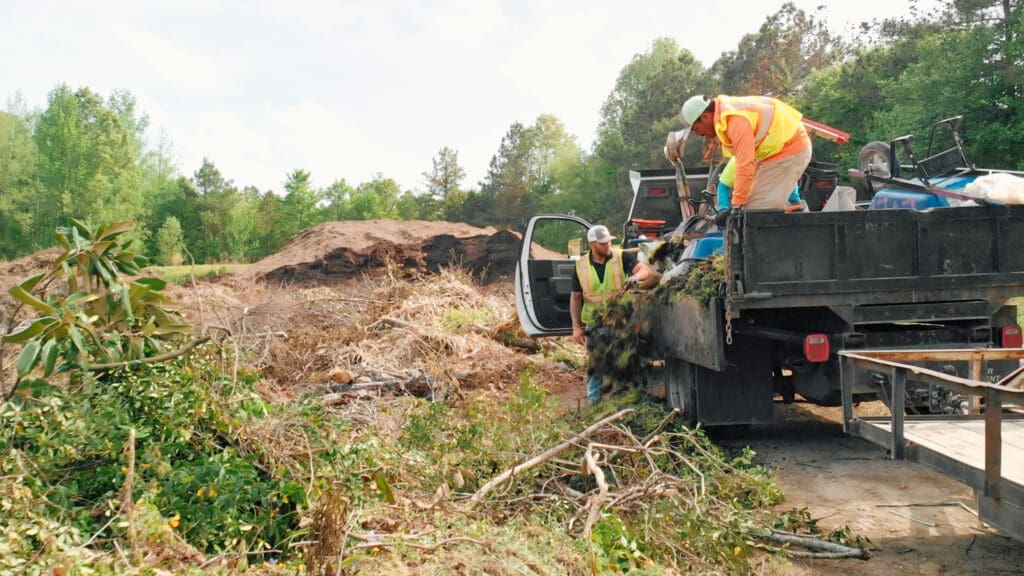
“We like to think it helps in multiple ways,” says Jeff Peterman, general manager of operations for Michael Hatcher & Associates. “Probably the most evident way is that we are recycling a natural resource and reusing it in the form of a soil additive. The purpose being to break down the heavy clay soil in our region and provide a suitable plant-growing environment. Another benefit is our reduced footprint within our local landfills. By storing our green waste throughout the year at our facility, we reduce our dumpster and dump fees.”
Peterman says they have reduced their overall dumpster and dump fees by more than half. They’ve also offset the costs of purchasing composted materials for soil preparation.
“There are costs to having a tub grinder come in and break down the green waste, but for us, they are a fraction of what we were spending on leaf compost and pine fines,” Petereman says.
He recommends that other landscape companies research their current spaces and evaluate how they can better use their green waste.
“Think about how your current operation is affecting the environment around us and do you want to do something about it,” he says. “And if nothing else, consider the cost savings of reducing your waste budget and your soil prep costs.”
Peterman encourages companies to be willing to adapt and adopt more sustainable practices, which can positively affect their bottom line.
“‘Do the next right thing’ is one of our winning behaviors,” Peterman says. “We firmly believe all our actions and efforts should revolve around our core values and nine winning behaviors. Whether it’s addressing client challenges or looking for efficiencies, we believe in addressing things in the correct manner.”
