


With your gas-powered equipment, you’ve never had to question what to do if your crews run out of fuel. They typically leave the yard with extra gas cans and if those run empty during the day, there’s always a gas station right around the corner.
However, as more landscape businesses are beginning to shift part or all of their operations to battery power, a major question for many is how to keep their electric equipment charged.
Manufacturers are aware there is no one-size-fits-all when it comes to battery charging for landscape companies and have developed numerous charging solutions in response.
Maximizing Overnight Charging
A common approach for those switching to battery power is to charge all the batteries needed overnight so they’re ready for crews the following morning.
Depending on your size, you may have numerous batteries to charge at the end of the day or just a handful as you test out battery-powered operations with a single crew.
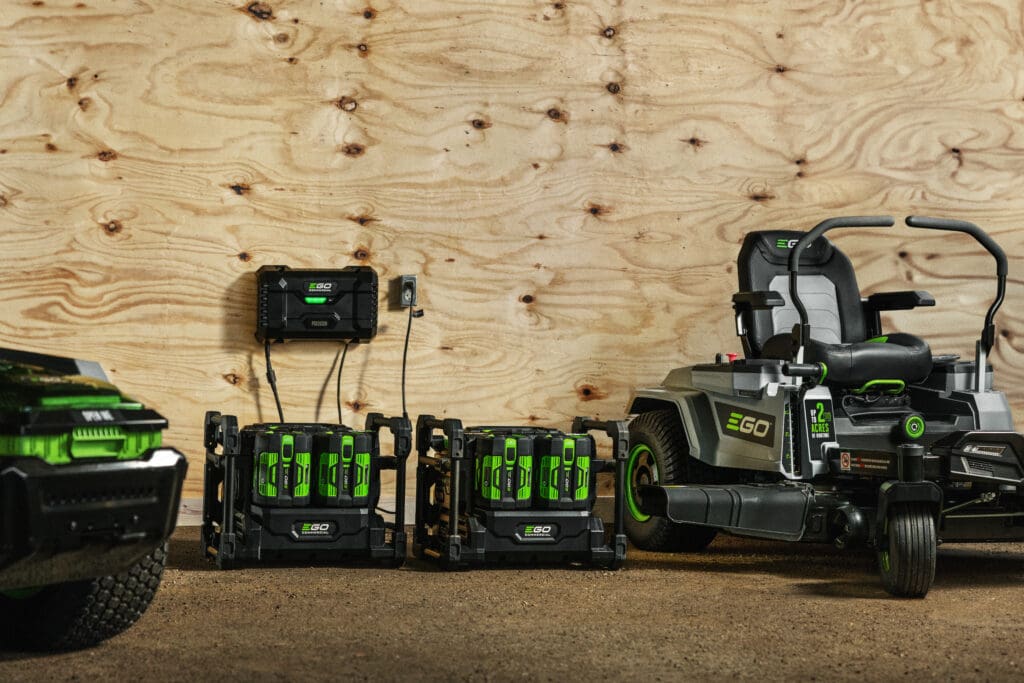
“EGO Commercial’s PGX Commercial Charging 3-Port Docks connected to a single 1600W Hub can charge up to 70 EGO 56V 2.5Ah ARC Lithium batteries — or up to 15kWh — overnight from any standard 15-amp, 120-volt circuit,” says Conrade Tufte, a manager of product – commercial OPE at Chervon North America, EGO’s parent company.
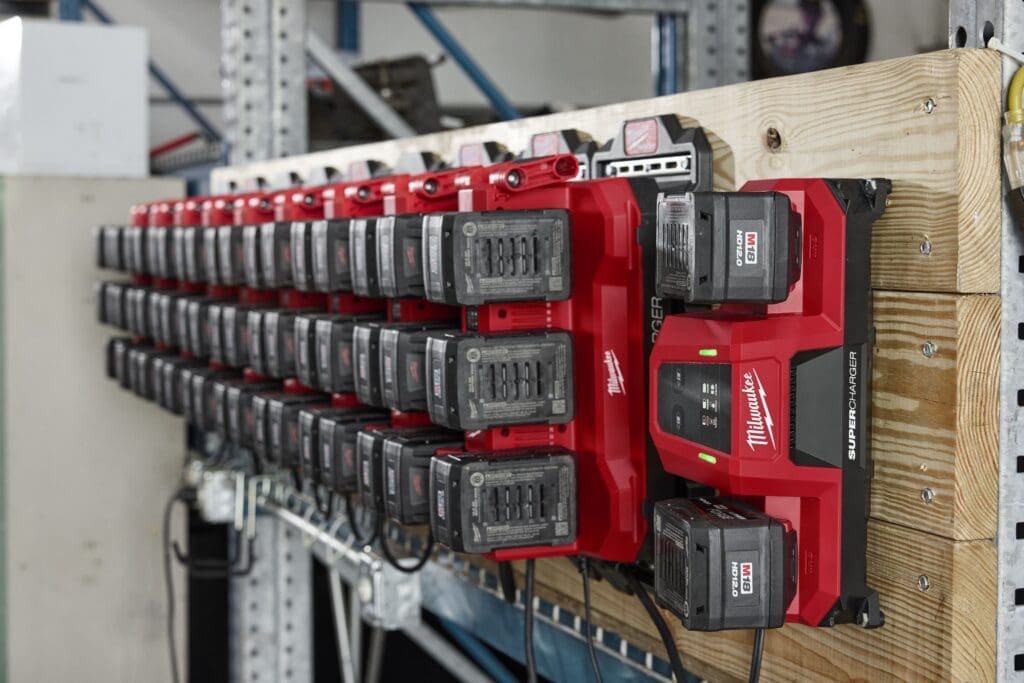
Milwaukee Tool recently introduced the M18 Six Bay Daisy Chain Rapid Charger, which allows up to 10 chargers to be daisy-chained together to charge up to 60 M18 batteries on a single 15-amp circuit overnight.
“By taking advantage of two charge rate modes, crews no longer have to worry about overloaded circuits, tripped breakers, or manually rotating batteries when utilizing overnight mode,” says Bradley Berkman, associate product manager at Milwaukee Tool.
Greenworks Commercial can also allow end users to charge up to 60 batteries from a single outlet with their ChargeLink system of charging caddies. Each caddy can hold six batteries, and the system can scale up to charge 10 caddies at a time.

“You can actually program your charging based on how many batteries and how many caddies each crew has; that’s a great solution for not just charging, but transporting and managing batteries,” says Per Kvarby, vice president of commercial product management for Greenworks Commercial. “So, a crew would just pick up their caddy, roll it out to their trailer, put it on the trailer, and there you have your batteries. They don’t roll around in the back of a pickup truck or anything like that.”
Paul Beblowksi, a product manager with STIHL, says their ProPower Hub allows their end users to charge up to 30 of their higher-power batteries overnight, which is more than enough to get a crew or two through the day.
Kress’s CyberTank is designed to charge itself when plugged into a standard 15-amp wall outlet and can charge up to three batteries at a time, each in 8 to 12 minutes, whether or not it is plugged into an outlet. Kress says these three batteries are sufficient to complete a full day’s work.
“The Kress Commercial Four-Port charger connects seamlessly with the CyberPlug to charge as many as five batteries at a time to provide all-day power,” says Todd Zimmerman, VP of product development at Kress. “The Four-Port charger can also be connected to a CyberTank to provide charging of six batteries.”
Aaron Griffith, director of professional dealer sales with Stanley Black & Decker, says they offer a four-port multi-charger that allows four batteries to charge at once.
Boosting Charging Infrastructure
Yet, as companies increase the number of batteries they need to charge at the end of the day, they can be hampered by their facility’s electrical infrastructure. This is why many manufacturers are leaning into providing solutions that allow businesses to take advantage of their existing infrastructure.
“One of the biggest challenges when transitioning from gas to battery is determining how many circuits are needed to support charging,” Berkman says. “Battery chargers pull different amounts of power depending on factors like battery size, type, age, and state of charge. Without the right solutions, it can be difficult to properly size electrical circuits, leading to confusion, inefficiencies, and potential overload issues.”
To help with this challenge, Milwaukee Tool has created their Power Manager, which is ideal for landscapers who have multiple systems like the M12, M18 and MX FUEL.
“Users simply plug in any combination of chargers, and the Power Manager will detect the power drawn from each outlet,” Berkman says. “Then, it energizes the maximum number of chargers possible without overloading the circuit or tripping a breaker.”
As the batteries complete charging, the Power Manager automatically activates additional outlets, charging efficiently overnight.
Kress also offers the KAC859L power manager to help with charging multiple CyberTanks and additional chargers at night.
“One power management strip can support charging up to two 5kWh or 7.2kWh CyberTanks or one CyberTank and two CyberPlug chargers from one standard outlet,” Zimmerman says. “Kress continues to work with landscapers to listen to understand their infrastructure concerns and how can provide solutions in the future.”
Greenworks Commercial’s power distribution manager features four outlets and is brand agnostic so multiple different chargers can be used with it.
“The beauty of this device is that it will control the flow of energy to the batteries, so you won’t trip a breaker or blow a fuse or anything like that,” Kvarby. “These are stackable as well. You can add as many power distribution managers as you want, depending on the size of your equipment. We want to make sure that we help the transition to battery, and this is one of our solutions.”
Tufte says EGO’s PGX Commercial Charging 1600W Hub can be mounted in a building, van or trailer and doesn’t require any electrical infrastructure upgrades as it can charge off any standard 15-amp 120V outlet.
“It’s economical by design, so you can start small and scale the system up as your needs and equipment fleet grow,” Tufte says.
On-The-Go Charging Solutions
Another major aspect of transitioning to battery power is eliminating range anxiety and maximizing uptime, which is why on-the-go charging is the third piece of the puzzle when it comes to efficient battery charging.
“It isn’t practical – physically or fiscally – for landscapers to be tethered to wall outlets or saddled with dozens of batteries all in hopes of getting through a full workday,” Zimmerman says. “In-field, rapid charging is the only way to make battery-powered equipment a viable solution for professional landscapers.”
Tufte adds that on-the-go charging keeps crews productive and allows them to seamlessly transition between tasks without interruptions or needing to return to the shop for power. Having the ability to recharge batteries in the field also unlocks the flexibility to handle additional work that may pop up.
“Having a fast, reliable mid-day charging solution allows crews to manage fewer batteries, invest less upfront capital to convert from gas (improving profitability), and ultimately stay as productive (or more) versus using gas equipment (less downtime),” Griffith says.
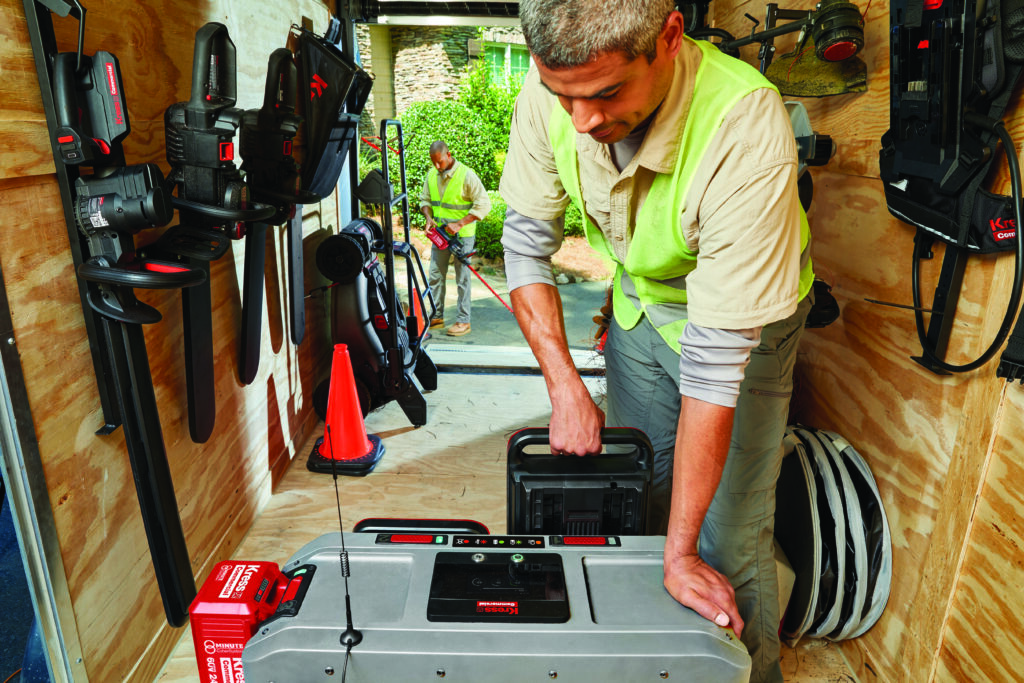
Zimmerman says Kress’s CyberSystem was designed for on-the-go charging as it can recharge a battery in eight minutes and the CyberTank can recharge as many as 30 CyberPack batteries on one charge.
“Kress also offers the CyberLite charging solution, which can transfer energy from a Kress 1.5kWh CyberCapsule battery to as many as five 240Wh CyberPack batteries in a day, providing a smaller, lightweight charging solution for smaller crews or extra power during peak season,” Zimmerman says.
Greenworks Commercial’s on-the-go charging solutions include their Optimus EnergyCube and ETO platform. The EnergyCube can simultaneously charge handheld batteries and Optimus zero-turn mowers at the shop or on a trailer.
“If you’re out there mowing, you have some tough jobs in the morning, and you’re running low on juice come the afternoon that you can charge up for an hour and have two more hours of runtime,” Kvarby says.
The ETO platform can charge handheld batteries off the Optimus zero-turn mower.
“We imagine that this could be a good solution for smaller crews,” Kvarby says. “If you have just a one or two-person operation, one mows and one trims and does the other stuff, then you have the batteries fully charged all the time on the unit.”
EGO offers a PGX Commercial Charging Power Bank that can charge batteries faster than their tools can deplete a battery while out in the field. It takes 25 minutes to charge two of their 4.0 Ah batteries. Tufte says these power banks can connect to each other and can stack up to three units high.
Stihl’s AL-301-4 quad charger allows professionals to easily charge up to 12 batteries in their trailer as they’re driving down the road. Meanwhile, their AL-501 rapid charger can recharge batteries quickly on a job site if they have access to power. Beblowski says that users can charge some of their batteries in approximately 40 minutes.
Stanley Black & Decker offers a USB charging kit that can rapidly recharge any of their current batteries used on outdoor tools.
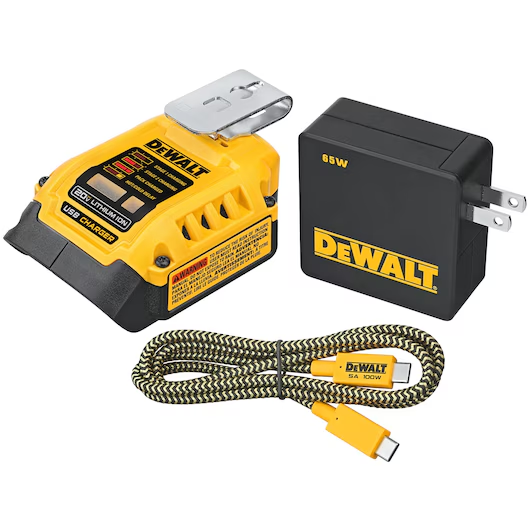
Photo: DEWALT
“We offer chargers that can fully recharge a 6 Ah battery in less than 45 minutes,” Griffith says. “We understand that speed of charge is paramount for landscape users, and we will soon deliver the fastest DEWALT charger, ideal for heavy-duty landscape applications requiring large capacity 60V FLEXVOLT packs.”
Contractors using Milwaukee Tool can utilize their ROLL-ON 7200W/3600W 2.5kWh Power Supply for their in the field charging needs, serving as a portable power source with no need for extension cords. They also offer the M18 Dual Bay Simultaneous Supercharger with four-point mounting, which provides battery charging in transit.
“Using this charger, the M18 REDLITHIUM FORGE XC8.0 and M18 REDLITHIUM FORGE HD12.0 batteries can reach 80% charge in just 35 minutes and fully charge in 45 minutes, ensuring users can get back to work faster than ever before,” Berkman says.
Berkman notes that contractors also need to pay attention to not just how fast a battery charges, but how quickly it can perform immediately after charging, even after coming off a tool in a hot environment. To address this issue, Milwaukee Tool has integrated their COOL-CYCLE Active Cooling System, which cools the battery during the charging process.
Previously, an M18 REDLITHIUM HIGH OUTPUT XC8.0 battery in hot conditions would take around 90 minutes to be ready for use. With the cooling technology, the battery is ready to power through back-to-back applications without overheating or slowdown.
“When we think about charging speed, we have to look beyond just raw charge time — it’s really about how quickly a battery is fully ready for its next high-power application,” Berkman says.
Key Takeaways
- Brands are increasing the ability to charge multiple batteries overnight, allowing crews to start their day fully powered without worrying about battery depletion.
- Manufacturers are also introducing power managers that help businesses optimize their existing electrical systems and prevent circuit overloads.
- On-the-go charging reduces range anxiety and brands like Kress and Milwaukee Tool are introducing innovations to speed the charging process and ensure batteries are ready to perform immediately after charging.
Looking for training on how to transition to battery successfully? NALP, in partnership with the American Green Zone Alliance, offers Battery-Power Equipment Training for Landscape Professionals.
