

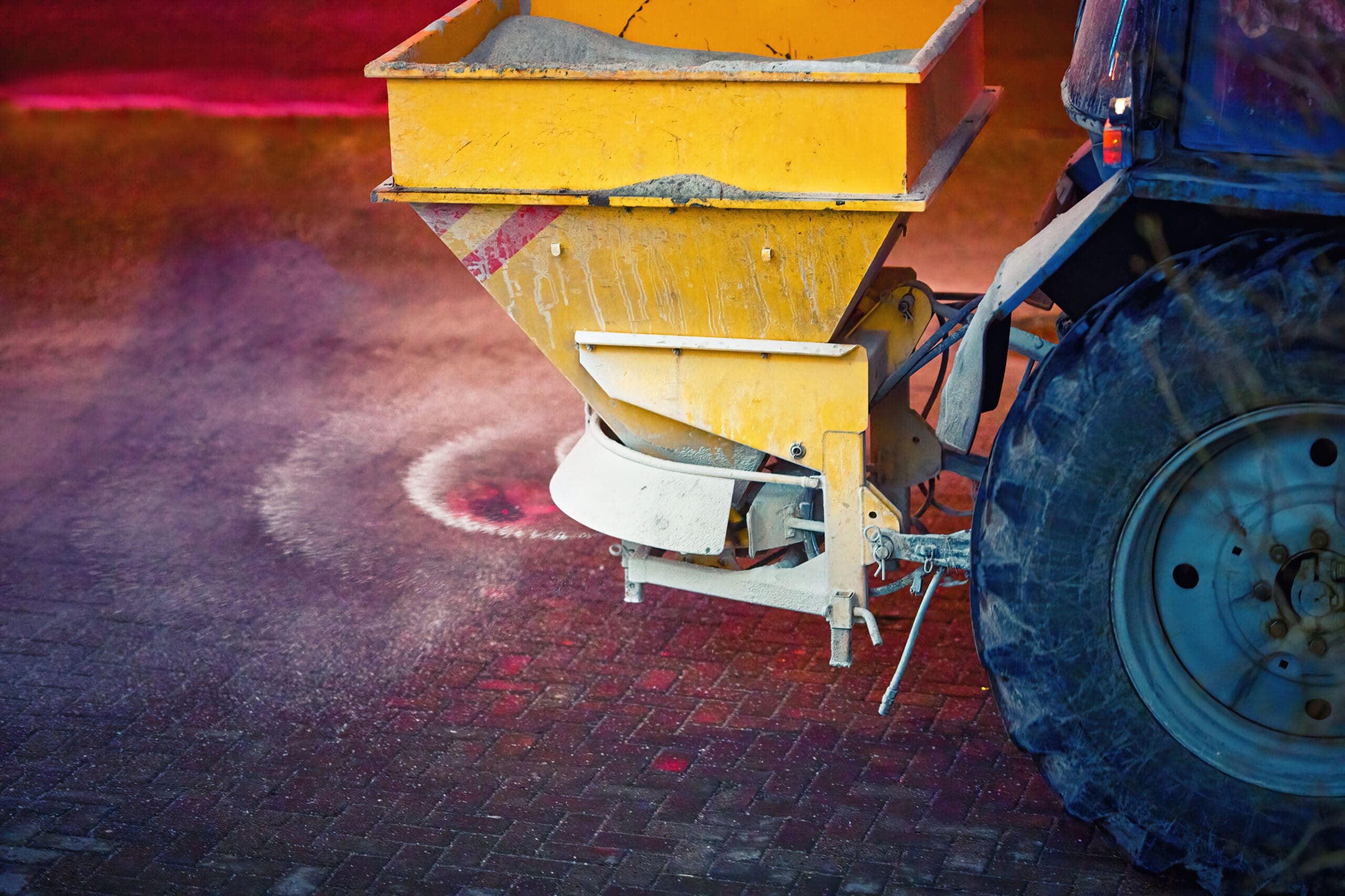
As winter arrives, remember to calibrate your salt spreaders to reduce the cost of over or under-applying. This dialed-in approach helps your bottom line while protecting your clients and the environment.
Timing and Other Factors
Spreaders should be calibrated at various times, especially when these events occur:
- Annually, before the snow and ice season.
- When you purchase a new vehicle or spreader.
- After the spreader or controller unit undergoes maintenance.
- After the vehicle has significant repairs or the hydraulic fluid/filters are replaced.
- When you replace or switch deicing material.
Each piece of equipment has slight differences, so you’ll want to know the rate for all equipment you plan to use. The ideal rates will depend on the equipment, material, location, and the severity of each snow/ice event. Likewise, the process for calibrating equipment will also vary. Here are factors that impact calibration results:
- Deicing materials
- Vehicle speed
- Type of spreader
- RPM
- Surface area
You can find various online charts that help you record the results. Many of those charts have slightly different ways to calibrate the equipment, so pick one that works best for you.
Tips for Calibrating Spreaders
Step 1: Keep Track of the Results
Before you calibrate, have a clear process to measure the results. These records will also be a great reference as you calibrate equipment in the future. These are the key measurements to record on the chart:
- Material, truck ID, date, and names of the people running the test.
- Spread Width (ft), when the auger gate is open at different intervals (1”,1.5”,2”, etc.)
- Discharge Rate (lbs/min).
- Average discharge rate for different speeds (mph).
- Pounds of material discharged per acre or 1,000 sq. ft.
- Type of Spreader
Step 2: Measure the Spreading Width
For this step, you’ll observe how wide your spreader throws the material. Before you activate the auger, increase the truck RPM to match a typical deicing run and partially fill the hopper with your material. The hopper shouldn’t be full but should have enough for the auger to operate normally.
Once you’ve let the spinner run, get a tape measure and record how far the material was thrown from one side to the other. You’ll want to subtract around 12″ from the total number to account for overlap. Use these measurements to compare the width of the salt spread at different spinner settings.
Step 3: Measure the Auger Discharge Rate
This step will tell you the amount of material the auger releases in a minute. First, you’ll turn off or remove the spinner. Next, run the auger for a few seconds to make sure it’s distributing properly before running the test.
Place a box below the auger to capture the solid material, then run the auger at different control settings while keeping the RPM at a normal operating level. Use a stopwatch to measure the time and determine how much salt is discharged in one minute.
Calculate the spread coverage with this formula once you know the discharge in pounds (lbs) per minute:
Spread Coverage = Spread width (ft) x Vehicle Speed (mph) x 5,280 (ft/mile) x 0.01667 (hr/min)
Once you have the spread coverage, divide 43,560 (sq. ft/acre) by the spread coverage. This gives you the time required to cover an acre in minutes. That number will be added to the formula below to calculate the spread coverage rate.
Spread Coverage Rate (lbs/acre) = Auger Discharge Rate (lbs/second) x 60 (s/min) x Time (min/acre)
Step 4: Decide the optimal settings
After you finish testing the spreading width and auger discharge rates, use the spread rates to determine the ideal rate for different materials at specific temperatures. While rates vary based on conditions, Wisconsin Salt Wise is a helpful starting point to examine spread rates on parking lots, sidewalks, and roads.
Calibrating Drop Spreaders for Sidewalks
While smaller, drop spreaders still require calibration to gauge the right amount of deicing material for each client. These steps and materials will help you calibrate drop spreaders.
- Spreader
- Deicing material
- Empty bucket
- Duct tape or cones
Step 1: Create a Test Area
Measure out an area that resembles a typical work zone and put down tape to mark the test area. These spreaders are usually calibrated in lbs. per 1000 sq. ft., but you can use a smaller area if needed. One example is a 25’ L x 10’ W (250 sq. ft) plot.
Step 2: Fill the Spreader with Material
Before you fill the spreader, weigh the empty bucket. Then, add the deicing material to the spreader. The chute should be closed for this step.
Step 3: Test the Rates at Different Settings
Start with a low setting and move the spreader through your test area. Make sure you cover the entire test area for uniform coverage. Once you’ve treated the test area, collect the dropped material. Then, you can add it to the bucket while subtracting the weight of the empty bucket. Take that number and apply it to 1,000 sq. ft. In the 25’ x 10’ example, the weight is multiplied by four to decide the amount for 1,000 sq. ft.
Step 4: Find your Optimal Rates
When you have that number, calculate the material used for different settings using the same formula. If possible, walk at a consistent speed for each test or have someone use a timer to keep track of your pace. After you know the rates, determine the ideal rate for each deicing material at different temperatures.
