

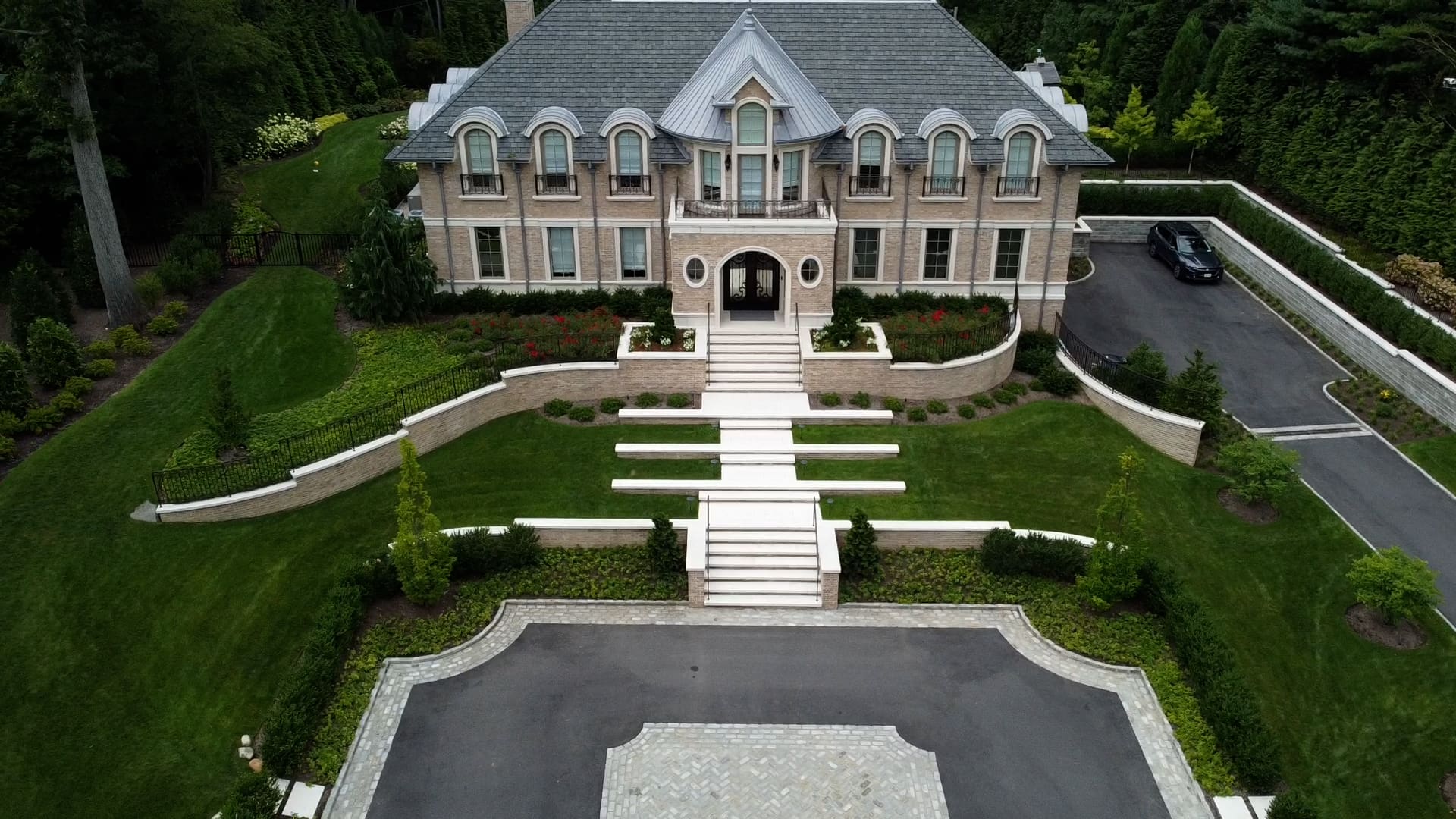
After being demolished and rebuilt, this hilltop home on Long Island, New York, has a new life. The owners were tired of the home’s outdated features and neglected landscape, so they decided to start over from scratch.
While the new house and features are modern, the landscape retains a natural feel, allowing the family to entertain and use the property for recreation. The owners worked with Goldberg & Rodler, Inc., based in Huntington, New York, to create their dream landscape, leading to a 2024 Gold Award of Excellence.
“We are all very pleased and honored that our team created something that merits highly in a national competition,” says Ashley Haugsjaa, design office manager and landscape designer with Goldberg & Rodler. “It’s gratifying to have been part of this project.”
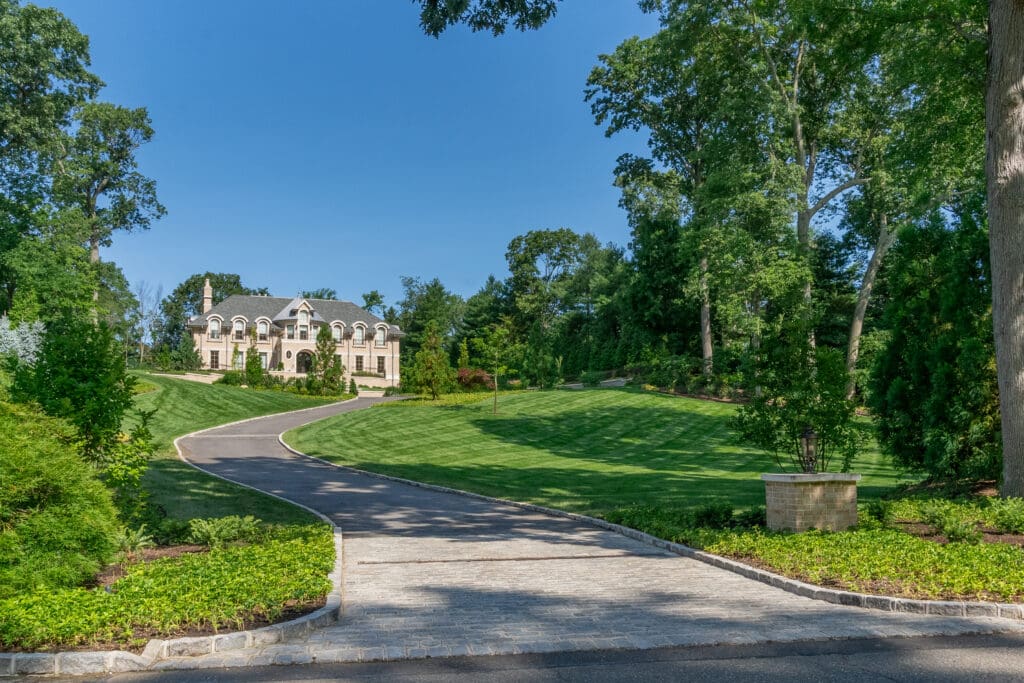
Most of the landscape is new, but remnants of the old property remain, including some trees that were preserved.
“While we waited for approvals to come through, we transplanted existing evergreens over 12 feet in height,” Haugsjaa says. “We dug them and held them in our yard for over two years until the backyard construction and grading were completed. Planting them earlier allowed time for the trees to grow before the family moved in. It also helped screen a line of utilities in the backyard.”
They saved a handful of other woody plants as well, like redbud, dogwood, and rhododendron. A permit was required to remove the trees, along with a plan to replace every inch of caliper. The trees that were removed didn’t go to waste either. Many were repurposed to construct the woodland path, create log benches, and provide mulch for the paths.
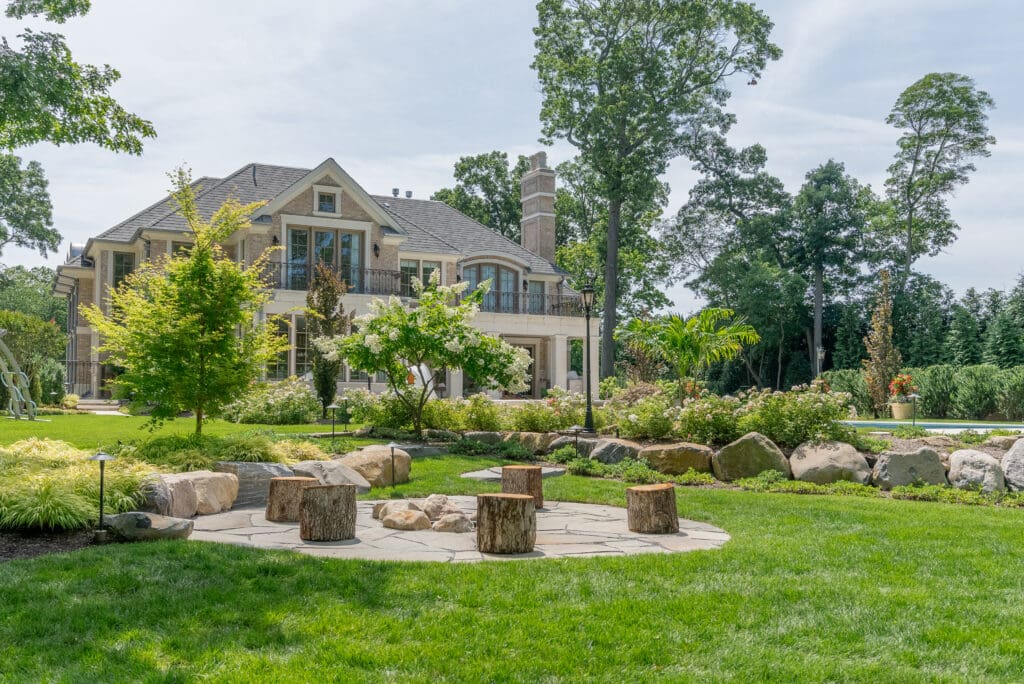
The hilly nature of this property led to several challenges. In the backyard, tight construction setbacks made it difficult to fit everything on the owner’s wishlist. Using multiple layers of retaining walls, the team made space for a pool, spa, and patio.
Space was also needed for pool equipment, generators, and air conditioning. Screening these areas was a priority, so a 5′ tongue and groove cedar fence was installed around the pool equipment. Additionally, roses and upright hollies were planted outside the fence to soften the space. The team had plans to remove 1,000 cubic yards of soil from the property but soon realized much of the soil was suitable for planting and creating berms in the front yard.
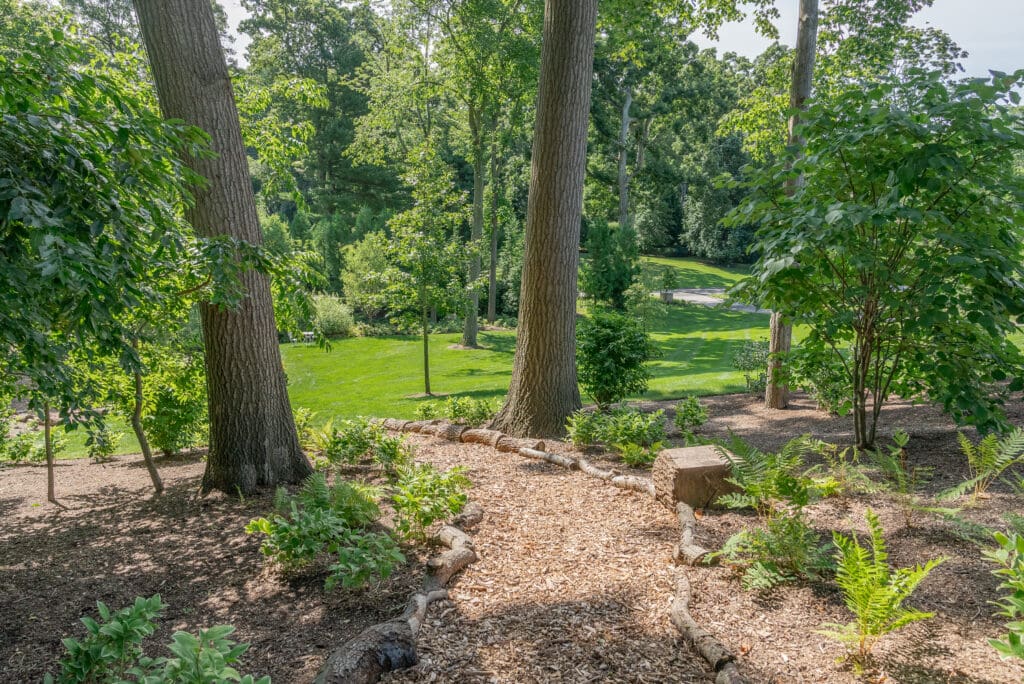
Many plants were added to the property’s interior, but the outer areas were a key focus, too. The backyard is screened using a mix of Green Giant arborvitae and skip laurel. In the front yard, you’ll find curved beds of shrubs, trees, and even woodland paths. Throughout the site, you’ll see layers of small trees, shrubs, and perennials that add a range of color in each season.
The old home had a steep driveway with limited parking access, so the team designed a longer, more curved driveway for the new house. With the improved design, the driveway is less steep and provides more parking options.
A parking court was created partway up the driveway, giving visitors easy access to the front entrance. As they walk to the front entryway, they’re greeted by a clean layout of beds that promote a classic estate look. The homeowners have a basement-level garage at the end of the driveway, which offers ample room to maneuver the cars.
Grading was another issue, as the site has layers of clay/hardpan soil. The team made changes by regrading large areas of the property while adding surface drains and subsurface gravel. The local code also required traditional drywells. Steps were taken to redirect the water flow using a rain garden in the lower corner of the property. To help with infiltration, two types of willow and Acorus (Sweet Flag) surround the rain garden.
Since the project began in 2019, many obstacles have been faced due to COVID and other factors, requiring an even greater team effort.
“Every member of the Goldberg & Rodler’s design and installation team has worked on this project at one point,” Haugsjaa says. “Together with all the tradespeople and other professionals, 50-100 people were involved.”
A few changes were made to the original plan, including the plantings. Deer and rabbit browsing was found shortly after new plants were installed, so the team swapped out those plants to minimize deer damage. A few plants they focused on are ferns, sarcoccca (sweet box), cephalotaxus (plum yew), and pachysandra (Japanese spurge).
Supply chain delays and virtual meetings were a constant challenge, but the team overcame every hurdle to uphold their standards. The installation was finished in 2023, but Haugsjaa says the team is still reaping the benefits of their labor.
“The client is extremely happy with their home and outdoor spaces, and we continue to work with them to care for their property year-round,” Haugsjaa says.
Interested in participating in the Awards of Excellence? Enter your projects by July 31, 2025.
