


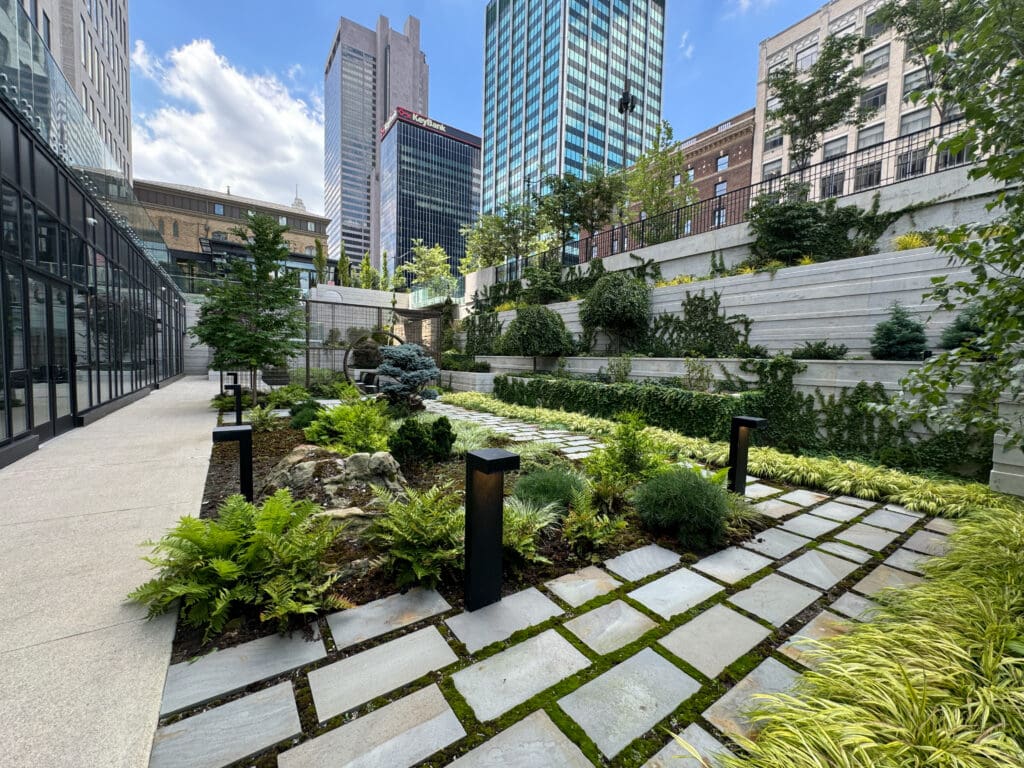
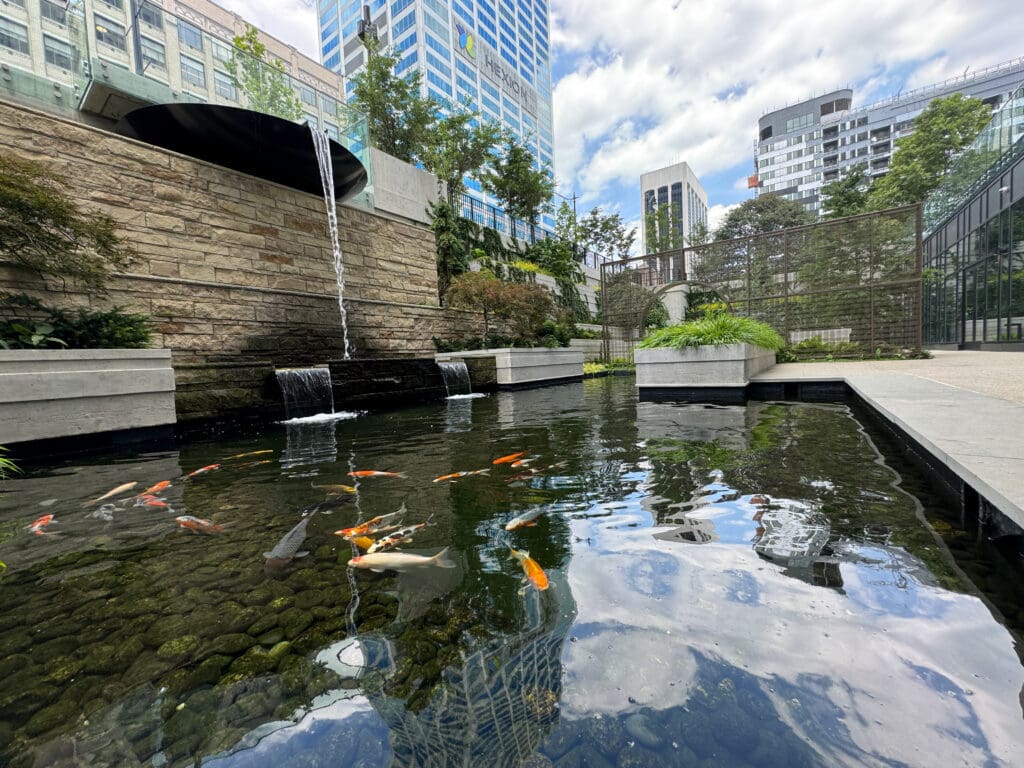
This sunken garden is the first of its kind in Columbus, Ohio. For many years, it was the home of a bank lobby; then, it was transformed into a unique green space that drew inspiration from other urban parks, like the High Line in New York.
Environmental Management Services, Inc. (EMI), based in Plain City, Ohio, was brought in to install this masterpiece, leading to a 2024 Gold Award of Excellence.
“It’s humbling to win an award of excellence for this project,” says Josh Holmes, project manager with EMI. “We pushed our team to the limits, and they exceeded those expectations. Without our team member’s willingness to be uncomfortable and work through the unknown, we wouldn’t be accepting this award. They are the real stars of the show on this one. It’s also rewarding for the city of Columbus and the owners/contractors we work with.”
With the urban location, space was a challenge from the start. Deliveries had to be quick, and parking was limited.
“We needed to utilize one of our four local facilities to stage materials since they could not be sent directly to the job site,” Holmes says. “Having the ability to bring plant material into our nursery when it’s the proper time to dig plants is huge.”
The site also had a narrow staircase from the street to the sunken area, but it was too narrow for moving trees. A crane was brought in to install the 18 trees, each with a 3.5 to 4-inch trunk diameter.
The sunken areas of the garden led to unique microclimates, which affected the drainage and plant selection.
“Since most of the plant material is in raised concrete planters 30 feet below street level, the growing conditions were much different than plants installed on grade,” Holmes says. “Drainage was a large part of the install, ensuring the planters didn’t hold water and kill the plant material.”
A subsurface drainage system was installed, including 50 tons of drainage aggregates and 400 linear feet of drain tile. Since the planters are made of concrete, the team made them deeper than usual to insulate the roots in winter.
As the year progresses, the glare from nearby windows causes the amount of light to change each season.
“This worked to our advantage in the growing months,” Holmes adds. “The sunken garden is on the north side of a 27-story (317-foot) skyscraper. The amount of direct sunlight is limited here, but the indirect light from the buildings makes up for less sunlight.”
Some trees used were London planetree, zelkova, and Japanese maples. The owner also insisted on adding a monkey puzzle tree (Araucaria araucana), which is still alive but may be moved to his personal greenhouse in the future. Additionally, the garden features 200 shrubs, including pyramidal hollies, dogwoods, and dwarf conifers. Over 400 square feet of moss are used in the gardens, showing off various textures and colors.
Like any project, some speed bumps were met along the way.
“We had to make some field adjustments on the plant material that was being installed,” Holmes says. “Most of the plantings were in raised concrete planters, and the spacing needed to be adjusted to ensure the trees were in the best position for survival.”
For the hardscapes, natural bluestone was used in the sunken garden, while the street level had porcelain tile to match the stone in the garden. The initial plans also called for bluestone on the street level, but future plans for a restaurant limited the depth under the street level. These pavers are supported with metal backing to help with durability in this high-traffic area. A glass panel railing was installed before the tiling, which meant the tiles had to be cut in a seperate area.
From start to finish, the uniqueness of this project stood out for Holmes and his team.
“Typically, landscapes are in the background as a supporting cast member,” Holmes says. “In this case, the garden is the main character. From the unique trees to the moss and ivy-covered walls, this garden is a living, breathing beast that loves to show everyone how beautiful it is. Every time I’m on-site there are multiple people appreciating our hard work and efforts to bring this concrete pit to life.”
Interested in participating in the Awards of Excellence? Be sure to enter your projects when entries open in early 2025.
